Decide before you carry anything
Purdue Extension's storage table gives more slack than panic suggests: 50°F to 60°F for keeping wine over years, and as much as four weeks at 75°F or cooler. A dead unit in a house held at 72°F therefore leaves the collection in no real danger for the length of an ordinary repair. Closed up in the cellar, the bottles are better off than on a hallway floor or in the back of a car.
The picture changes in a heat wave, in a cellar with an outside wall, or when the part is back-ordered. Purdue also warns that repeated warming and cooling tests the closure, so one move out and one move back is the limit worth planning for.
- Stay put: under 70°F, with a technician booked this week.
- Move a shortlist: the room is in the low seventies and still rising.
- Move most of it: the air is closing on 75°F, or parts are weeks out.
- Move everything today: the house itself is hot, or water is coming into the cellar.
Source: Purdue Extension — Wine Storage Guidelines (FS-58-W) — 50°F to 60°F long term, 75°F or below for one to four weeks, never 86°F; swings test the closure; heat shortens whites' life; sparkling bottles hold about 90 psi; below 50°F slows development, 32°F for an hour forms crystals, freezing near 23°F; bottles on their sides; condensation on cold bottles can lead to mold
Which bottles leave first
Not every bottle carries the same risk. Purdue notes that heat shortens the life of whites in particular, and that warmth above 60°F speeds maturation and can change a wine's character. Bottles bought to age for a decade have the most to lose from a hot month; the case earmarked for this summer's dinners has the least.
Write the shortlist before opening the door, so the cellar stands open only while boxes are actually going out.
Sparkling wine goes first
Purdue gives the pressure inside a sparkling bottle as about 6 atmospheres, some 90 psi, and reports bottles bursting after exposure to heat. Move them in their cases, cork end away from you, and never stack them loose in a warm car.
Bottles you will open soon can wait
Everyday reds and anything due to be opened in the next few weeks can ride out a warm spell in the cellar. Leaving them where they are also keeps liquid mass in the room, which slows its drift for the bottles that stay.
Source: Purdue Extension — Wine Storage Guidelines (FS-58-W) — 50°F to 60°F long term, 75°F or below for one to four weeks, never 86°F; swings test the closure; heat shortens whites' life; sparkling bottles hold about 90 psi; below 50°F slows development, 32°F for an hour forms crystals, freezing near 23°F; bottles on their sides; condensation on cold bottles can lead to mold

Where the bottles wait
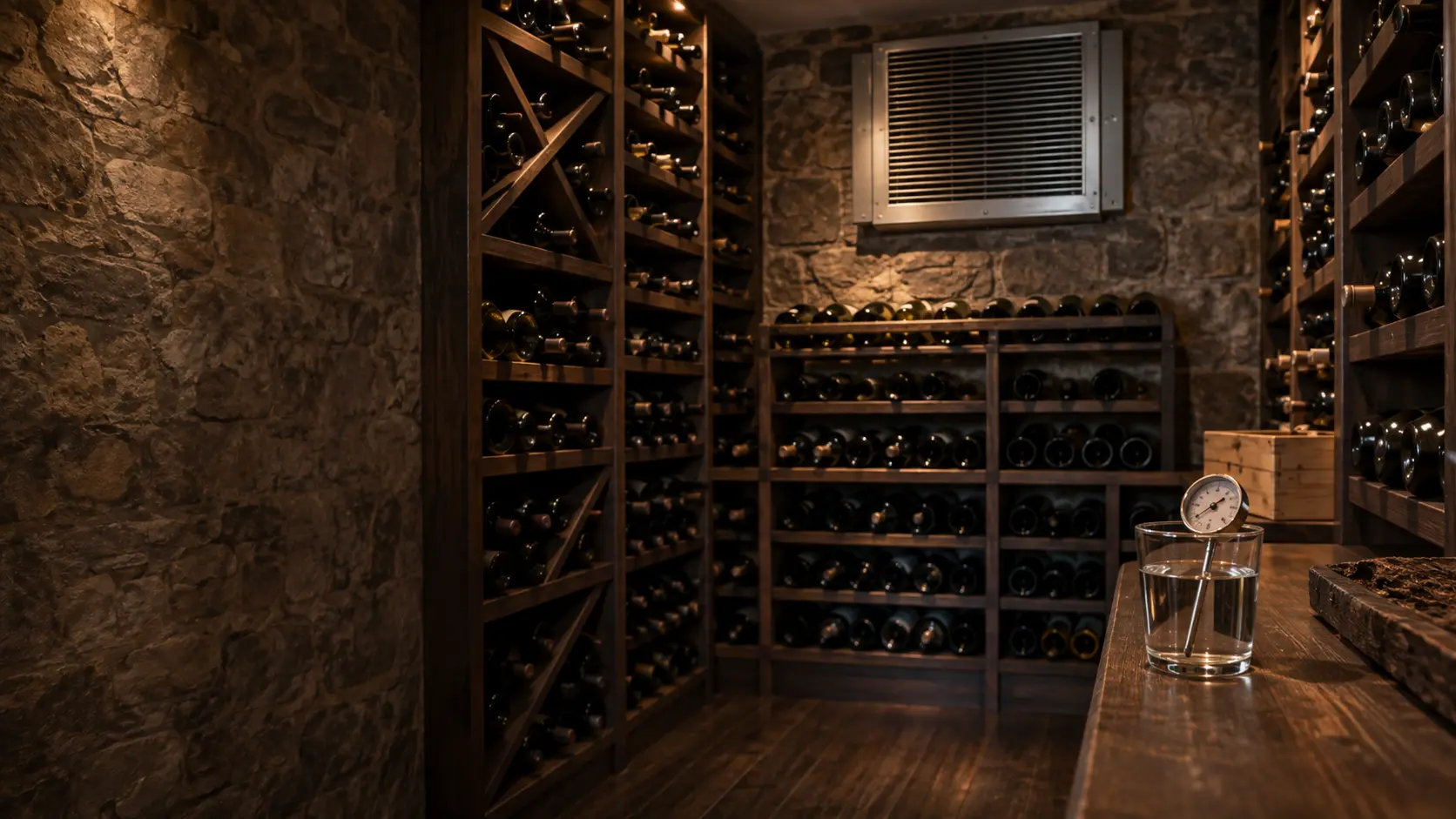
Look for a dark spot that stays cool and does not swing: a windowless closet at the bottom of the house, a basement corner far from the furnace, the space under a staircase. Avoid garages, attics, rooms with west-facing windows and anywhere near a water heater. A thermometer left there for a day before the move tells you more than a guess.
Keep corked bottles on their sides or upside down, as Purdue recommends, and mark each case so you know which way it is lying.
Why colder is not safer
A kitchen refrigerator runs well below cellar temperature, and its dry air is hard on corks over time. Purdue adds that storage below 50°F may keep a wine from developing, that an hour at 32°F can throw tartrate crystals, and that wines of 14 percent alcohol or less begin to freeze near 23°F. A few special bottles for a few days are fine; a whole collection for a month is not.
Source: Purdue Extension — Wine Storage Guidelines (FS-58-W) — 50°F to 60°F long term, 75°F or below for one to four weeks, never 86°F; swings test the closure; heat shortens whites' life; sparkling bottles hold about 90 psi; below 50°F slows development, 32°F for an hour forms crystals, freezing near 23°F; bottles on their sides; condensation on cold bottles can lead to mold
Carrying them without breakage or damp labels
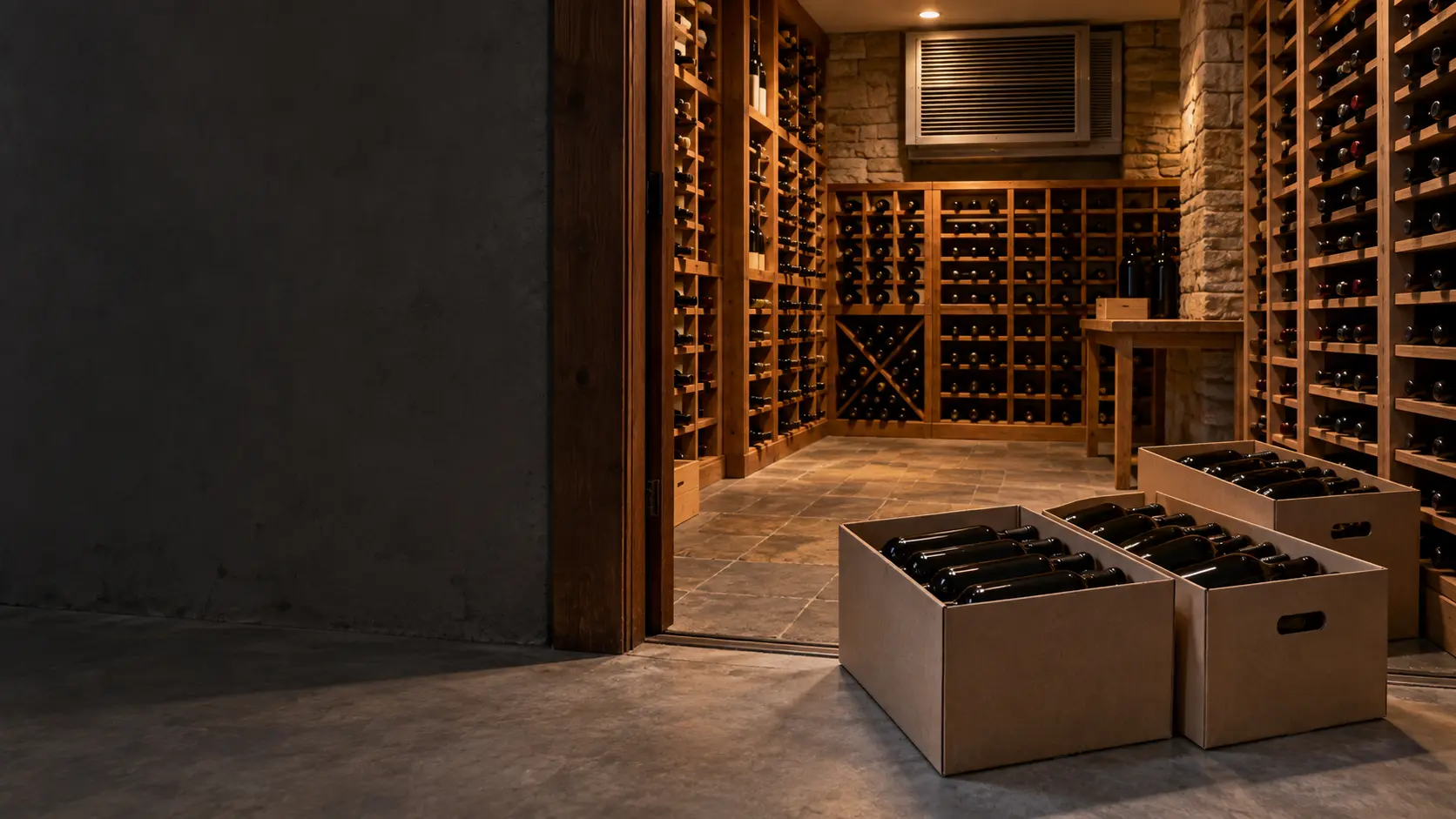
Use the original cases or boxes with dividers, keep bottles lying down, and carry one box at a time on stairs. Before anything leaves a rack, take a photo of each bay or tape a paper note to the rack with its row numbers, so refilling does not turn into a day of sorting.
Purdue points out that a bottle moved from very cold storage into warmer, humid air collects condensation on the glass, label and cork, and that this can lead to mold. Bottles coming out of a 55°F cellar on a muggy day will sweat; leave them in their boxes with the lids open until the glass is dry.
- Original wooden or cardboard cases, or boxes with dividers.
- A marker and tape for noting which rack each box came from.
- A thermometer for the room where the bottles will wait.
- A second person for the stairs and a clear, lit path.
Source: Purdue Extension — Wine Storage Guidelines (FS-58-W) — 50°F to 60°F long term, 75°F or below for one to four weeks, never 86°F; swings test the closure; heat shortens whites' life; sparkling bottles hold about 90 psi; below 50°F slows development, 32°F for an hour forms crystals, freezing near 23°F; bottles on their sides; condensation on cold bottles can lead to mold
Bringing them back after the repair
Wait until the cellar has held its set point for a day or two before refilling. Breezaire's instructions say a newly started unit brings a room down slowly and ask owners not to touch the setting for at least three days; WhisperKool notes that temperature settles before humidity does.
Return the bottles in batches rather than all at once. Every warm case adds heat for the unit to pull out, and a room refilled over two or three days recovers without long, heavy runs.
Source: Breezaire — WKL Series Installation Instructions — A newly started unit lowers the room temperature slowly; do not change the setting for at least 3 days; WhisperKool — Frequently Asked Questions — After a disturbance temperature stabilizes first and humidity normalizes gradually