
Wine Cellar Too Warm
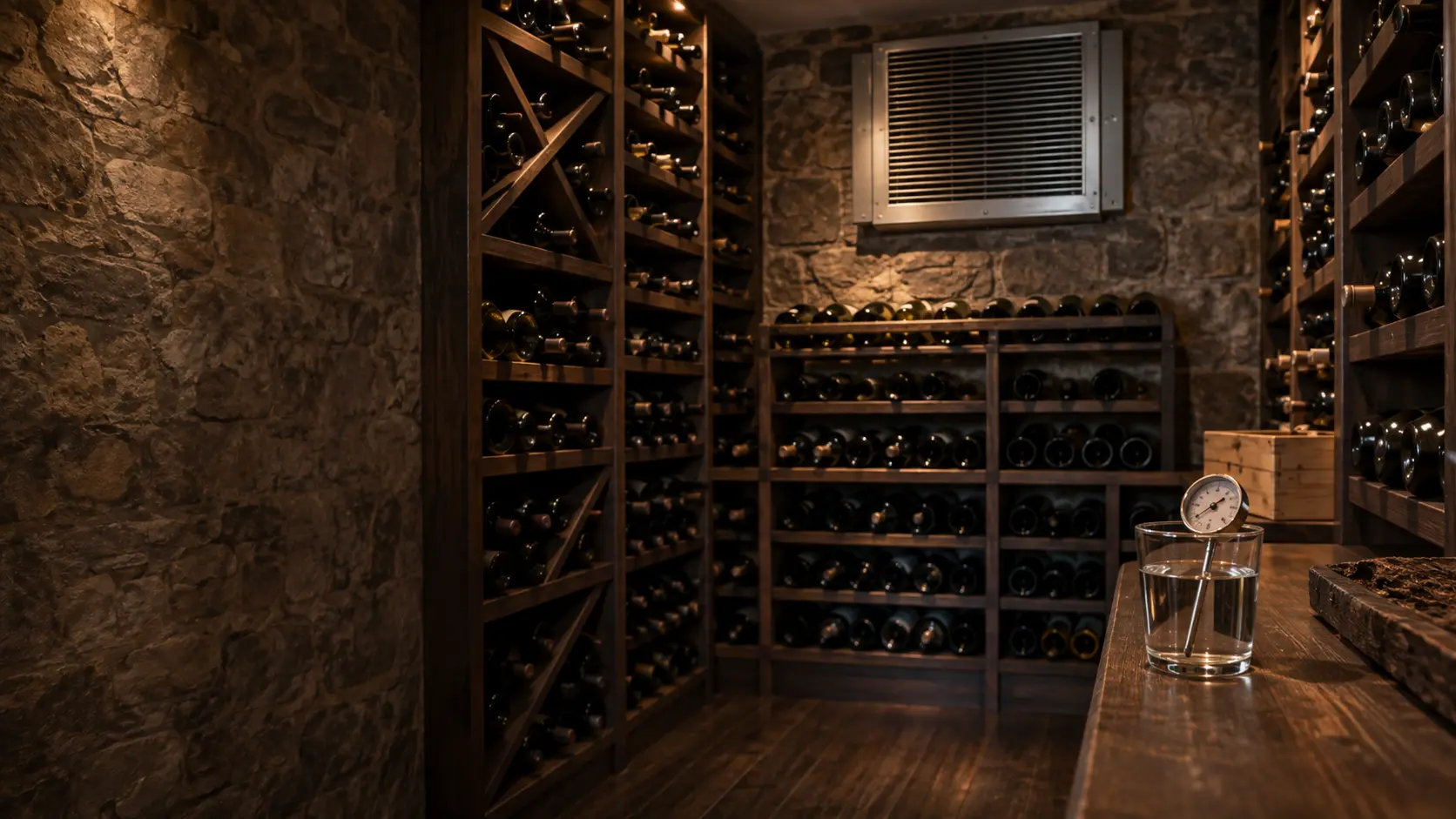
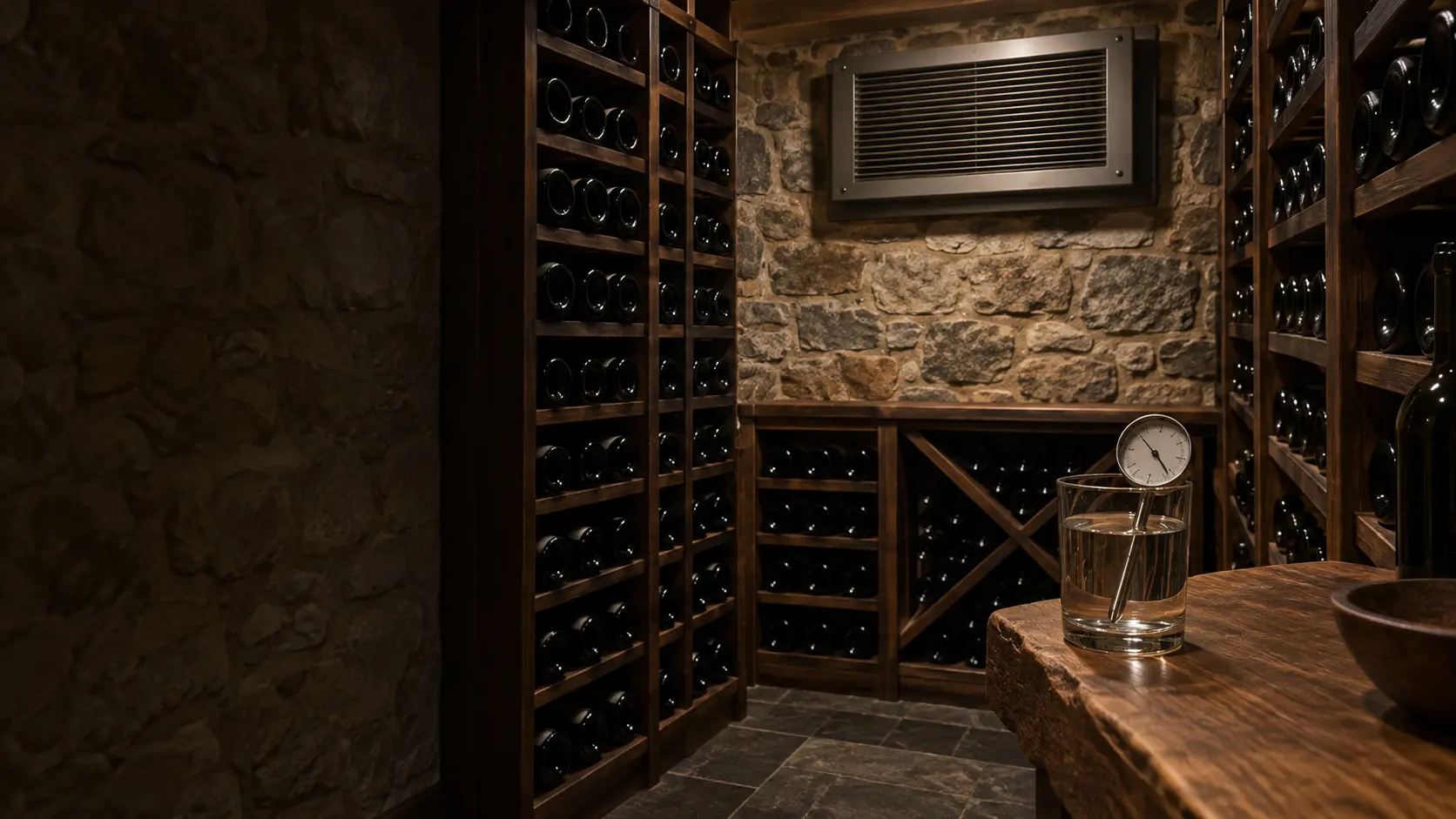
A wine cellar too warm shows up slowly: the room smells of the house instead of cool stone, a bottle picked from a middle rack feels barely cooler than your hand, and the wall thermometer has crept from the mid 50s into the 60s over a week.
Mon–Sat, 8am–8pm
- The collection is exposed
- 5 questions that narrow it
- 6 causes, cheapest first
Book a visit
Three short steps, about a minute.
or call (844) 398-5977
Loading appointment form…
The appointment form couldn’t load. Please try again.
Collection first: cellar door shut, water near power left alone, breaker off from a dry panel
Treat a warming cellar as urgent once the room is above the mid 60s and still climbing, because the collection is at stake, not the machine. Keep the door shut, move the bottles you would least like to lose to a cool dark corner, and book a visit before a hot week turns into lifted corks.
What it
usually means.
A cellar cooling unit does two jobs at once: it pulls heat out of the room and it has to throw that heat somewhere else. A through-the-wall unit dumps it out of its back grille into the next room, a ducted unit sends it down a duct, and a split system carries it through copper lines to a condenser outdoors or in a utility space. When the cellar warms, either the unit has lost part of its cooling, the heat it throws off has nowhere to go, or the room itself is letting in more heat than the unit was sized for. That last case is common: a door without a proper seal, a gap in the vapor barrier behind the racking, a new glass wall or a summer that is hotter than the one the unit was chosen for. The collection is what is at stake. A few days near 65°F costs little, but weeks in the 70s age wine faster than intended, and a hot spell can lift corks, so a warming cellar is handled here as urgent.
 The 6 causes, cheapest first
Answer these first
What does a thermometer read after an hour in a glass of water on a rack at mid height, rather than the display on the unit?
Is the unit running and blowing air that feels cool on the cellar side, or running without much difference at all?
Where does the exhaust go: a room next door, a closet, a garage, or a condenser outside, and how warm is that space today?
Has anything changed in the room lately, such as new racking against a wall, a glass panel, a door replaced or a gap opened for wiring?
Is it a through-the-wall, ducted, split or ceiling unit, and do you know the model number from its label?
Check these
before you book.
Wine cellar too warm: 5 checks, and none of them costs anything.
Keep the cellar door shut; every trip inside lets warm house air across the racks, and a struggling unit may never win it back.
If the room passes about 70°F, carry the most valuable bottles to the coolest dark spot in the house, such as a basement corner or an interior closet away from appliances, and lay them on their sides.
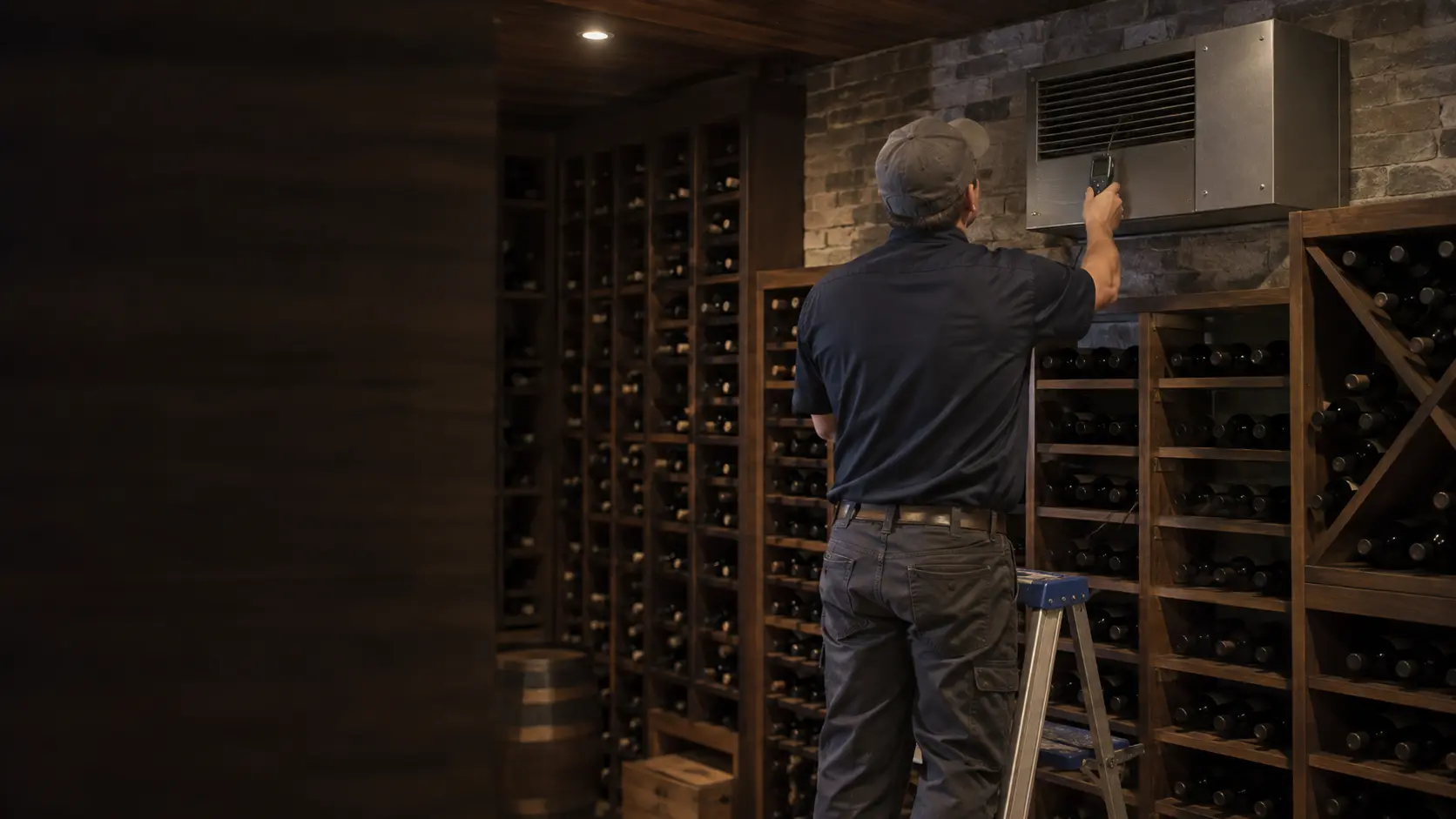
Look at the exhaust side: make sure the grille in the next room is not blocked by boxes or a closed closet door, and that the space there is not baking.
Also worth checking
- Put a thermometer in a glass of water on a middle rack and read it after an hour, so we know the temperature of the wine and not of the air at the grille.
- Note the make, the model number and the type of system: through the wall, ducted, split or ceiling mounted.
The causes,
cheapest first.
6 things wine cellar too warm turns out to be, from exhaust side too hot or boxed in to room gaining more heat than the unit can remove.
The cost guide-
01 no repair
Exhaust side too hot or boxed in
A through-the-wall unit needs its hot side to breathe into a room at least as large as the cellar and cooler than the high 80s. Blowing into a closed closet or a hot garage, it recirculates its own heat and cools almost nothing. Clearing the space or opening a door there is the first test.
-
02 low to moderate
Evaporator or condenser fan stopped
Without the cellar-side fan, cold stays trapped in the coil; without the hot-side fan, the compressor overheats and cuts out. Either one leaves the room warming while the unit hums.
-
03 low to moderate
Coil iced over and blocking the air
A coil covered in ice passes almost no air, so the cellar warms even though the unit runs cold. It usually traces back to a stalled fan, a setting too low or a short refrigerant charge.
-
04 moderate to highest
Refrigerant charge low from a slow leak
A leak at a brazed joint in the unit, or at a flare fitting on a split system's line set, lets the unit run for hours and deliver little. We find the leak before anyone adds refrigerant.
-
05 highest
Compressor not starting
A failed start component or a worn compressor leaves the fans running with no cooling behind them. It is the largest repair on a cellar unit, and it is confirmed with measurements before any part is ordered.
-
06 varies
Room gaining more heat than the unit can remove
Missing insulation, a torn vapor barrier, an interior door with no weatherstrip or a wall of glass adds heat the unit was never sized for. The machine may be healthy and simply outmatched; a load check of the room shows which.
What else
it could be.
Most often confused with cellar cooling unit running constantly, then cellar cooling unit exhaust overheating.
All problems


The makes
it happens on.
7 makes on this site; wine cellar too warm can show up on any of them. Each mark opens that make's own page.
All 7 brandsWine Cellar Too Warm,
where we come out.
9 metros, each with its own page.
All service areasTampa BayFL · 31 areas
Miami / South FloridaFL · 47 areas
New York MetroNY · 75 areas
HoustonTX · 36 areas
ChicagoIL · 50 areas
Los AngelesCA · 95 areas
San DiegoCA · 31 areas

Questions about
wine cellar too warm.
At what temperature does a wine cellar start to put the bottles at risk?
The unit runs all day but the cellar keeps warming. Is the unit too small?
Can I open the cellar door to let the air conditioning in?
Is a through-the-wall cellar unit worth fixing when it stops cooling?
Back to your everyday
Still seeing wine cellar too warm?
Book with what you checked above — 5 answers save the technician the first part of the visit.