


Through-the-Wall Cellar Cooling Unit Repair
A self-contained box set into an opening in the cellar wall: its cold face blows into the wine room, and its warm face breathes out into the room next door.
Mon–Sat, 8am–8pm
- 4 things that fail on it
- 7 makes build it
- 6 problems it shows
Book a visit
Three short steps, about a minute.
or call (844) 398-5977
Loading appointment form…
The appointment form couldn’t load. Please try again.
Is yours
a through-the-wall?
A through-the-wall unit carries the whole cooling system in one steel case that sits in a framed hole in a cellar wall, usually high up, since cold air sinks toward the racks. The side facing the bottles has the evaporator and a fan that pulls cellar air across it; the side facing the neighboring space has the condenser and a second fan that throws the heat it collected out into that space. That arrangement makes the room next door part of the machine. When the exhaust side opens into a small closet, a laundry corner or a stair hall that runs warm, the unit ends up breathing its own discharge, pressures climb and the cellar creeps up a degree at a time. The wall matters too: the gap around the case has to be sealed and insulated, or warm air leaks straight past the cold coil. Most service calls on this type start on the exhaust side, with a thermometer in that room, before the case is pulled.
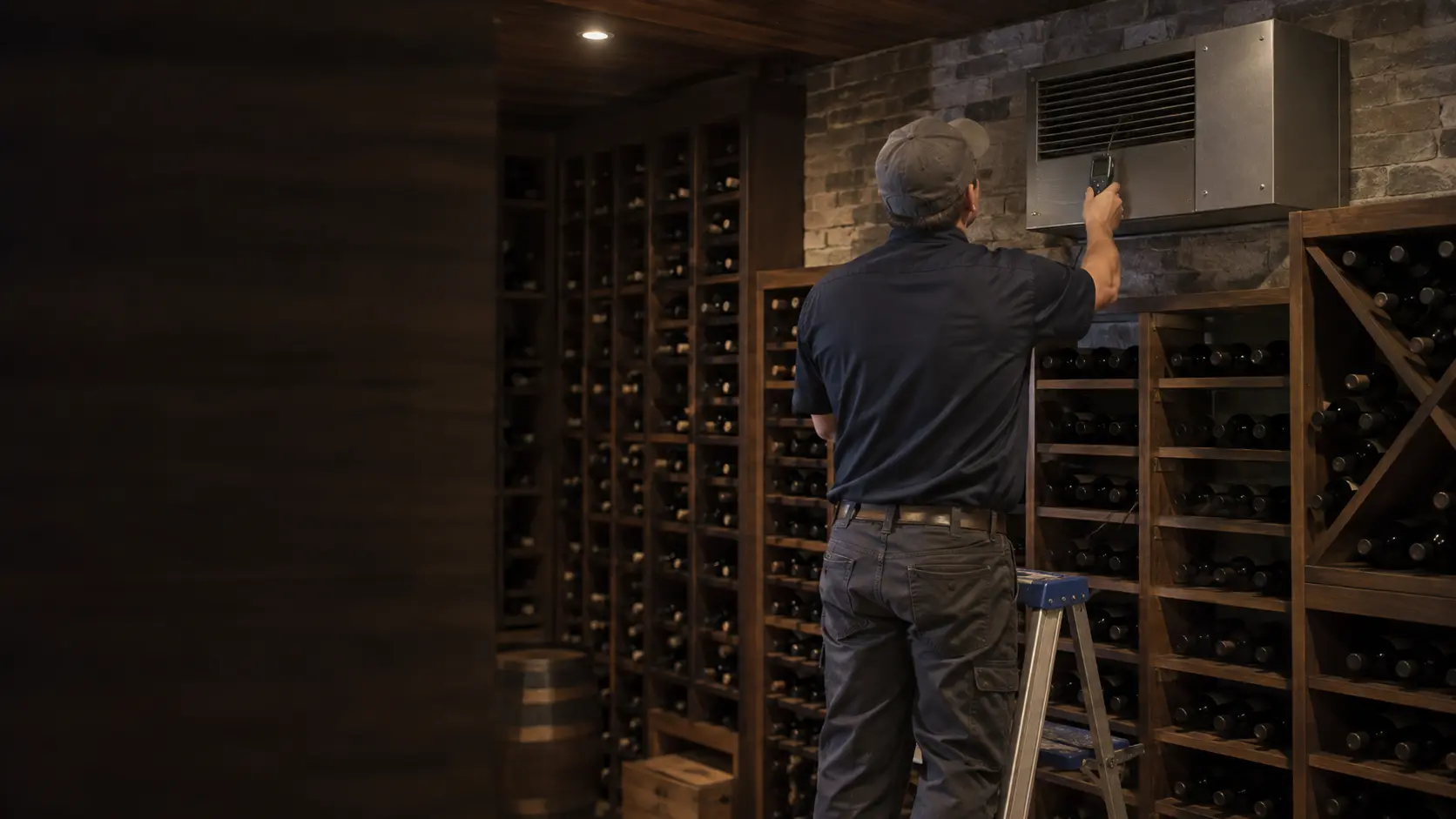 What fails on a through-the-wall cellar cooling unit
How to tell
One rectangular grille, often near the ceiling, sits flush in a cellar wall, and on the far side of that same wall a second grille of the same size faces another room.
Nothing runs outdoors and no ducts leave the unit; the power cord usually drops from the exhaust side to an outlet in the neighboring room.
A clear plastic drain tube or a small drip tray hangs below the cellar-side grille, or a condensate line runs down inside the wall.
A control panel or a small display sits on the case itself, on the cellar side, rather than on a separate wall thermostat.
Not yours?Ducted cellar cooling unitSplit-system cellar coolingCeiling-mounted cellar cooling
What fails
on this design.
On a through-the-wall cellar cooling unit: an exhaust room that cannot absorb the heat, a dirty condenser on the exhaust face, ice on the cellar-side coil, fan motors that run for years without a rest.
The problems it showsAn exhaust room that cannot absorb the heat
The heat pulled out of the cellar lands in the space behind the unit. A closet with the door shut, or a room that already sits in the upper 80s in August, sends that warm air straight back into the condenser, and the unit runs all afternoon while the cellar drifts upward.
A dirty condenser on the exhaust face
Lint from a nearby laundry, pet hair and household dust collect on the condenser fins facing the warm room. Over a few seasons the coil clogs, the compressor works hotter, and the thermal overload starts shutting it off in the middle of a cycle.
Ice on the cellar-side coil
A cellar held near 55°F runs the evaporator close to freezing. A tired fan, a thermostat set too low or a door that lets humid house air in lets ice form, the airflow drops, and water pours out of the case when it finally thaws.
Fan motors that run for years without a rest
Both fans often spin whenever the unit is powered. Bearings dry out, blades pick up grime and a motor starts to hum, rattle or stall, and one quiet fan is enough to leave the cellar warm or the exhaust side overheated.
Getting at it,
and whether to.
Most repairs are done from the exhaust side, where the case slides out of its sleeve, so the neighboring room needs about four feet of clear floor in front of the grille.
What repairs costOn the visit
- Clear any racks, cases or crates stacked under the cellar-side grille so a ladder can stand there and the drain can be traced.
- If the unit hangs high on a finished wall with trim around it, expect the trim to come off and go back on; the technician checks for a sealed sleeve before pulling anything.
- Keep the cellar door closed until the visit; a full, well-insulated room of bottles loses cold slowly, and every opening lets in warm, humid air.
Repair or replace
A through-the-wall unit fits one opening at one capacity, so a fan, a thermostat, a start relay or a cleaned and restored condenser nearly always makes more sense than a new case. The line moves when an older unit needs a compressor or a sealed-system leak repair, or when the unit was undersized for the room from the start; then a larger or better-placed system may serve the collection better. You see both options with their bands before anything is ordered.
Book a visit for a through-the-wall cellar cooling unitThe problems
it shows.
On a through-the-wall cellar cooling unit, most often wine cellar too warm.
All problems
Wine Cellar Too Warm
6 causes, cheapest first

Cellar Cooling Unit Exhaust Overheating
5 causes, cheapest first
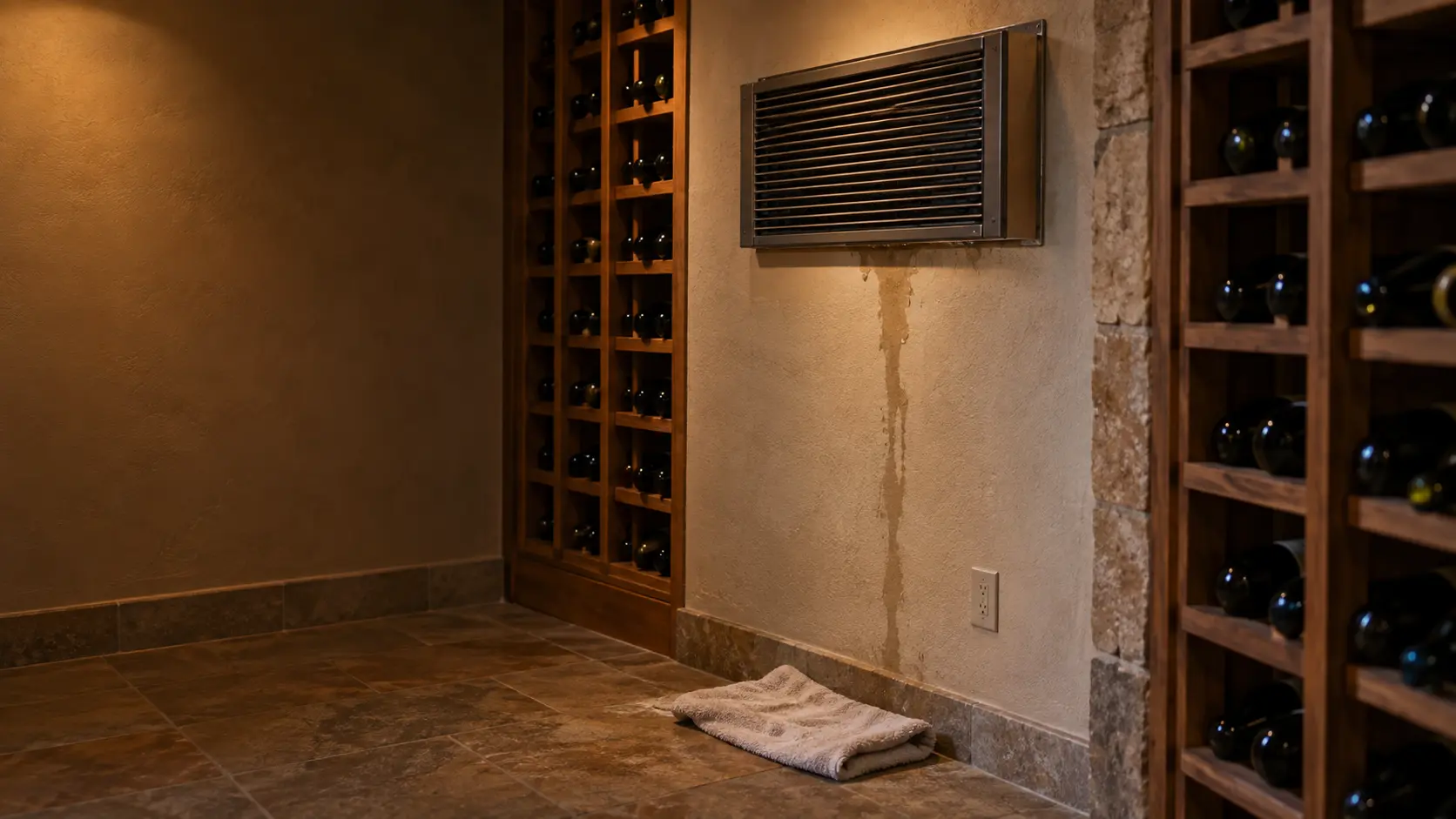
Cellar Cooling Unit Leaking Water
6 causes, cheapest first

Cellar Cooling Unit Loud or Vibrating
5 causes, cheapest first

Cellar Cooling Evaporator Coil Icing Up
5 causes, cheapest first

Cellar Cooling Unit Running Constantly
5 causes, cheapest first
Who builds
a through-the-wall.
7 of the makes on this site build a through-the-wall cellar cooling unit. Each mark opens that make's own page.
All 7 brandsThrough-the-wall cellar cooling unit repair,
where we come out.
9 metros, each with its own page.
All service areasTampa BayFL · 31 areas
Miami / South FloridaFL · 47 areas
New York MetroNY · 75 areas
HoustonTX · 36 areas
ChicagoIL · 50 areas
Los AngelesCA · 95 areas
San DiegoCA · 31 areas

Questions about
through-the-wall cellar cooling units.
How warm can the room behind a through-the-wall cellar unit get?
Can the exhaust side of my cellar unit blow into a closet?
Why does water drip from the grille inside my wine cellar?
Is a through-the-wall unit louder than other cellar systems?
Back to your everyday
Is it a through-the-wall cellar cooling unit?
Say so when you book — it changes what the technician brings and how the visit is planned.