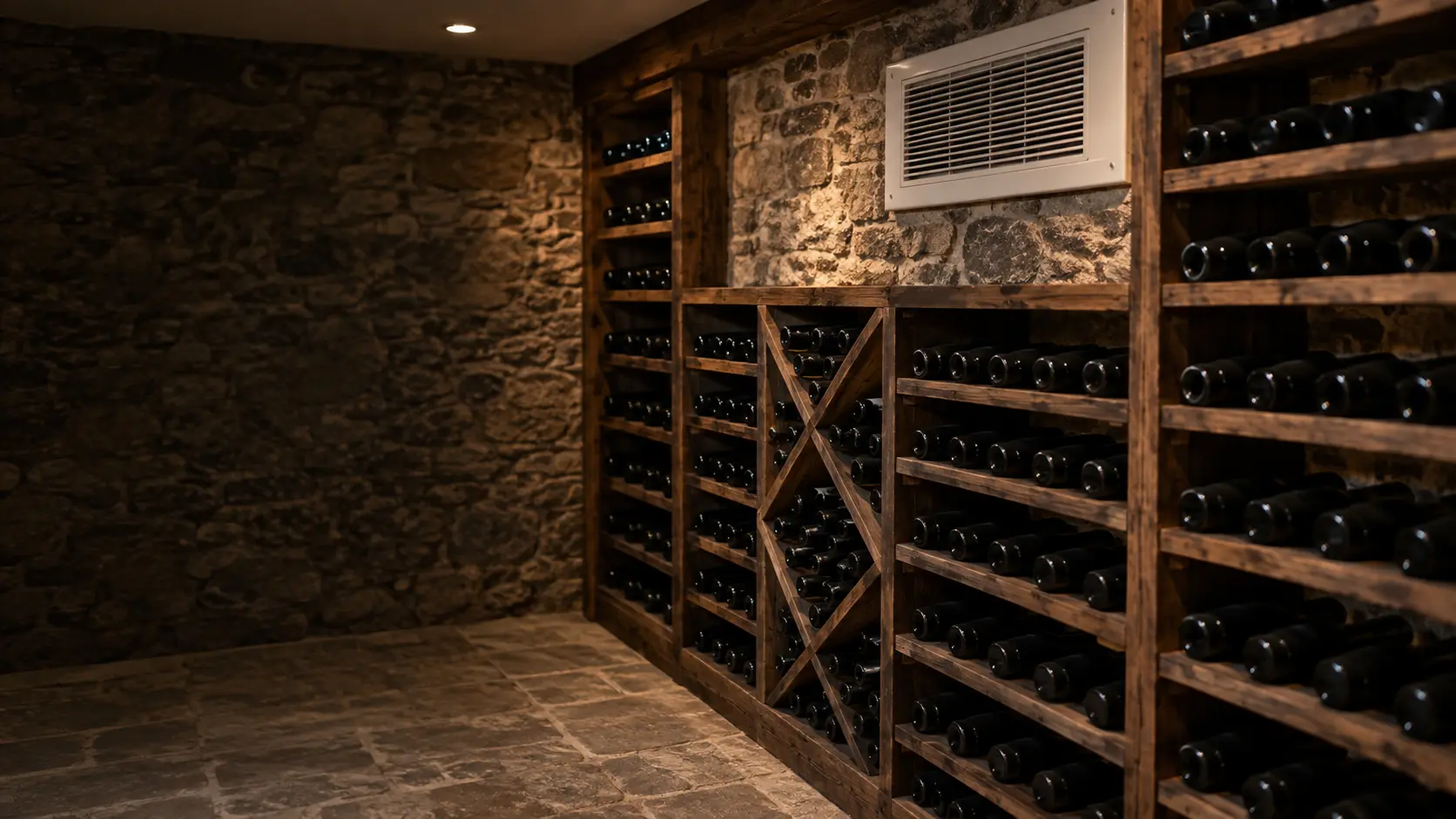

Wine Cellar Too Warm
Usually turns out to be
- 1 Cellar cooling load and room check
- 2 Cellar evaporator and condenser fan repair
- 3 Cellar coil icing and defrost repair
- 4 Cellar compressor and sealed system repair

What we do
Ten repairs we take on. Each cellar cooling job we do has its own page: what the technician does to the unit and the room, where it sits among the lighter and heavier repairs, and the point at which an old unit is no longer worth the part.
Mon–Sat, 8am–8pm
Book a visit
Three short steps, about a minute.
or call (844) 398-5977
Loading appointment form…
The appointment form couldn’t load. Please try again.
Familiar brands. Expert care.
Independent repair service. Not affiliated with, authorized or endorsed by any manufacturer. Brand names and model numbers are the property of their respective owners and are used here for identification only, to describe the appliances we service.
In the order it gets done: the cheapest cause first, and the expensive answer at the bottom where it usually belongs.
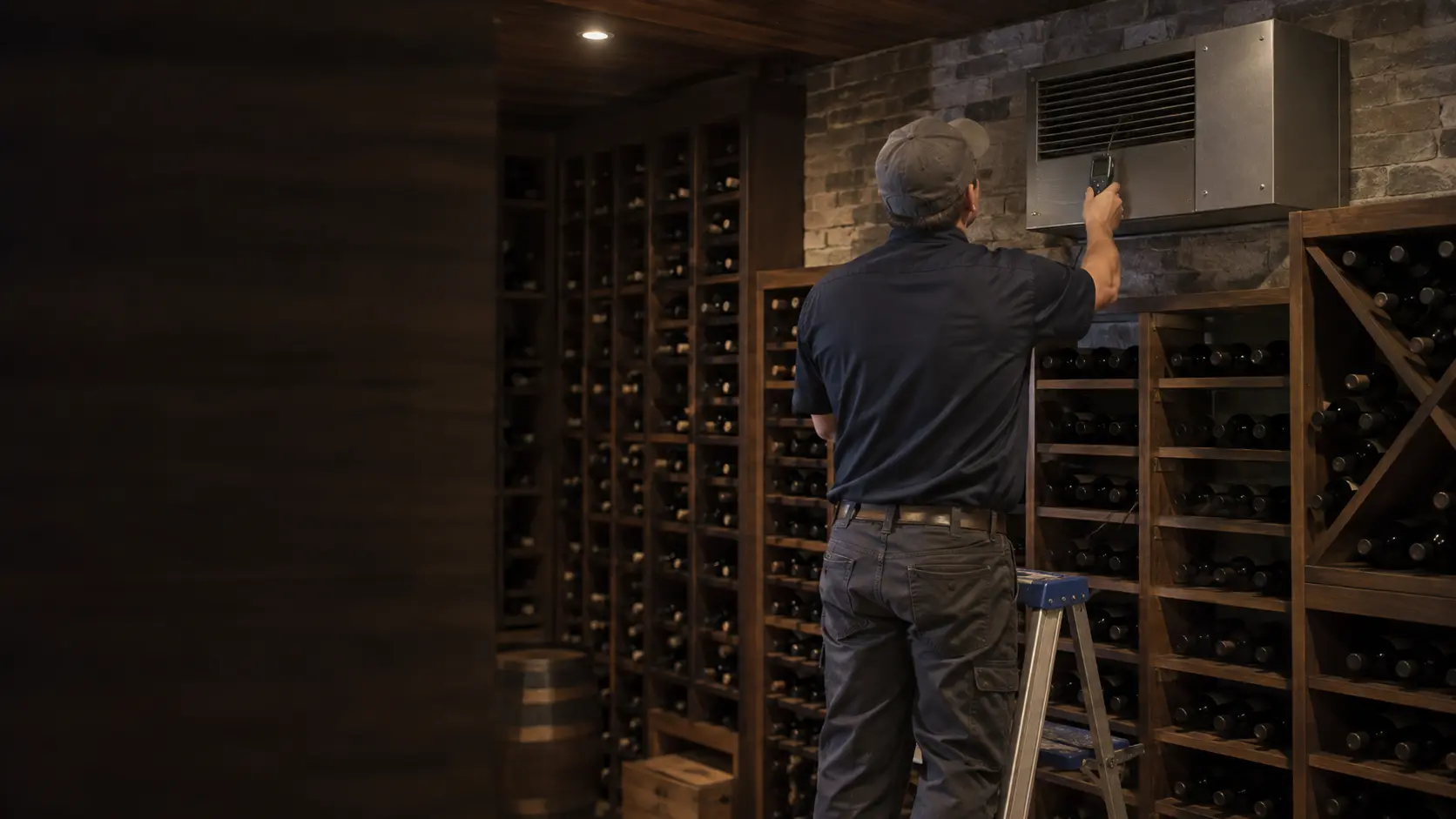
A visit that reads the cellar, the room the heat goes to and the cooling unit itself, and ends with one named cause, whether it is a part or the room.
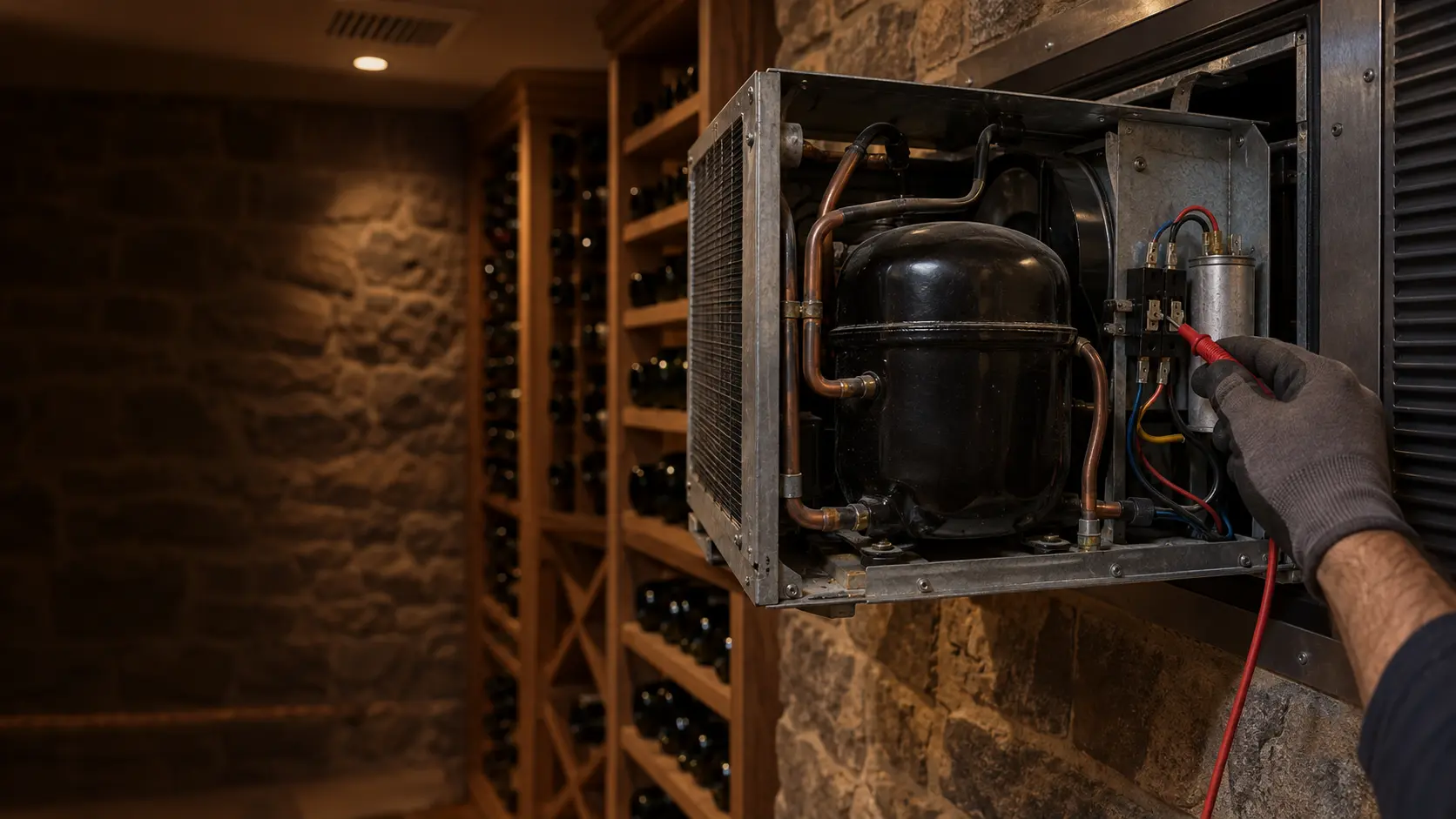
Getting the heart of the cellar unit pumping again, from the start capacitor, relay and contactor that give out first to a compressor or a sealed-system restriction.

Finding where a cellar unit or a split system is losing its refrigerant, repairing the joint or coil, and charging it by weight rather than topping it off.

Restoring the two fans a cellar unit depends on: the one that moves cellar air across the cold coil and the one that throws the heat away.

Getting the controller, its display and its probes to read the cellar truthfully and call for cooling at the right time.
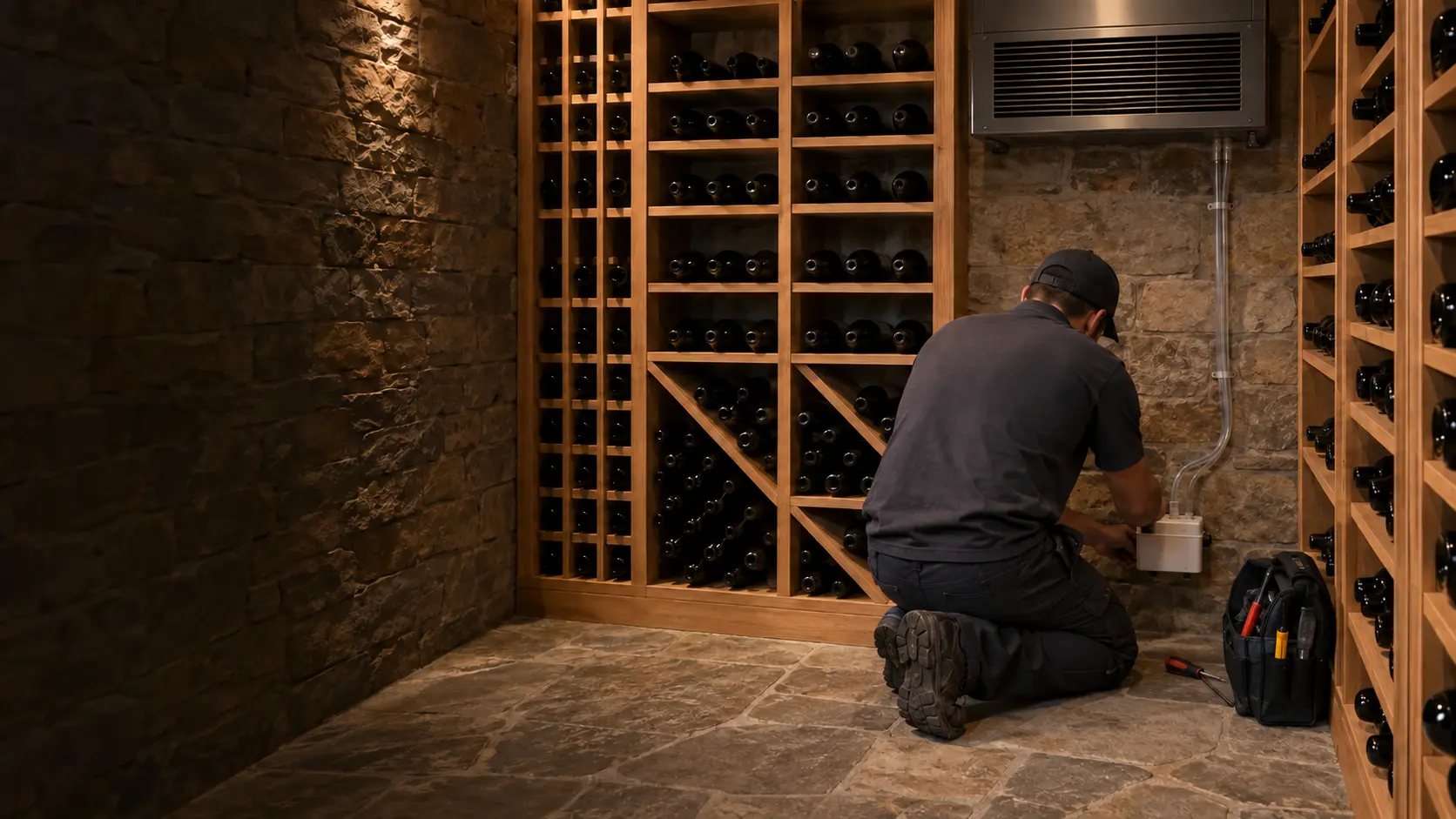
Clearing and rerouting the line that carries water off the cellar coil, and repairing the condensate pump where the water has to travel uphill.
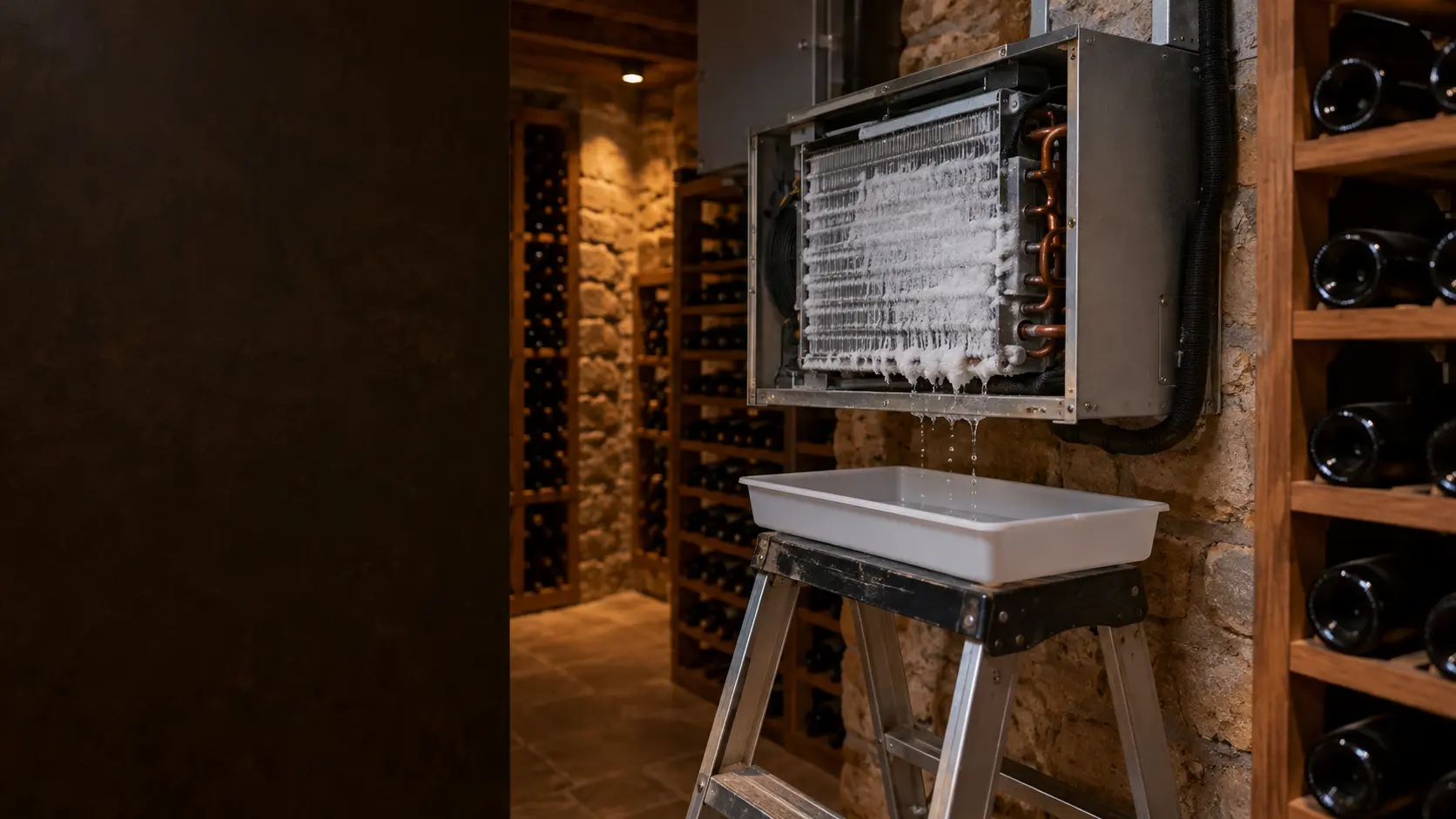
Stopping ice from forming on the cellar coil by finding what starves it, whether airflow, charge, controls or humid air coming into the room.
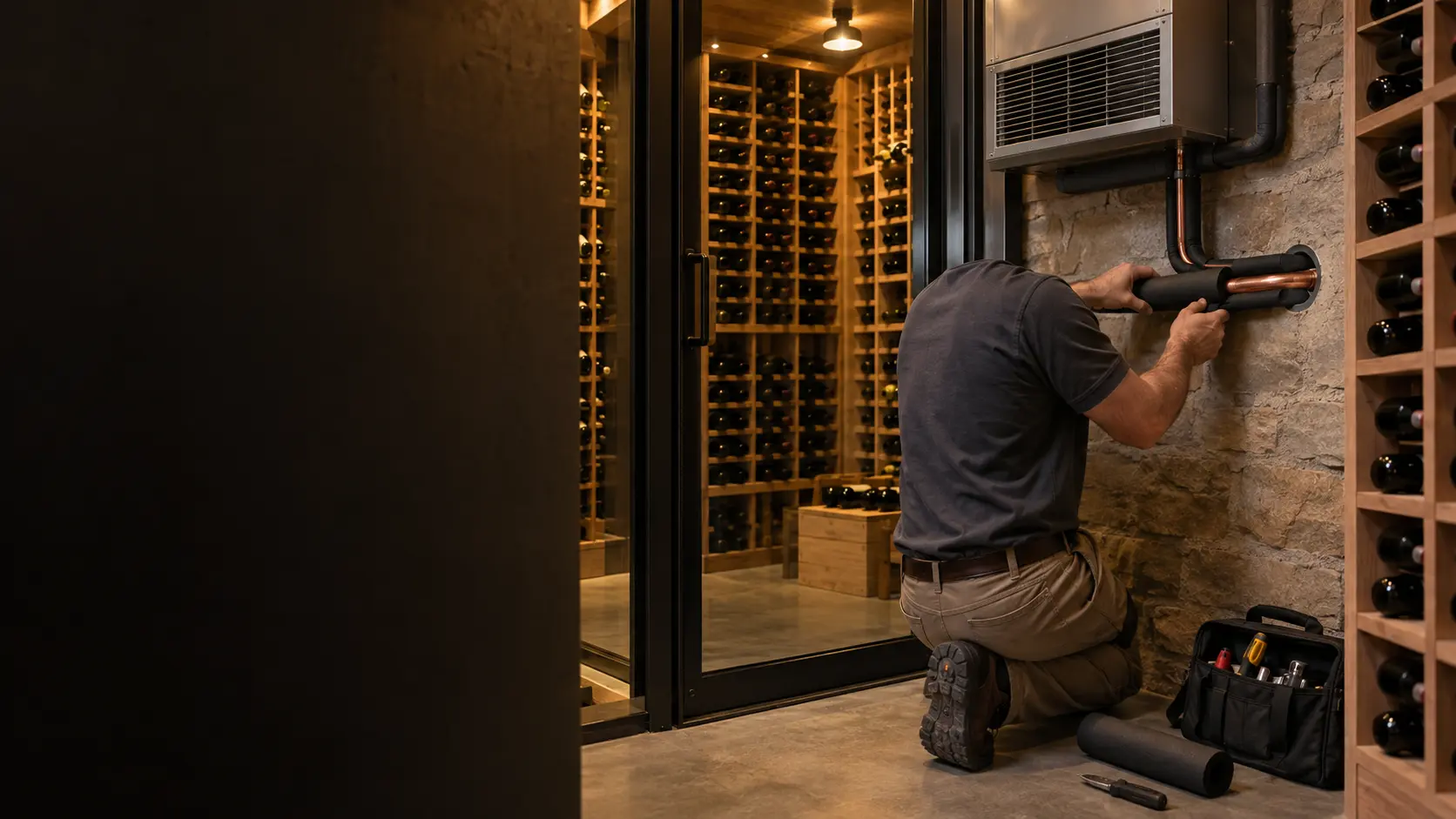
Repairing, reinsulating or rerunning the copper lines and control cable that join the cellar evaporator to its outdoor or remote condensing unit.

Bringing a wine cellar back into its humidity window, roughly 50 to 70 percent, by fixing the humidifier, the fan settings, the drain or the room.
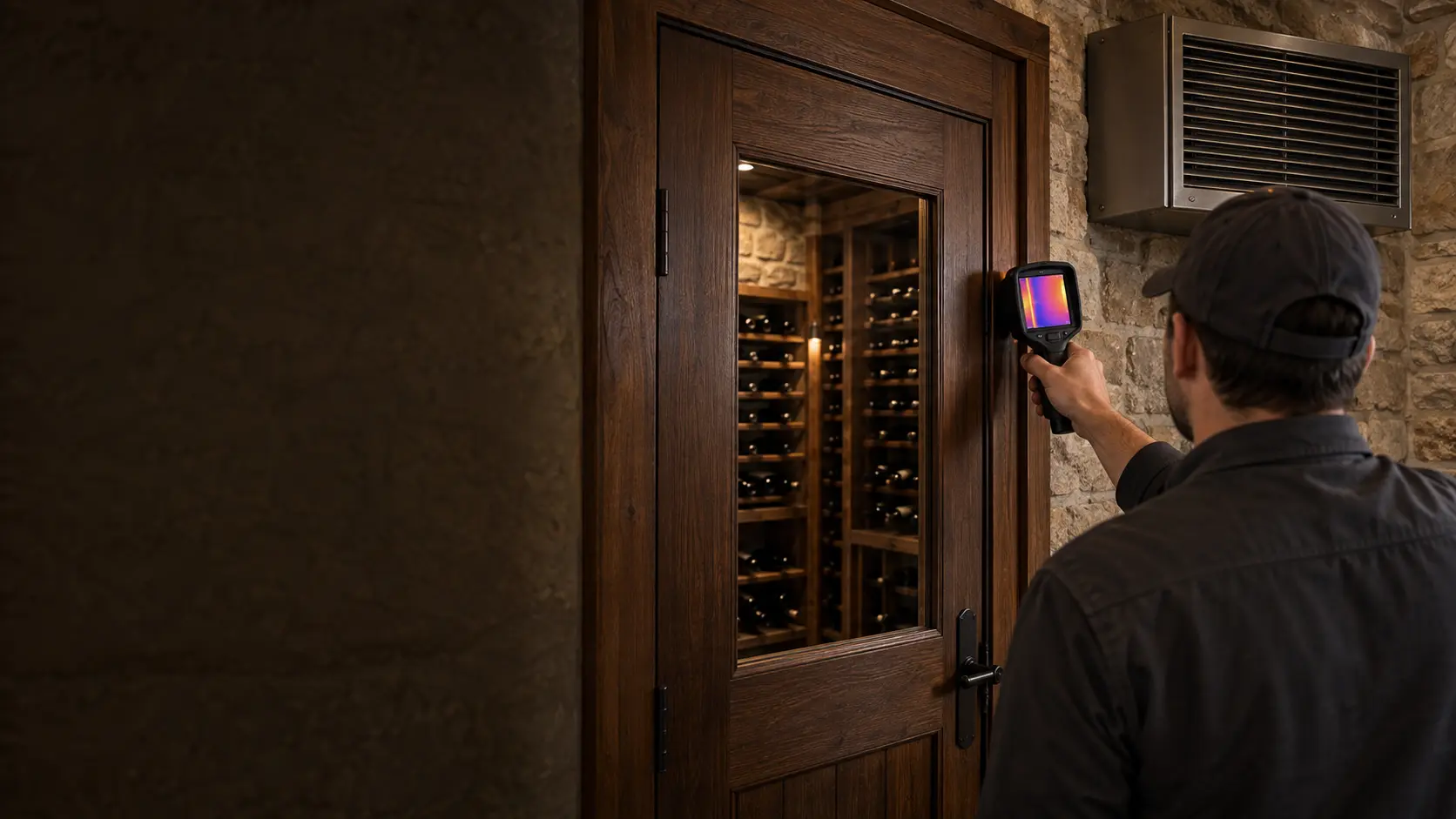
Measuring the cellar as the cooling unit sees it: insulation, vapor barrier, door, glass and the heat load, to show whether the unit can ever keep up.
Before you bookBands rather than prices, because nobody can quote a figure before the wine cellar cooling unit has been looked at — and the diagnostic visit that decides it, set against the repair.
10 repairsCheapest firstDiagnostic visit Read the cost guideWeigh a cellar repair against two things: what a new system for the same room would take to install, and the collection sitting in that room. Fans, drains, probes, pumps and humidifier parts are a small share of either, and so is most sealed-system work on a split system or a unit built into finished walls. The harder call comes with an older through-the-wall unit that needs a compressor or a second leak repair, or a unit that was never large enough for its room; there the technician puts repair, replacement and any room fix side by side.
| Repair | Relative cost | Notes |
|---|---|---|
| Start capacitor, contactor, compressor or sealed-system restriction | moderate to highest | A capacitor, relay or contactor is a small part reached once the unit's panel is off. A new compressor, or clearing a restriction with brazing, a drier, a vacuum and a weighed charge, sits near the top of the scale, and more so when the unit must come out of a wall or a ceiling. |
| Leak search, joint or coil repair and a weighed charge | highest | Finding the leak, repairing it, evacuating and charging by weight is the most involved work a cellar unit takes. A long line set or a leak hidden behind a finished wall adds hours; a leak at a service valve on an outdoor unit is the quicker end. |
| Evaporator or condenser fan motor, blade or capacitor | low to moderate | A fan motor and its blade or capacitor are modest parts on most units. Reaching the cellar-side fan on a ceiling unit, or an outdoor fan on a roof or a tight pad, adds a little time. |
| Air or coil probe, display, transformer or control board | moderate | A probe or a fuse is a small repair. A control board or a remote display made for one make of cellar unit costs more and sometimes has to be ordered, and a long cable run to a wall display can add time. |
| Drain line, drain pan or condensate pump | low | Clearing and flushing a drain line is quick work. A new condensate pump, a replacement pan or rerouting a line that has no slope sits a little higher, and a pan in a ceiling reached from an attic takes longer. |
| Thawing an iced coil and correcting its cause | low to moderate | The thaw and a setting or probe change stay low. When the cause turns out to be a fan or a leak, that repair is priced on its own row. |
| Line set section, insulation or control cable | moderate to highest | Reinsulating an exposed length or fixing the control cable is moderate work. Replacing a crushed or leaking section inside a wall or under a deck means cutting in, brazing, evacuating and charging, and sits near the top. |
| Humidifier module, humidity probe or settings | low to moderate | Cleaning a scaled pad, freeing a valve or changing fan and differential settings is low on the scale. A new humidifier module or a separate humidifier with its water line is a step up. |
| Cooling load and room survey | lowest | The survey itself is a measured visit with a thermal camera and a written list. Any insulation, vapor barrier or door work it points to is done by the right trade and priced separately. |
Most people arrive knowing the symptom, not the repair. These are the jobs each one usually turns out to be, cheapest first — and every one of them starts with the wine cellar cooling diagnostic visit.
Usually turns out to be
Usually turns out to be
Usually turns out to be
What to check firstUsually turns out to be
What to check firstUsually turns out to be
What to check firstUsually turns out to be
What to check firstUsually turns out to be
Usually turns out to be

Back to your everyday
Three short steps online, or one call. Tell us what you are seeing and pick a window that works.