


wine cellar cooling unit repair specialists
Steady at 55°F.
The cellar cooled,
the wine at rest.
Repairs for the unit that keeps a whole room of wine at cellar temperature.
Tell us what the room is doing. We’ll find out why.
- Compressors, refrigerant and line sets
- Controllers, probes, fans and drains
- Through-wall, ducted, split, ceiling
What to expect
Experienced technicians
More than 12 years in appliance repair
Upfront pricing
The cost of the repair in writing, before any work begins
OEM parts on order
Original manufacturer parts ordered against your model number, never third-party substitutes
Warranty on our workmanship
Every repair is backed by a warranty on the work we performed
Your next step
to a working wine cellar cooling unit.
A few details now.
A little less to worry about.
Say what the cellar is doing
Choose the kind of cellar cooling unit and describe the room: how warm it reads, any water, ice, noise or code on the controller.
Choose the day
Pick a date and a morning or afternoon window that works for you.
Tell us where the cellar is
Give the address and a number the technician can call on the way.
Every cellar cooling unit carries a rating plate with the make, model and serial number: a through-the-wall unit usually on a side of its housing, sometimes readable only from the exhaust side; a ducted unit on the cabinet in the attic, closet or mechanical room where it sits; a split system twice, once on the evaporator in the cellar and once on the condenser outside. A photo of that plate tells us the exact equipment before we set out.
or call (844) 398-5977
Loading appointment form…
The appointment form couldn’t load. Please try again.
Four steps,
and no surprises.
The three steps in the form are how you book. These four are what actually happens once a technician is standing in your cellar.
The room and the unit, both measured
The technician reads the cellar's temperature and humidity, the air going in and coming off the coil, and the heat at the exhaust side, then checks the door seal, the drain and whatever the room itself may be adding to the load.
The cause and the figure, before any work
You hear what failed and what it costs to put right, then choose. If the unit is undersized for the room, or the room is the real problem, the technician tells you that plainly.
Common cellar parts in the van
Probes, fan motors, capacitors, relays, drain fittings and condensate pumps often come along. Model-specific parts such as a compressor, a controller or a coil are ordered, and a model number in the booking gets that order moving sooner.
The cellar heading back to 55°F
After the repair the technician watches the unit start, the fans turn and the drain carry water away, confirms the room is falling toward its set point, and tells you how long the cellar needs before it is fully settled.
Not every wine cellar cooling unit
breaks the same way.
A through-the-wall unit sits in an opening between the cellar and the next room and pushes its heat out the back, a ducted unit lives outside the cellar and sends cool air in through supply and return ducts, a split system hangs an evaporator in the room and puts the condenser outdoors with a line set between them, and a ceiling unit cools from above with its heat carried away overhead. Which of the four keeps your cellar?
All wine cellar cooling unit types
Through-the-wall cellar cooling unit
A self-contained box set into an opening in the cellar wall: its cold face blows into the wine room, and its warm face breathes out into the room next door.

Ducted cellar cooling unit
A self-contained cooling unit placed outside the cellar, in a mechanical room, attic or basement, that sends chilled air in and takes return air back through insulated ducts.

Split-system cellar cooling
An evaporator inside or beside the cellar and a condensing unit outside or in another room, joined by an insulated copper line set and charged on site.

Ceiling-mounted cellar cooling
A cooling unit hung in the cellar ceiling or set into the space above it, so only a grille shows, with its heat sent into the space above or ducted away.
Every kind we serviceAll wine cellar cooling units, side by side
The archive puts the 4 types against each other: how to tell which you own, what fails on each, and which manufacturers build them.
How to tell yoursWhat fails on eachWho makes them Open the type archiveA cellar that holds its set point.
Walls and racks that stay dry.
Maybe the thermometer by the racks reads 62°F on a hot afternoon, water is streaking down the wall under the unit, the evaporator has turned white with ice, or the fan never seems to rest. Start from the thing you saw most recently; each page opens with what it probably means for the room and the bottles, and gets to a visit only at the end.
 All 17 problems
Wine Cellar Too Warm
A wine cellar too warm shows up slowly: the room smells of the house instead of cool stone, a bottle picked from a middle rack feels barely cooler than your hand, and the wall thermometer has crept from the mid 50s into the 60s over a week.
Cellar Cooling Unit Leaking Water
A cellar cooling unit leaking water leaves a dark stain spreading down the wall under the unit, drips landing on the top row of bottles, a wet patch on the floor of the next room, or water where a ceiling unit meets the drywall.
Burning Smell From a Cellar Cooling Unit
A cellar cooling unit burning smell reaches you as hot plastic or scorched dust at the cellar door or at the exhaust grille next door, sometimes with a buzz, a flicker of the controller or the unit shutting off on its own.
Cellar Cooling Unit Tripping the Breaker
A cellar cooling unit tripping breaker trouble looks like a silent unit, a warm cellar in the morning, and a breaker or GFCI outlet that has snapped off, sometimes the moment the compressor tries to start.
Cellar Cooling Unit Not Turning On
A cellar cooling unit not turning on stays silent and dark: no fan, no hum from the compressor, no light on the controller, while the cellar thermometer slowly drifts upward.
Wine Cellar Too Cold
A wine cellar too cold feels like stepping into a walk-in: the thermometer sits in the 40s, bottles come out beaded with water, and the unit keeps running long after the room should have been satisfied.
Familiar brands. Expert care.
For the brands
in your cellar.
Independent repair service. Not affiliated with, authorized or endorsed by any manufacturer. Brand names and model numbers are the property of their respective owners and are used here for identification only, to describe the appliances we service.
What a repair
usually costs.
Weigh a cellar repair against two things: what a new system for the same room would take to install, and the collection sitting in that room. Fans, drains, probes, pumps and humidifier parts are a small share of either, and so is most sealed-system work on a split system or a unit built into finished walls. The harder call comes with an older through-the-wall unit that needs a compressor or a second leak repair, or a unit that was never large enough for its room; there the technician puts repair, replacement and any room fix side by side.
| Repair | Relative cost | Notes |
|---|---|---|
| Start capacitor, contactor, compressor or sealed-system restriction | moderate to highest | A capacitor, relay or contactor is a small part reached once the unit's panel is off. A new compressor, or clearing a restriction with brazing, a drier, a vacuum and a weighed charge, sits near the top of the scale, and more so when the unit must come out of a wall or a ceiling. |
| Leak search, joint or coil repair and a weighed charge | highest | Finding the leak, repairing it, evacuating and charging by weight is the most involved work a cellar unit takes. A long line set or a leak hidden behind a finished wall adds hours; a leak at a service valve on an outdoor unit is the quicker end. |
| Evaporator or condenser fan motor, blade or capacitor | low to moderate | A fan motor and its blade or capacitor are modest parts on most units. Reaching the cellar-side fan on a ceiling unit, or an outdoor fan on a roof or a tight pad, adds a little time. |
| Air or coil probe, display, transformer or control board | moderate | A probe or a fuse is a small repair. A control board or a remote display made for one make of cellar unit costs more and sometimes has to be ordered, and a long cable run to a wall display can add time. |
| Drain line, drain pan or condensate pump | low | Clearing and flushing a drain line is quick work. A new condensate pump, a replacement pan or rerouting a line that has no slope sits a little higher, and a pan in a ceiling reached from an attic takes longer. |
| Thawing an iced coil and correcting its cause | low to moderate | The thaw and a setting or probe change stay low. When the cause turns out to be a fan or a leak, that repair is priced on its own row. |
| Line set section, insulation or control cable | moderate to highest | Reinsulating an exposed length or fixing the control cable is moderate work. Replacing a crushed or leaking section inside a wall or under a deck means cutting in, brazing, evacuating and charging, and sits near the top. |
| Humidifier module, humidity probe or settings | low to moderate | Cleaning a scaled pad, freeing a valve or changing fan and differential settings is low on the scale. A new humidifier module or a separate humidifier with its water line is a step up. |
| Cooling load and room survey | lowest | The survey itself is a measured visit with a thermal camera and a written list. Any insulation, vapor barrier or door work it points to is done by the right trade and priced separately. |
9 metros,
one appliance.
Where a cellar is built decides how hard its cooling works: a garage conversion that bakes all summer, a basement that stays damp, a condo where the exhaust has nowhere to go, a coastal house where storms cut the power and salt air eats the condenser fins. Each note says what a town or a neighborhood asks of the cellar cooling in it, not what the town itself is like.
All service areasTampa BayFL · 31 areas
Tampa Bay houses sit low with no basements, so a cellar is an interior closet or a room built into the house, cooled against humidity and heat all year. Helene and Milton brought surge to the shoreline and long outages in 2024, and owners learned to raise racks and keep a sealed door shut. A condenser near the water faces salt air every day.
OrlandoFL · 30 areas
Orlando's custom and vacation houses often include a glass wine room beside the dining room or the game room, and the owners may be away for months. Summer lightning, afternoon storms and hurricanes like Ian and Milton cut power, and a cellar in an empty house depends on an alarm that reaches someone. The room's glass and sun exposure set its load more than its size does.
Miami / South FloridaFL · 47 areas
South Florida has no basements, so every cellar here is a room above grade cooled against heat and humidity all year. Salt air shortens the life of condensers near the water, hurricanes bring outages and surge, and many condo owners leave for months with the collection behind a locked door. In towers, where the unit's heat may go is decided by the building.
New York MetroNY · 75 areas
New York cellars divide between brownstone basements that stay cool and wine rooms inside apartments that do not. Co-op boards, building engineers and landmarks rules decide where a unit may vent, and Hurricane Sandy in 2012 showed what floodwater does to basement cellars near the rivers. A through-the-wall unit venting into a boiler room, or a split system with a roof condenser, is the usual answer.
HoustonTX · 36 areas
Houston's clay soil and high water table leave almost no basements, so cellars are rooms above grade fighting heat and humidity through their walls. Hurricane Beryl's outage in 2024 and Harvey's floods in 2017 shaped how collectors plan: sealed rooms that hold their cool, generators, and units lifted clear of water. A vapor barrier on the warm side of the wall matters here more than almost anywhere.
ChicagoIL · 50 areas
Chicagoland is basement country, and many cellars sit in a room that already stays near 60 degrees, so the cooling unit's job is modest and humidity is the harder part. Winters below zero test any split condenser outdoors, spring storms test sumps and floor drains, and downtown high-rise wine rooms face the same question as any tower: where the heat goes.
Los AngelesCA · 95 areas
A Los Angeles cellar may be a hillside room that stays cool on its own or a glass showpiece in a Valley house where summer passes 100 degrees. Earthquakes make anchored racks and a secured unit part of every build, and the 2025 fires and wind-season shutoffs taught collectors to plan for a cellar without power. Split and ducted systems are common where owners want the equipment out of earshot.
San DiegoCA · 31 areas
The San Diego coast is mild enough that a well-sealed cellar needs little help for much of the year, while the inland valleys run hot all summer. Salt air reaches condensers near the shore, Santa Ana winds bring sudden heat and dry air, and earthquakes make anchored racks part of the build. Many cellars are rooms in hillside houses where the unit can exhaust into a garage below.
San Francisco Bay AreaCA · 74 areas
Bay Area collectors live next door to wine country, and their cellars take every form, from cool San Francisco basements that barely need a unit to glass rooms in hot inland valleys that need a strong one. The Hayward and San Andreas seismic zones make anchored racks and a secured unit part of the build, and a fire-weather shutoff of the power grid shows each owner how many hours a sealed cellar stays near 55 with its unit silent.

Answers before
you book.
How soon can a technician get to my wine cellar?
Do you repair the kind of cellar cooling I have?
What should I have ready before the cellar visit?
What does a wine cellar cooling repair usually cost?
My cellar unit has seen a lot of summers. Is it still worth fixing?
The cellar is warming and the racks are full. What should I do first?
Work out what
you are dealing with.
Split by what you are trying to find out rather than by what part of the appliance it concerns.
All 22 guides
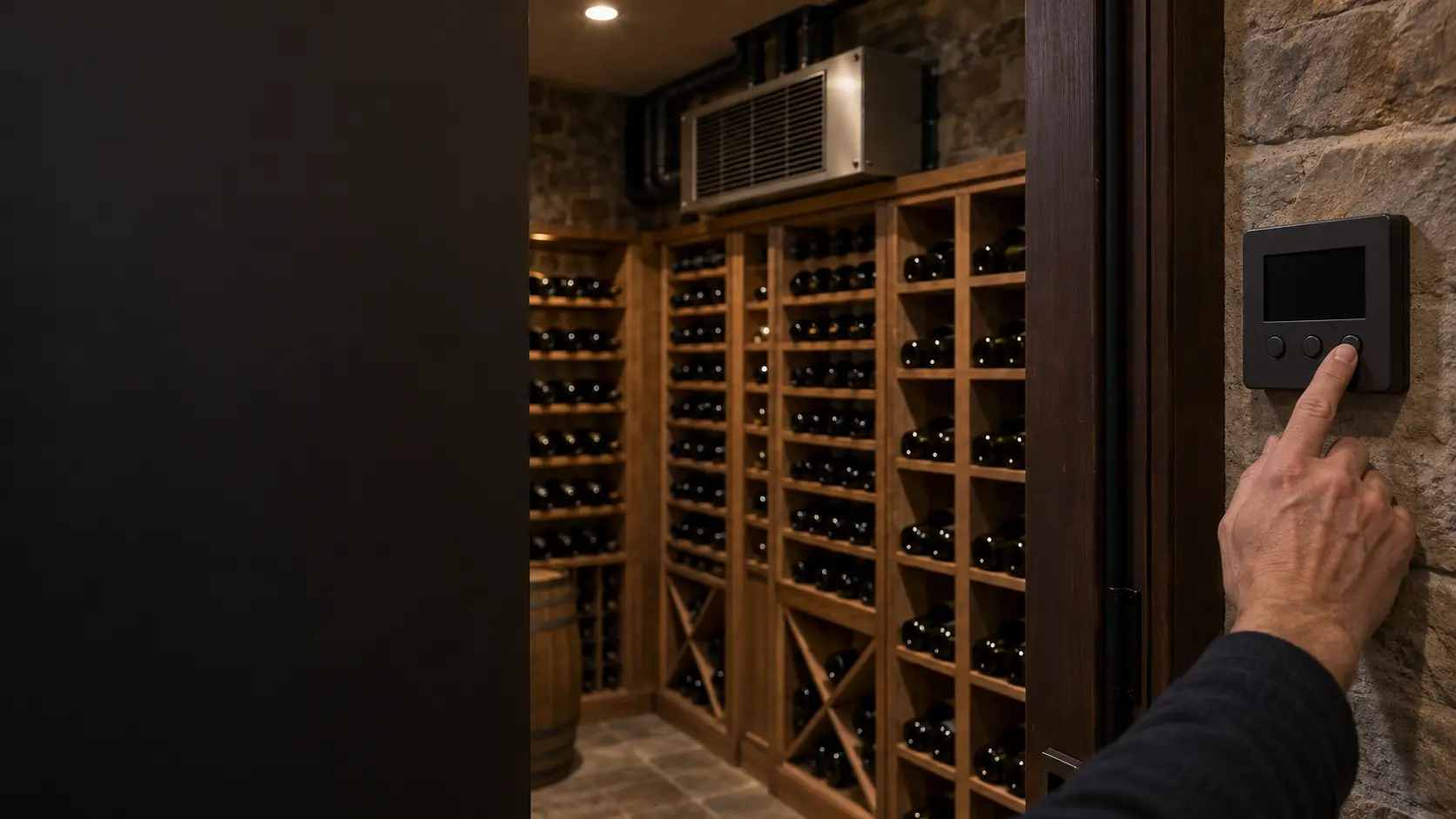
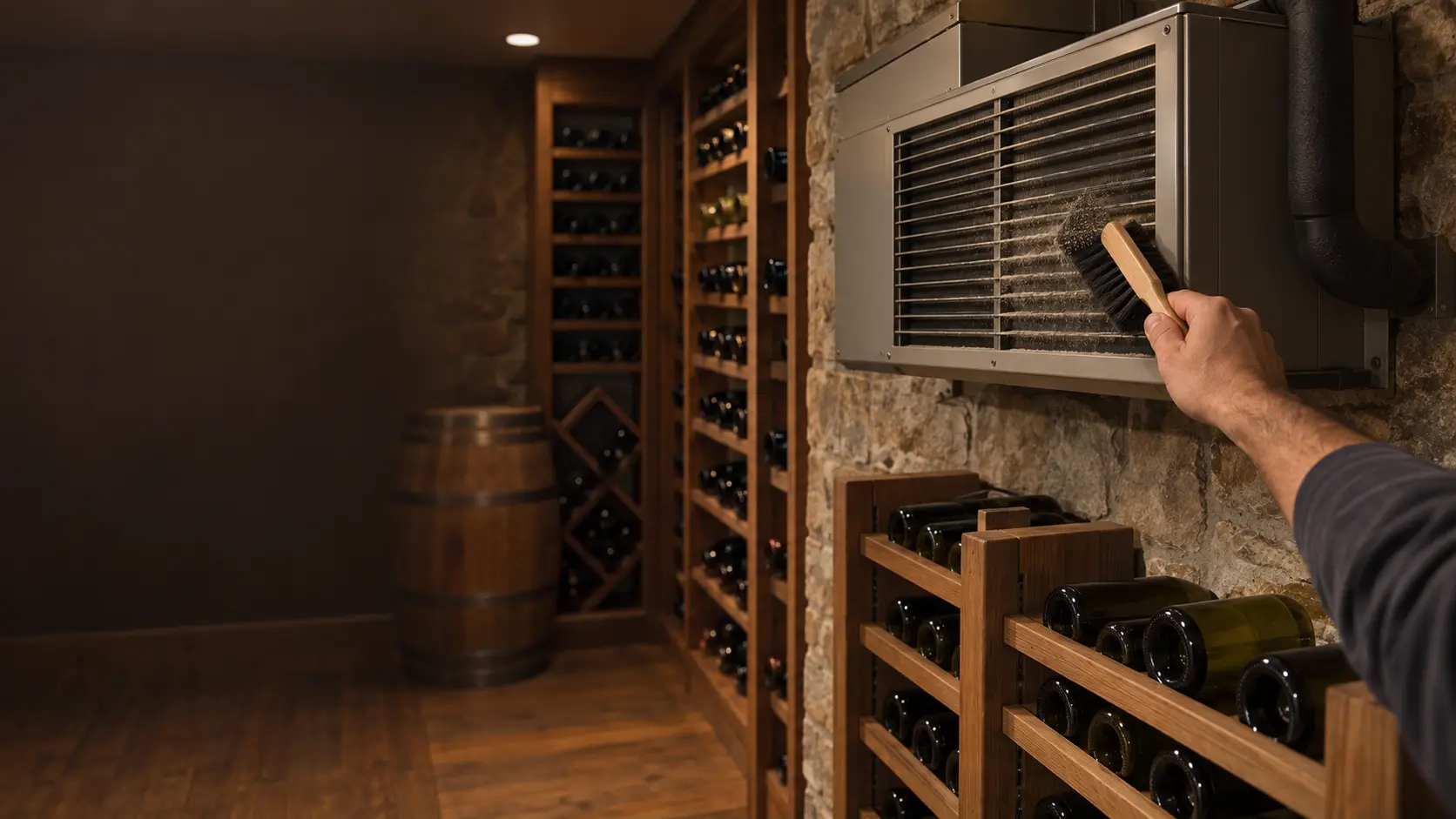
Maintenance and prevention
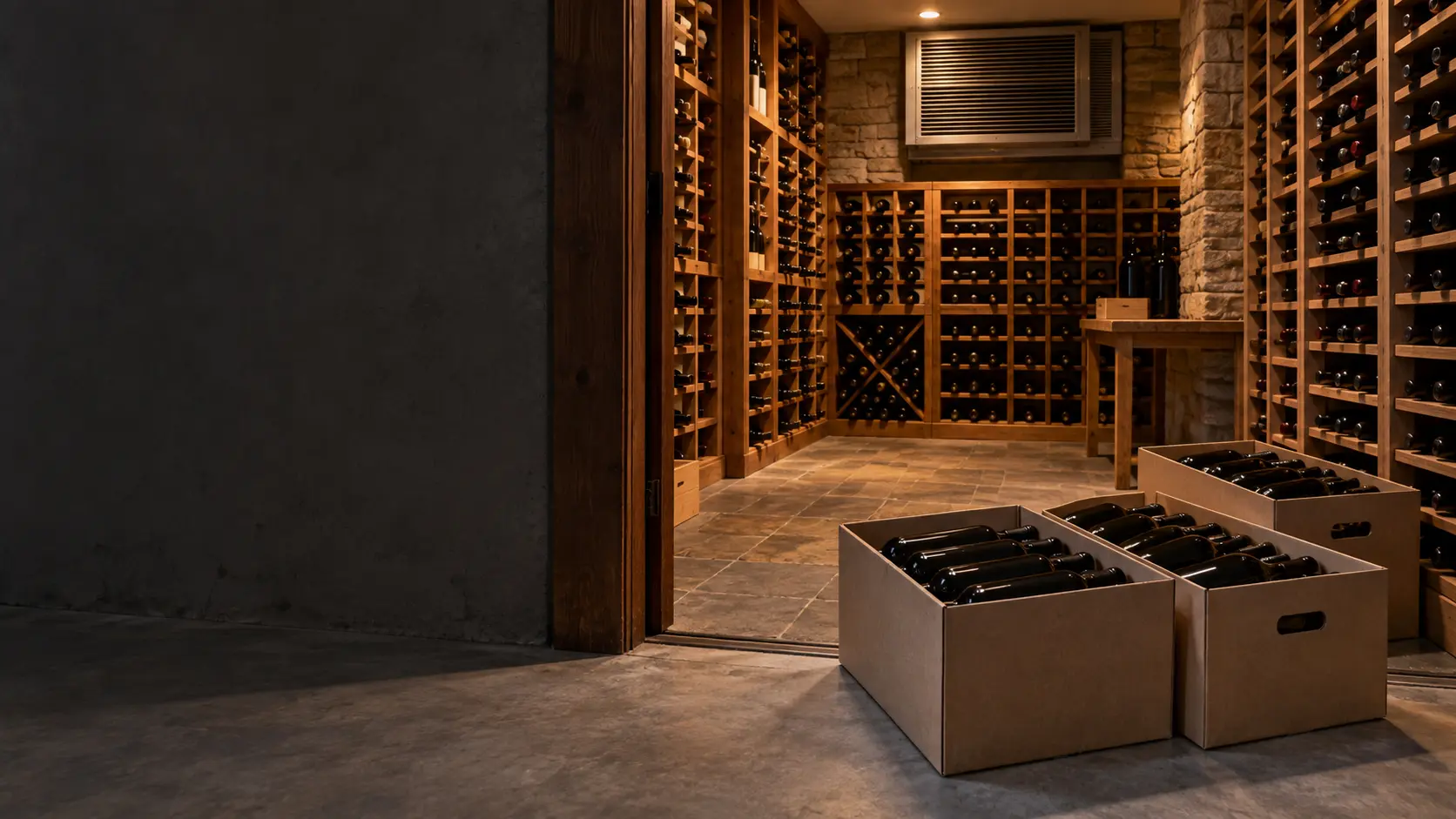
The collection, power and water

Choosing and comparing

Installation and setup
Wondering what the repair might cost? That has a page of its own, because a real figure depends on the unit, the room and what the technician measures there — wine cellar cooling repair cost.
Back to your everyday
Let’s get your wine cellar cooling unit working again.
Three short steps, a window that suits you, and a price for the actual repair before any work starts.