


Ducted Cellar Cooling Unit Repair
A self-contained cooling unit placed outside the cellar, in a mechanical room, attic or basement, that sends chilled air in and takes return air back through insulated ducts.
Mon–Sat, 8am–8pm
- 4 things that fail on it
- 5 makes build it
- 6 problems it shows
Book a visit
Three short steps, about a minute.
or call (844) 398-5977
Loading appointment form…
The appointment form couldn’t load. Please try again.
Is yours
a ducted?
A ducted self-contained system keeps the machine out of the wine room entirely. The unit sits somewhere it can be heard and serviced without disturbing the bottles, and two insulated ducts join it to the cellar: one delivers cold supply air through a ceiling or wall grille, the other brings cellar air back to the coil. Many units also have a third path, a duct or an open side that sends the heat outside the cellar to a space that can take it. Because the air travels, this type depends on the ductwork as much as on the refrigeration parts. A duct that was crushed during a remodel, a run that is longer than the maker allows, flex duct with too many bends or insulation that has slipped off in a hot attic can all show up as a cellar that never quite reaches its set point. A service call looks at the airflow at both grilles, the path of every duct and the space around the unit before it opens a panel.
 What fails on a ducted cellar cooling unit
How to tell
Inside the cellar there are only grilles, one supply and one return, in the ceiling or high on the walls, and no machine sound comes from the room itself.
Following the ducts leads to a metal cabinet in a mechanical room, a basement bay, a garage or an attic, often on a platform with a drain pan below it.
A separate wired thermostat or a remote display is mounted inside the cellar or just outside its door.
The unit's label calls it a ducted self-contained system, and it has round or rectangular collars where the ducts attach.
Not yours?Through-the-wall cellar cooling unitSplit-system cellar coolingCeiling-mounted cellar cooling
What fails
on this design.
On a ducted cellar cooling unit: ductwork that starves the coil, heat soaking into the supply duct, a filter or return grille that nobody checks, the condensate path in a hidden space.
The problems it showsDuctwork that starves the coil
Flex duct sags, gets stepped on in an attic or is bent tight around a joist. Each restriction cuts the air moving over the coil, the unit runs longer to do less, and in a bad case the coil ices because too little warm cellar air reaches it.
Heat soaking into the supply duct
A cold duct crossing a summer attic gains heat along its whole length when its wrap is torn or compressed. The unit may be producing cold air at its collar that arrives several degrees warmer at the cellar grille, and the duct sweats onto the ceiling below.
A filter or return grille that nobody checks
Ducted units draw cellar air through a filter that sits out of sight. Cork dust, cardboard fibers from wine cases and ordinary lint load it up, airflow falls off, and the cellar warms slowly over weeks.
The condensate path in a hidden space
The unit sheds water into a pan with a drain line or a small pump. In an attic or a closed mechanical room nobody sees the pan fill, and the first sign can be a stain on a ceiling or a wet subfloor.
Getting at it,
and whether to.
The first stop is wherever the unit lives, so make sure the attic hatch, the mechanical room or the basement bay can be reached and has a light.
What repairs costOn the visit
- Inside the cellar the technician needs to stand under the supply and return grilles with a ladder to measure airflow; clear anything stacked below them.
- Tell us where the ducts run if you know; a run through a finished ceiling can only be checked at its ends and wherever an access panel exists.
- If the cellar is warming, keep its door shut and leave the unit on unless water is leaking near power; switch it off at the breaker from a dry spot if it is.
Repair or replace
Most ducted-unit problems are airflow and water problems rather than failed machinery, and cleaning, re-hanging or re-insulating a duct, a filter or a drain costs far less than any new system. Where the compressor or the sealed system has failed on an older unit, the question becomes whether the same unit, installed in the same spot, is still the right size for the cellar. The technician lays out repair and replacement side by side.
Book a visit for a ducted cellar cooling unitThe problems
it shows.
On a ducted cellar cooling unit, most often wine cellar too warm.
All problems
Wine Cellar Too Warm
6 causes, cheapest first

Cellar Cooling Unit Running Constantly
5 causes, cheapest first
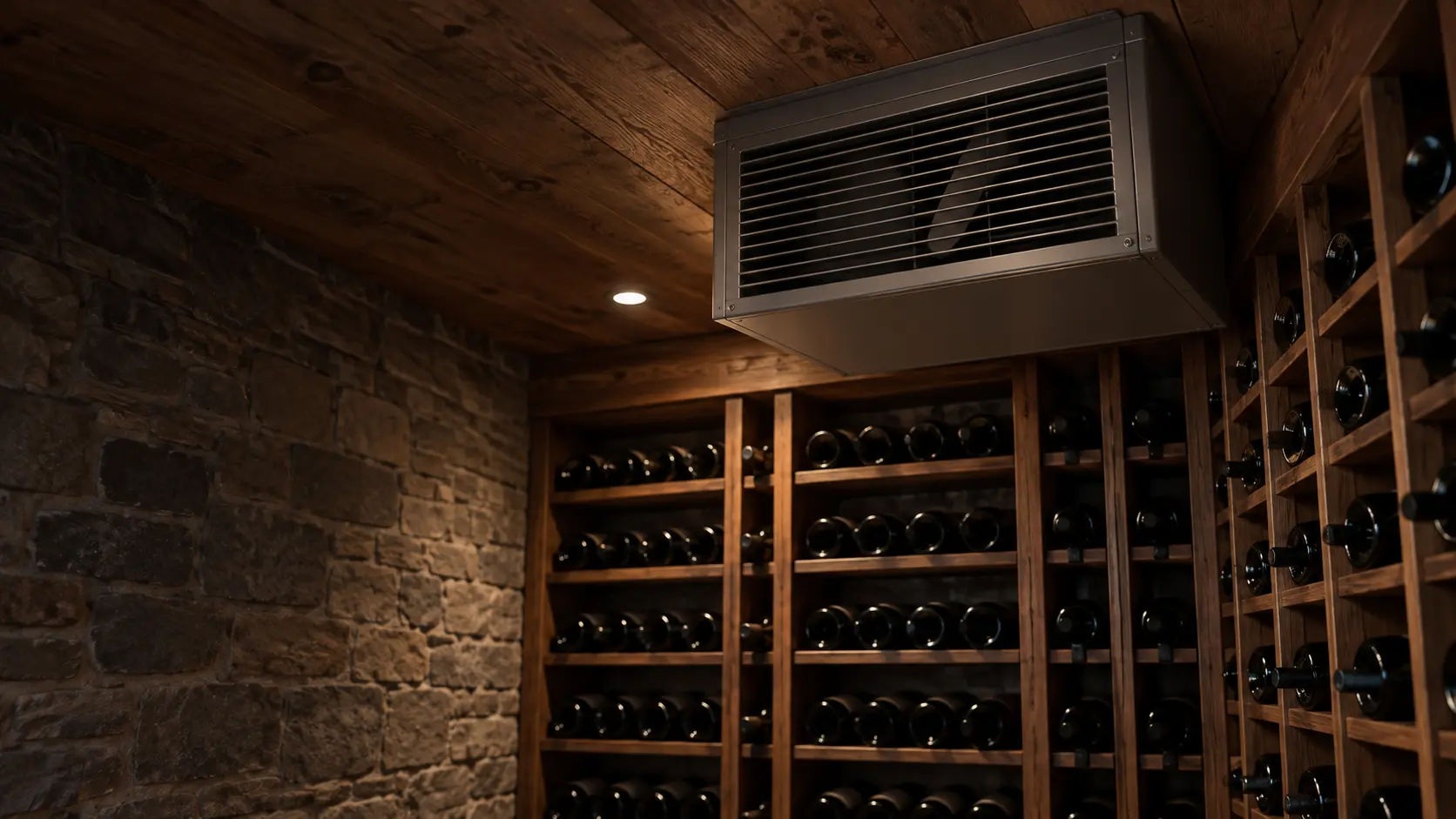
Cellar Cooling Unit Fan Not Running
4 causes, cheapest first

Wine Cellar Humidity Too Low
4 causes, cheapest first
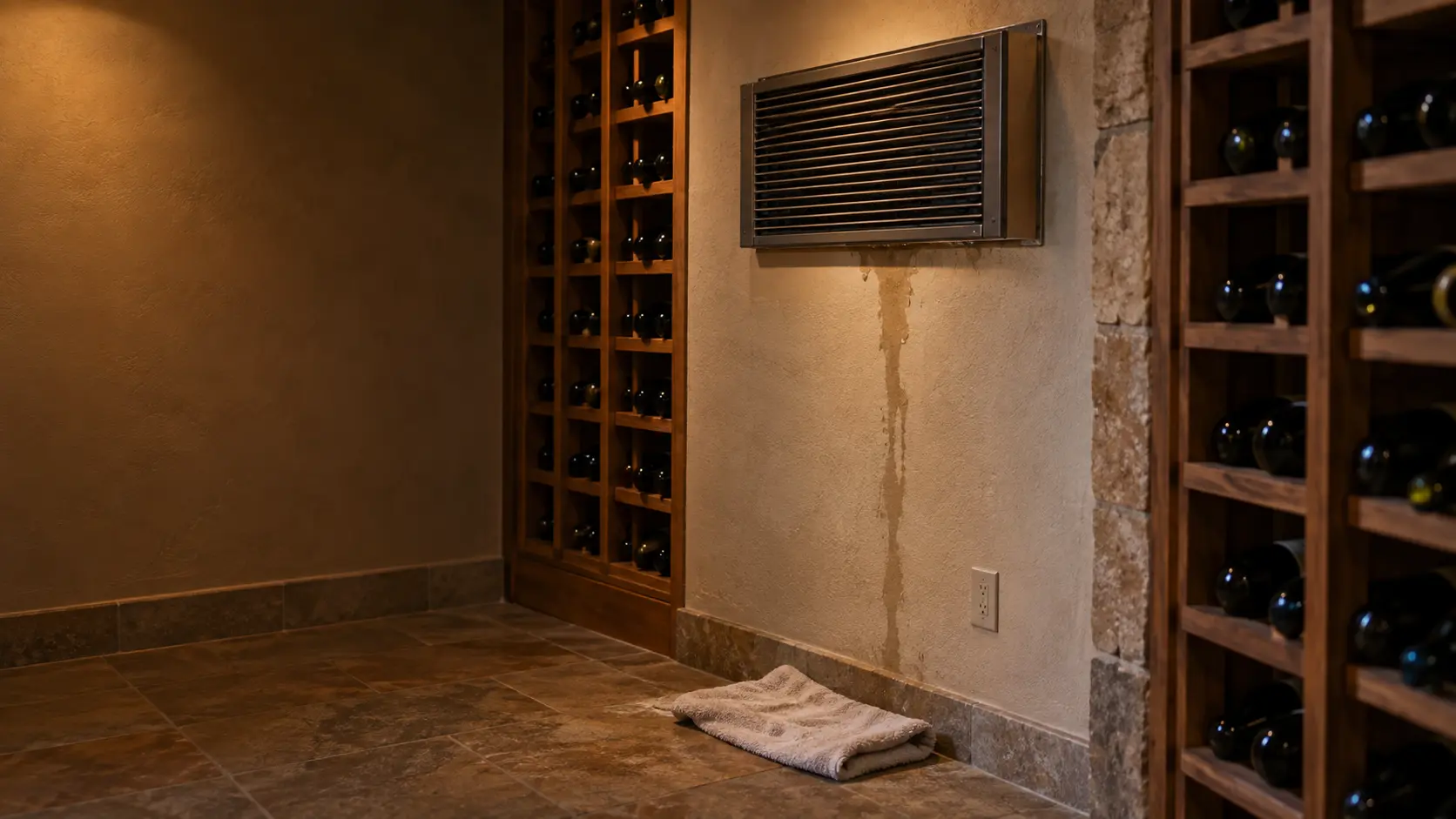
Cellar Cooling Unit Leaking Water
6 causes, cheapest first

Cellar Cooling Unit Short Cycling
5 causes, cheapest first
Who builds
a ducted.
5 of the makes on this site build a ducted cellar cooling unit. Each mark opens that make's own page.
All 7 brandsDucted cellar cooling unit repair,
where we come out.
9 metros, each with its own page.
All service areasTampa BayFL · 31 areas
Miami / South FloridaFL · 47 areas
New York MetroNY · 75 areas
HoustonTX · 36 areas
ChicagoIL · 50 areas
Los AngelesCA · 95 areas
San DiegoCA · 31 areas

Questions about
ducted cellar cooling units.
How long can the ducts on a ducted cellar unit be?
Why is there water on the ceiling under my cellar's supply duct?
Does a ducted cellar system need a filter change?
Can a ducted cooling unit be placed in an attic?
Back to your everyday
Is it a ducted cellar cooling unit?
Say so when you book — it changes what the technician brings and how the visit is planned.