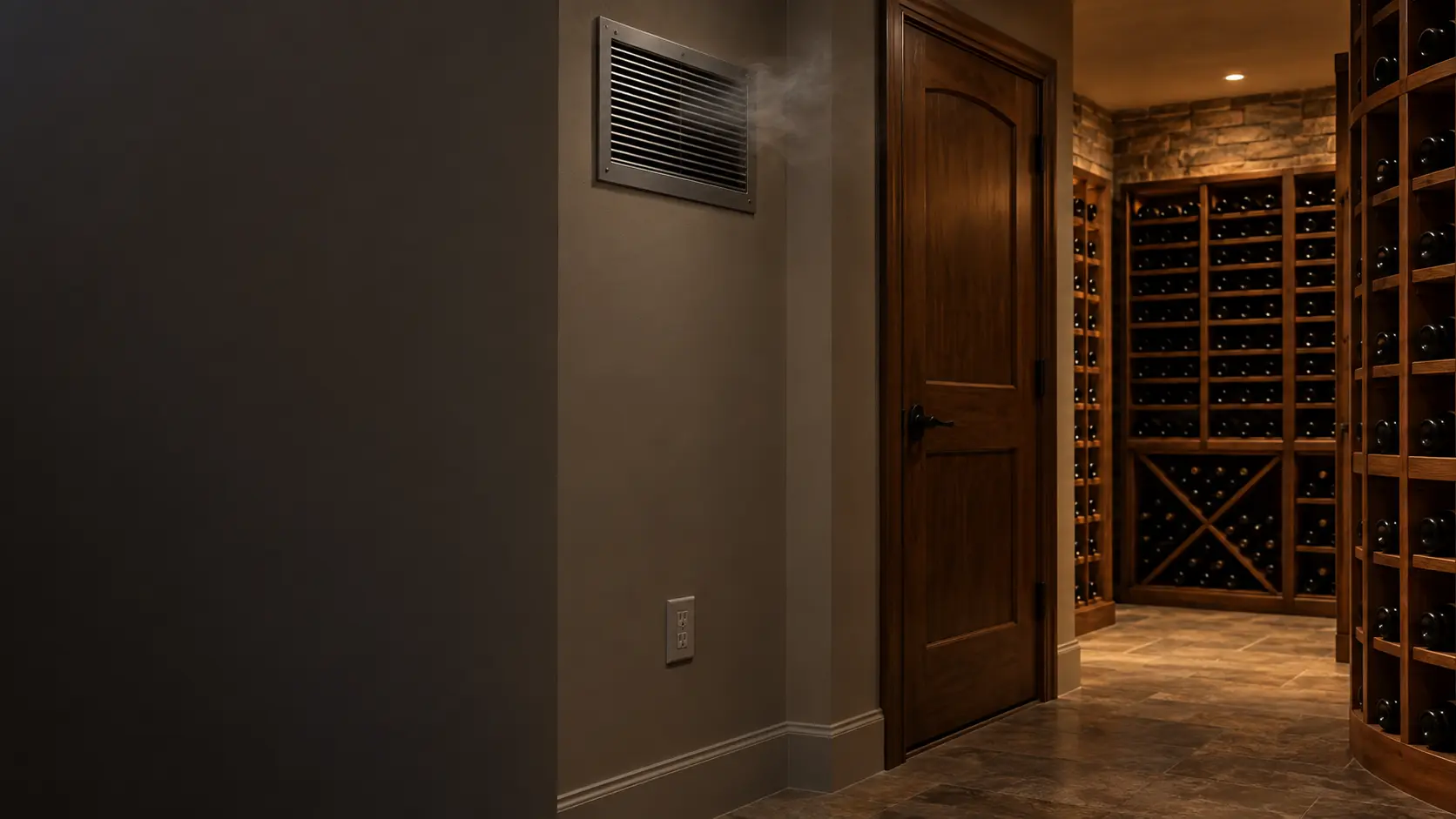
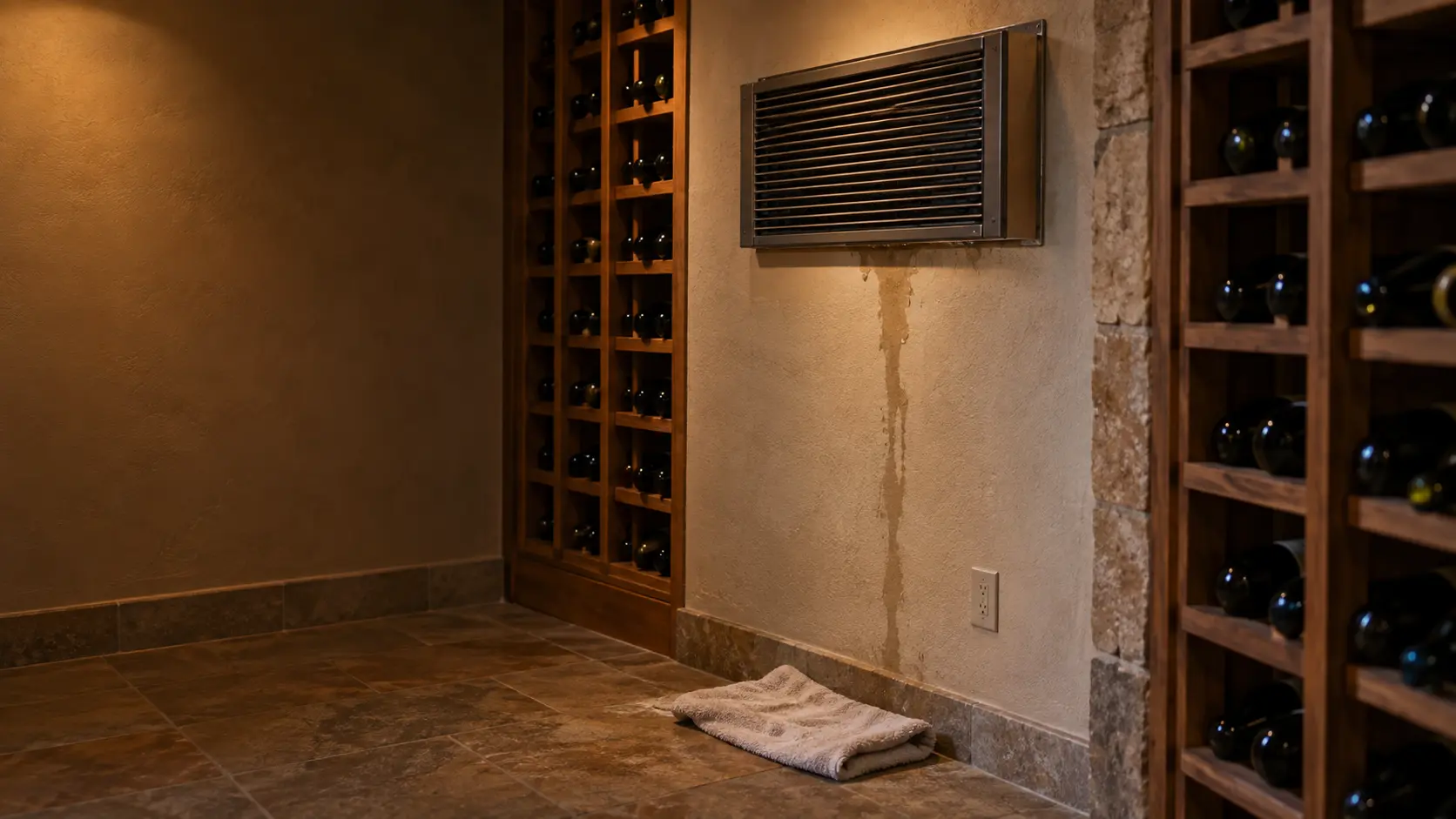
Beads of water running down the wall below a cellar cooling unit onto a stone floor.

Start with the symptom

Wine cellar cooling unit
problems,
symptom first.

Every symptom we are called out for, traced to the causes that actually explain it — cheapest first. Start from what you are seeing rather than from what you think is broken.

(844) 398-5977

Mon–Sat, 8am–8pm

  • 17 symptoms
  • 4 need a visit now
  • Causes in cost order

Book a visit

Three short steps, about a minute.

or call (844) 398-5977

Needs a visit now

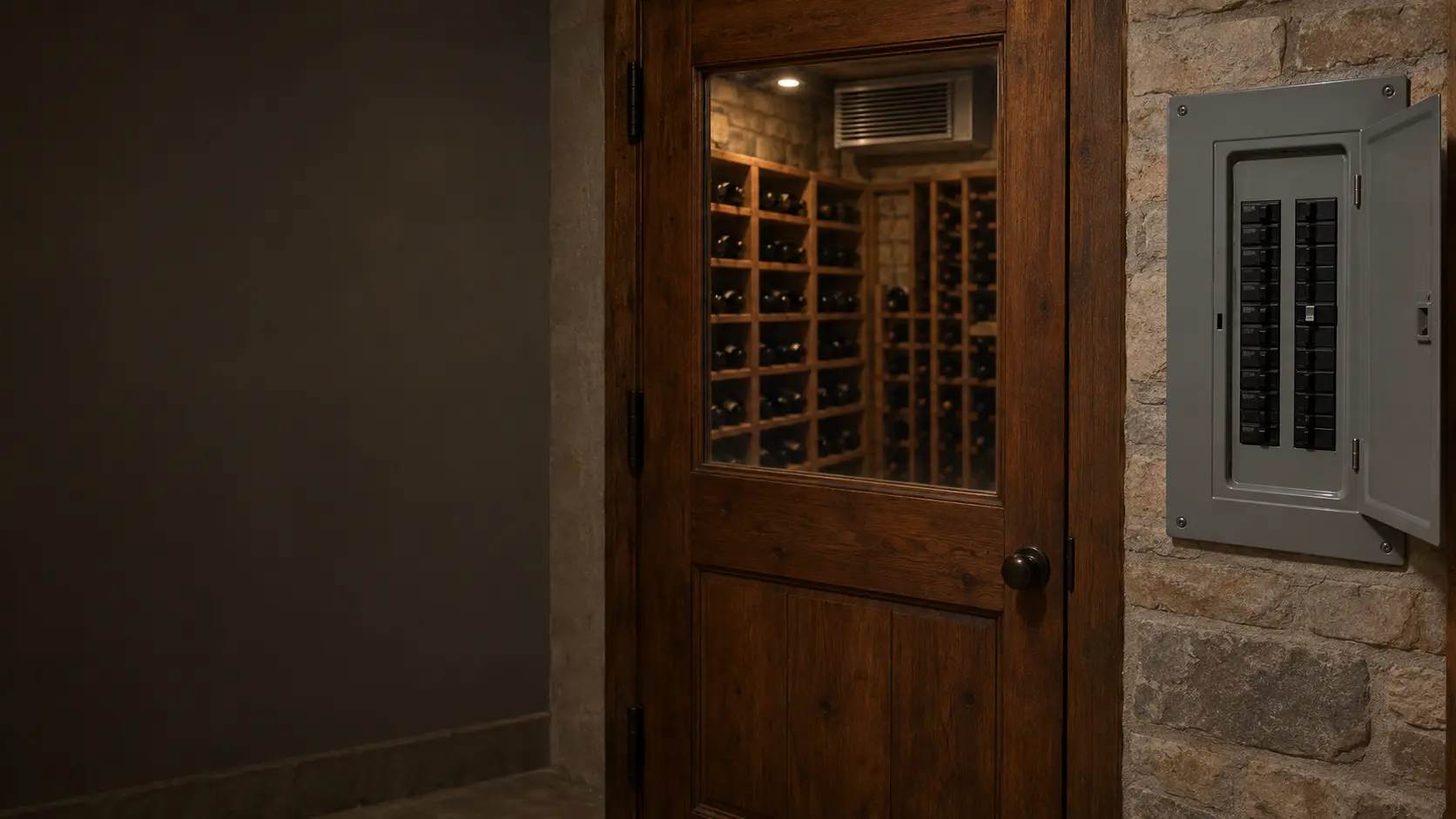
These four sit at the top because a room full of wine, or the house around it, is exposed: a cellar warming with every rack occupied, water from the unit soaking into drywall or pooling near an outlet, a scorched smell at the grille or on the exhaust side, and a unit that trips its breaker again each time it tries to start. Keep the cellar door closed while you read; a well-sealed room full of bottles holds its temperature for many hours, and every trip inside with the door propped open costs some of that. If the room passes about 70°F, or help is more than a day off, take the bottles that matter most to the coolest dark corner of the house and lay them down. Where water has reached an outlet, a power strip or the unit's cord, stay out of it; cut the power only at the breaker panel, and only while standing on a dry floor well away from the leak.

The collection is exposed

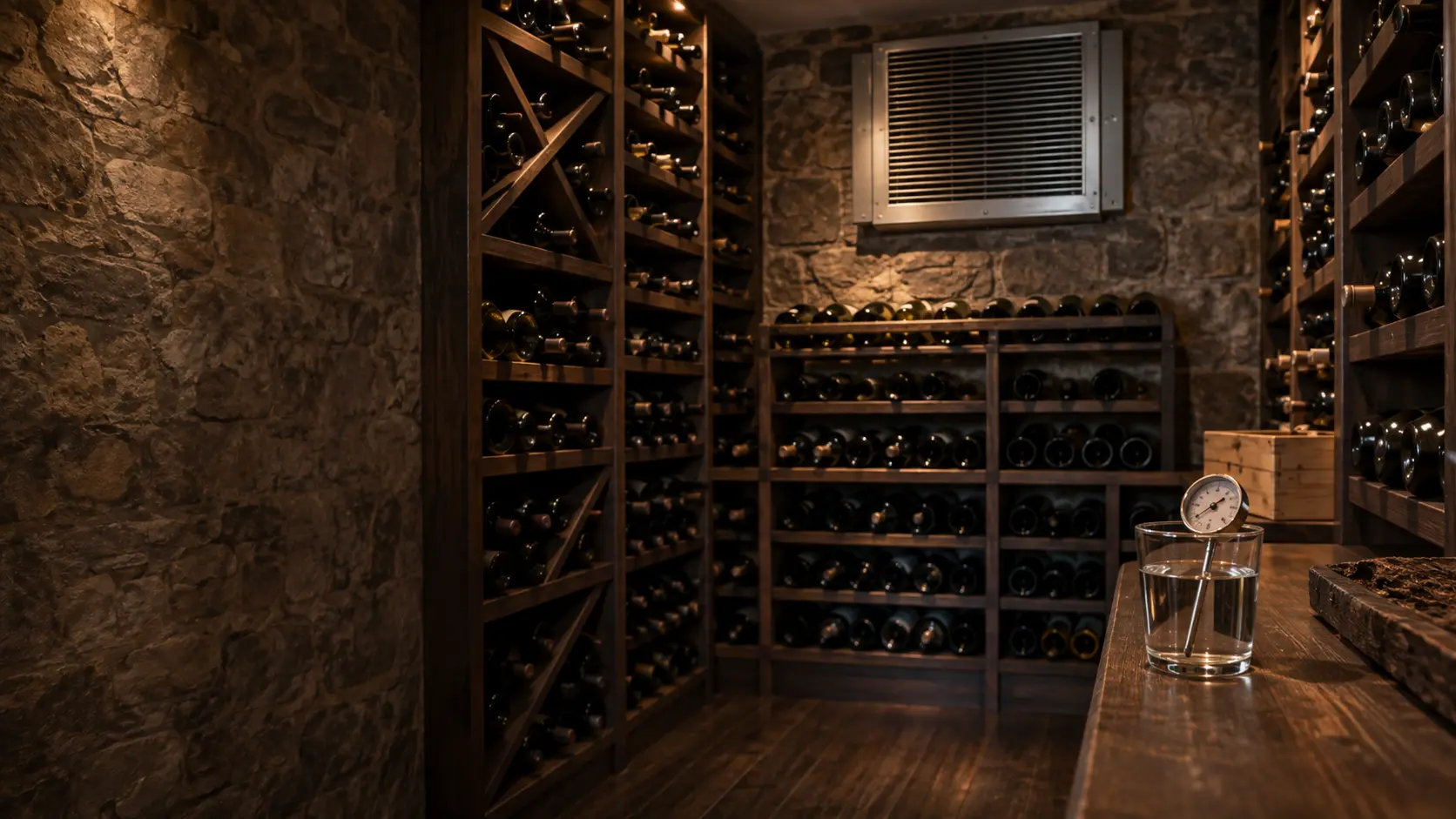
Wine Cellar Too Warm

A wine cellar too warm shows up slowly: the room smells of the house instead of cool stone, a bottle picked from a middle rack feels barely cooler than your hand, and the wall thermometer has crept from the mid 50s into the 60s over a week.

Causes, cheapest first

  1. Exhaust side too hot or boxed inno repair
  2. Room gaining more heat than the unit can removevaries
  3. Evaporator or condenser fan stoppedlow to moderate
All 6 causes and what to check
The collection is exposed

Cellar Cooling Unit Leaking Water

A cellar cooling unit leaking water leaves a dark stain spreading down the wall under the unit, drips landing on the top row of bottles, a wet patch on the floor of the next room, or water where a ceiling unit meets the drywall.

Causes, cheapest first

  1. Condensate tray or outlet cloggedlow
  2. Drain line kinked, disconnected or flatlow to moderate
  3. Condensate pump stoppedlow to moderate
All 6 causes and what to check
The collection is exposed

Burning Smell From a Cellar Cooling Unit

A cellar cooling unit burning smell reaches you as hot plastic or scorched dust at the cellar door or at the exhaust grille next door, sometimes with a buzz, a flicker of the controller or the unit shutting off on its own.

Causes, cheapest first

  1. Fan motor overheatinglow to moderate
  2. Loose or burned wiring connectionlow to moderate
  3. Compressor start components overheatingmoderate
All 5 causes and what to check
The collection is exposed

Cellar Cooling Unit Tripping the Breaker

A cellar cooling unit tripping breaker trouble looks like a silent unit, a warm cellar in the morning, and a breaker or GFCI outlet that has snapped off, sometimes the moment the compressor tries to start.

Causes, cheapest first

  1. Water reaching wiring or the controllerlow to moderate
  2. Compressor drawing too much at startmoderate to highest
  3. Circuit shared with other loadsno repair
All 5 causes and what to check

Everything else we are called out for

In these cases the cellar is still sitting near its setting and the bottles are resting, so an ordinary appointment is the right pace. Each page lists what an owner can look at safely while the unit keeps the room cool.

Cellar Cooling Unit Not Turning On

A cellar cooling unit not turning on stays silent and dark: no fan, no hum from the compressor, no light on the controller, while the cellar thermometer slowly drifts upward.
5 causes

Wine Cellar Too Cold

A wine cellar too cold feels like stepping into a walk-in: the thermometer sits in the 40s, bottles come out beaded with water, and the unit keeps running long after the room should have been satisfied.
4 causes

Wine Cellar Humidity Too Low

Wine cellar humidity too low shows up on a hygrometer reading under 50 %, in capsules that feel papery, in labels curling at the edges, and after years in a faint fill line dropping in the neck of older bottles.
4 causes

Wine Cellar Humidity Too High or Mold

Wine cellar mold starts as a musty smell, then white or green fuzz on the rack posts, spotted labels and dark specks in the corners, usually with a hygrometer reading well above 70 %.
5 causes

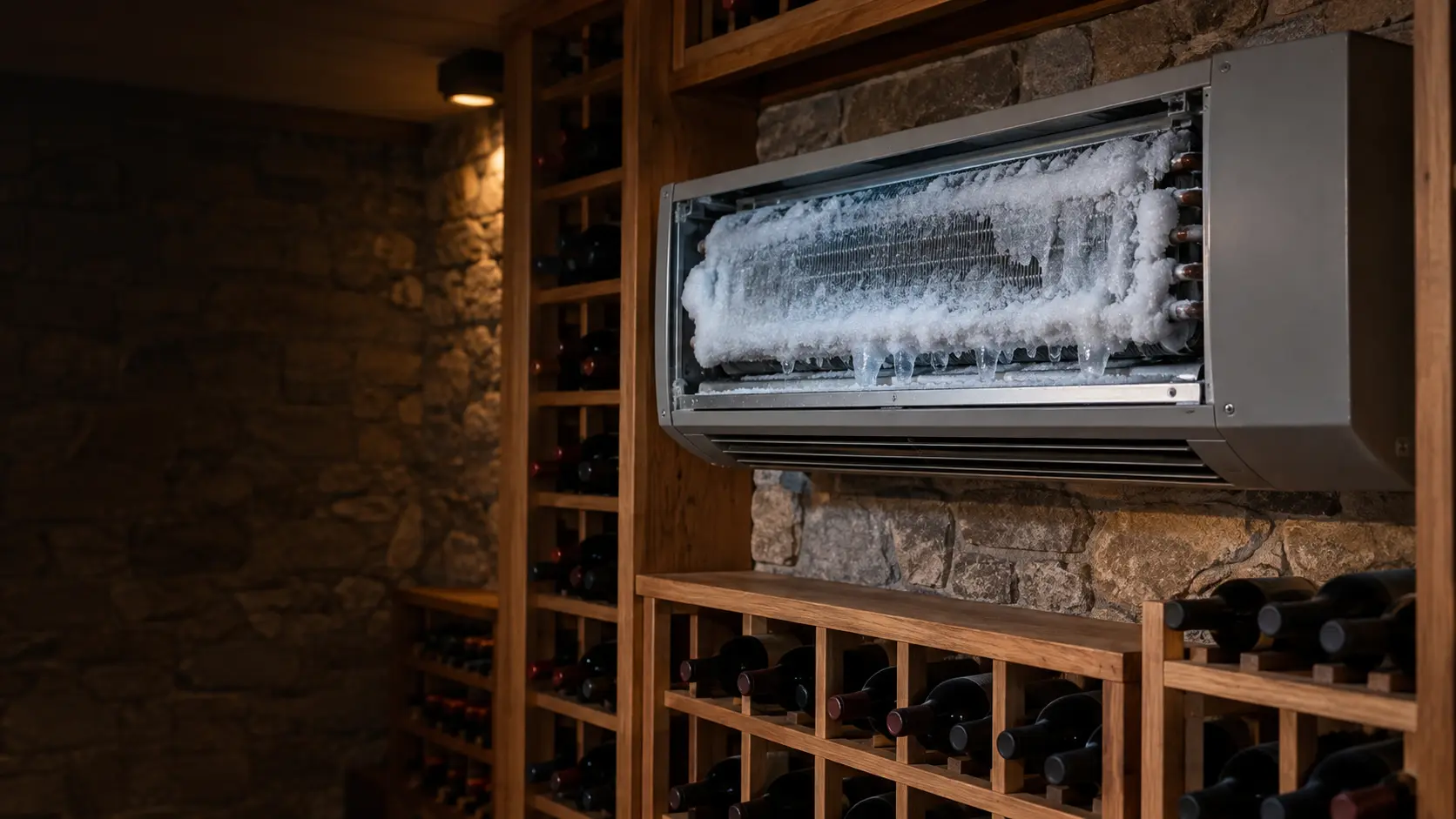
Cellar Cooling Evaporator Coil Icing Up

A cellar cooling coil icing up shows as white frost behind the cellar-side grille, weak air from the unit, water dripping when it goes quiet, and a room that warms while the unit keeps running.
5 causes

Cellar Cooling Unit Running Constantly

A cellar cooling unit running constantly never falls quiet: the compressor hums all day and night, the exhaust side stays warm, and the cellar either barely holds its temperature or drifts slowly upward.
5 causes

Cellar Cooling Unit Short Cycling

A cellar cooling unit short cycling starts, runs for a few minutes and stops, then starts again soon after, so the room temperature bounces and the air feels cold but clammy.
5 causes

Cellar Cooling Unit Loud or Vibrating

A cellar cooling unit loud enough to notice rattles, buzzes or drones through the cellar and the next room, sometimes shaking the bottles in the nearest rack or humming through the wall studs.
5 causes

Condensation on Wine Cellar Walls or Glass

Condensation on wine cellar glass shows as a fog or beads of water on a glass wall or door, streaks running down to the frame, and in a cellar with poor walls, damp patches on the drywall or ceiling.
5 causes

Cellar Cooling Unit Exhaust Overheating

A cellar cooling unit exhaust overheating makes the room on the other side of the wall uncomfortably warm, blows hot air hard enough to feel from across the room, and often makes the unit stop and restart in the afternoon.
5 causes

Cellar Cooling Unit Fan Not Running

A cellar cooling unit fan not running leaves the cellar-side grille still and silent while the compressor hums, or leaves the exhaust side quiet and the unit hot to the touch.
4 causes

Cellar Cooling Controller Display Blank

A cellar cooling controller display blank shows nothing at all, flickers, shows half a number, or ignores its buttons, sometimes while the unit keeps cooling and sometimes while it stops.
4 causes

Cellar Cooling Unit Error Code

A cellar cooling unit error code appears as letters or digits on the controller, a flashing reading, a blinking light on the unit, or an alarm tone, sometimes while the cellar still holds its temperature.
8 causes

Not every wine cellar cooling unit
breaks the same way.

A through-the-wall unit sits in an opening between the cellar and the next room and pushes its heat out the back, a ducted unit lives outside the cellar and sends cool air in through supply and return ducts, a split system hangs an evaporator in the room and puts the condenser outdoors with a line set between them, and a ceiling unit cools from above with its heat carried away overhead. Which of the four keeps your cellar?

All wine cellar cooling unit types

Familiar brands. Expert care.

For the brands
in your cellar.

Independent repair service. Not affiliated with, authorized or endorsed by any manufacturer. Brand names and model numbers are the property of their respective owners and are used here for identification only, to describe the appliances we service.

The repairs behind the symptoms

Most people arrive knowing what they are seeing, not what is wrong. These are the jobs a visit usually turns out to be.

diagnostic

Wine cellar cooling diagnostic visit

A visit that reads the cellar, the room the heat goes to and the cooling unit itself, and ends with one named cause, whether it is a part or the room.

moderate to highest

Cellar compressor and sealed system repair

Getting the heart of the cellar unit pumping again, from the start capacitor, relay and contactor that give out first to a compressor or a sealed-system restriction.

highest

Cellar cooling leak search and recharge

Finding where a cellar unit or a split system is losing its refrigerant, repairing the joint or coil, and charging it by weight rather than topping it off.

low to moderate

Cellar evaporator and condenser fan repair

Restoring the two fans a cellar unit depends on: the one that moves cellar air across the cold coil and the one that throws the heat away.

moderate

Cellar controller and sensor repair

Getting the controller, its display and its probes to read the cellar truthfully and call for cooling at the right time.

low

Cellar condensate drain and pump repair

Clearing and rerouting the line that carries water off the cellar coil, and repairing the condensate pump where the water has to travel uphill.

low to moderate

Cellar coil icing and defrost repair

Stopping ice from forming on the cellar coil by finding what starves it, whether airflow, charge, controls or humid air coming into the room.

moderate to highest

Split-system cellar line set repair

Repairing, reinsulating or rerunning the copper lines and control cable that join the cellar evaporator to its outdoor or remote condensing unit.

low to moderate

Cellar humidity control repair

Bringing a wine cellar back into its humidity window, roughly 50 to 70 percent, by fixing the humidifier, the fan settings, the drain or the room.

lowest

Cellar cooling load and room check

Measuring the cellar as the cooling unit sees it: insulation, vapor barrier, door, glass and the heat load, to show whether the unit can ever keep up.

A couple lifting a bottle from a lit stone-walled wine cellar, the cooling unit's grille high on the far wall
For the heart of your home.

Questions about
the problems.

My cellar is doing something that is not listed. Can I still book?
Yes. The pages here cover the complaints we hear most; anything else books the same way. A sentence in the notes about the sound, the smell, the reading on the controller or where the water shows up gives the technician a place to start.
Damp walls and a warm cellar at the same time: where do I start?
Start with the one you noticed first. In a cellar, moisture on the walls or behind the racks often points to a gap in the vapor barrier or a door that lets house air in, and that same leak loads the unit until the room cannot stay cool. Each page links to the problems that tend to travel with it.
Which cellar problems need a technician today?
A room climbing toward 70°F with the racks full, water from the unit running into a wall or across the floor near an outlet, a burning smell, and a breaker that will not stay on. Each problem page says how urgent it is; a noisy fan while the room holds its setting, or a little dew on a cold pipe, can wait for the booked day.
Did the wine suffer if the cellar ran warm for a few days?
A slow climb of a few degrees that comes back down rarely does lasting harm; wine minds big swings and real heat far more than a short spell above 55°F. Look for corks that have pushed up or wine weeping around the capsule, which means the bottle got warm enough to expand. Keep the door closed while the unit recovers, and open any doubtful bottles sooner rather than later.

Back to your everyday

Let’s get your wine cellar cooling unit working again.

Three short steps online, or one call. Tell us what you are seeing and pick a window that works.

(844) 398-5977 Schedule a repair