

Cellar Cooling Load and Room Check
Measuring the cellar as the cooling unit sees it: insulation, vapor barrier, door, glass and the heat load, to show whether the unit can ever keep up.
Mon–Sat, 8am–8pm
- Lowest cost band
- 5 steps on the visit
- 6 problems it answers
Book a visit
Three short steps, about a minute.
or call (844) 398-5977
Loading appointment form…
The appointment form couldn’t load. Please try again.
What the cellar cooling load and room check
involves.
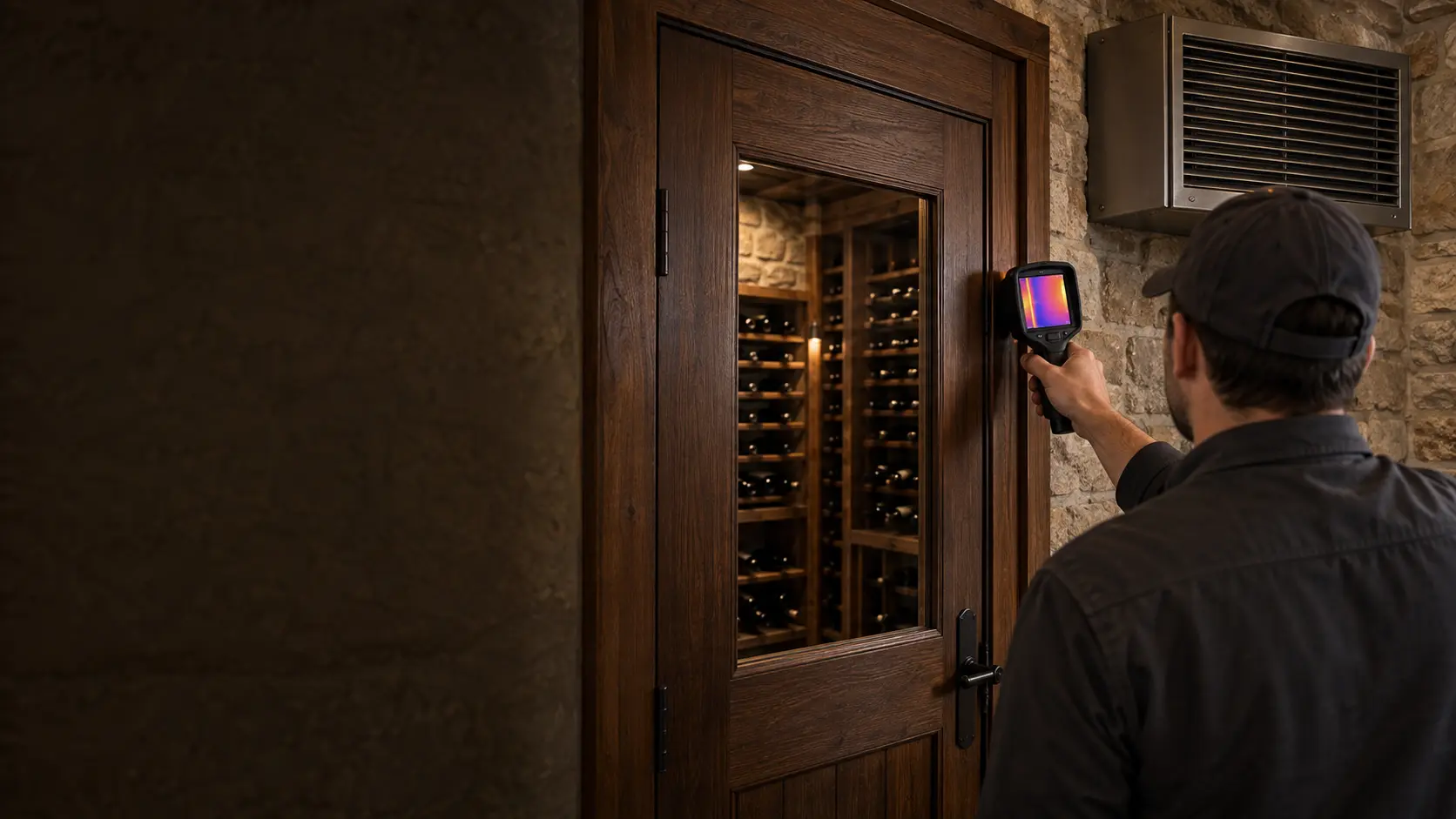
A cooling unit rated for a room of a certain size assumes that room is built like a cellar: insulated walls and ceiling, a continuous vapor barrier on the warm side, an exterior-grade door with a seal and a sweep, and little glass. Many cellars fall short of that. A room framed in a basement corner with bare drywall, a display wall of glass facing a warm living room, recessed lights that open into the ceiling or a door with daylight under it all add heat and moisture the unit has to remove. When the load is larger than the unit's capacity, no repair makes the cellar hold 55°F on a hot day. This visit measures the room and what surrounds it, uses a thermal camera to find cold walls and warm gaps, checks the door seal and threshold, counts the glass and lights, and estimates the heat load against the unit's rating at the conditions it actually works in. You leave with a list of what adds the most heat, which fixes are small, such as a door sweep, a sealed light or a moved exhaust, and whether the unit is the right size for the room.
How the visit goesWhat it usually costsLowest · Cooling load and room survey
The survey itself is a measured visit with a thermal camera and a written list. Any insulation, vapor barrier or door work it points to is done by the right trade and priced separately.
Answers 6 problemsWine Cellar Too Warm
Cellar Cooling Unit Running Constantly · Condensation on Wine Cellar Walls or Glass · Wine Cellar Humidity Too High or Mold · Cellar Cooling Unit Exhaust Overheating · Wine Cellar Humidity Too Low
Comes up most onThrough-the-wall cellar cooling unit
Ducted cellar cooling unit · Split-system cellar cooling · Ceiling-mounted cellar cooling
Codes that lead hereE1 · AL · OH · AH1
Breezaire E1: the unit stopped after a slow first cool-down.
Cellar cooling load and room check,
step by step.
Give you a list of what adds the most heat, which fixes are simple, and whether the unit matches the room.
Measure the cellar, note the walls and ceiling that face warm space, the glass, the lights and the door.
Scan walls, ceiling and door with a thermal camera to find missing insulation and air leaks.
Check the door seal, the sweep, the gaps around the unit and any penetrations for pipes, wires or lights.
Estimate the heat load against the unit's rated capacity at the temperatures it actually works in.
Give you a list of what adds the most heat, which fixes are simple, and whether the unit matches the room.
The problems
it answers.
6 of them, from wine cellar too warm to wine cellar humidity too low.
All problems
Wine Cellar Too Warm
6 causes, cheapest first
Before you call
Tell us this when you book
- The cellar's rough size and how many walls face warm rooms, the outdoors or glass
- Whether the room was built as a cellar, with insulation and a vapor barrier, or converted later
- The door type and whether light or air comes in around it
- The unit's model and when it was installed
It also answers
Lowest,
on the site's scale.
The survey itself is a measured visit with a thermal camera and a written list. Any insulation, vapor barrier or door work it points to is done by the right trade and priced separately.
Read the full cost guideWhere it
comes up most.
Most bookings: Through-the-wall cellar cooling unit, Ducted cellar cooling unit, Split-system cellar cooling, Ceiling-mounted cellar cooling.
All wine cellar cooling unit typesCodes that lead here
E1Breezaire · Temperature and alarmsAH1CellarCool · Temperature and alarmsHACellarPro · Temperature and alarmsALKoolR · Temperature and alarms
Often the same visit


The makes
we see it on.
7 makes on this site, and the cellar cooling load and room check on any of them. Each mark opens that make's own page.
All 7 brandsCellar cooling load and room check,
where we come out.
The cellar, the climate and the building all change how the cellar cooling load and room check goes. These notes are about that, metro by metro.
All service areasTampa BayFL · 31 areas
Many Tampa Bay cellars are glass-fronted rooms carved out of a living area, and the load check adds up the glass, the exterior walls and the house temperature on the far side, showing whether the unit was sized for a room that now runs hotter than planned.
OrlandoFL · 30 areas
An Orlando wine room built on a slab with a west wall in the afternoon sun carries far more heat than its size suggests, and the room check measures wall and glass temperatures and the unit's output to show whether a larger unit or better insulation is the answer.
Miami / South FloridaFL · 47 areas
In a South Florida tower the cellar's biggest heat load is often a wall of glass or exhaust air with nowhere to go, and the room check measures both before any unit is replaced, since a larger unit in the same closet only makes that closet hotter.
New York MetroNY · 75 areas
A New York brownstone cellar sits partly below grade and stays cool, while a wine room in a high-floor apartment takes sun and heat on every side, and the load check tells the owner which kind of room they have and what cooling it really needs.
HoustonTX · 36 areas
Houston cellars built against an exterior wall take in heat through the brick all afternoon, and the room check looks at insulation depth, the vapor barrier and the door seal, the three things that decide whether the unit can keep up in August.
ChicagoIL · 50 areas
A Chicagoland basement cellar gains little heat through its walls, so one that cannot hold 55 often leaks air through the door or a ceiling open to the house above, and the room check finds that gap before a larger unit is ever suggested.
Los AngelesCA · 95 areas
Los Angeles glass-walled cellars look striking, but single-pane glass or a door without a threshold seal can double the load, and the room check measures the heat each surface brings in so the owner can weigh sealing against a bigger unit.
San DiegoCA · 31 areas
San Diego cellars near the coast were often sized for mild air, and when a remodel moved the exhaust into a hotter space or added glass, the room check recalculates the load to show whether the unit still fits the room.
San Francisco Bay AreaCA · 74 areas
Bay Area cellars sit anywhere from cool fog-belt basements to hot inland valleys around Walnut Creek and Livermore, and the load check measures what each wall and ceiling brings in, since the same unit can be ample in one town and short in the next.

Questions about
the cellar cooling load and room check.
How do I know if my cellar unit is too small?
Does a glass wall make a wine cellar harder to cool?
What is a vapor barrier, and why does a cellar need one?
Back to your everyday
Ready to book the cellar cooling load and room check?
Have these to hand: the cellar's rough size and how many walls face warm rooms, the outdoors or glass, whether the room was built as a cellar, with insulation and a vapor barrier, or converted later, the door type and whether light or air comes in around it, the unit's model and when it was installed.