


Cellar Cooling Unit Exhaust Overheating
A cellar cooling unit exhaust overheating makes the room on the other side of the wall uncomfortably warm, blows hot air hard enough to feel from across the room, and often makes the unit stop and restart in the afternoon.
Mon–Sat, 8am–8pm
- 5 checks before you book
- 5 questions that narrow it
- 5 causes, cheapest first
Book a visit
Three short steps, about a minute.
or call (844) 398-5977
Loading appointment form…
The appointment form couldn’t load. Please try again.
What it
usually means.
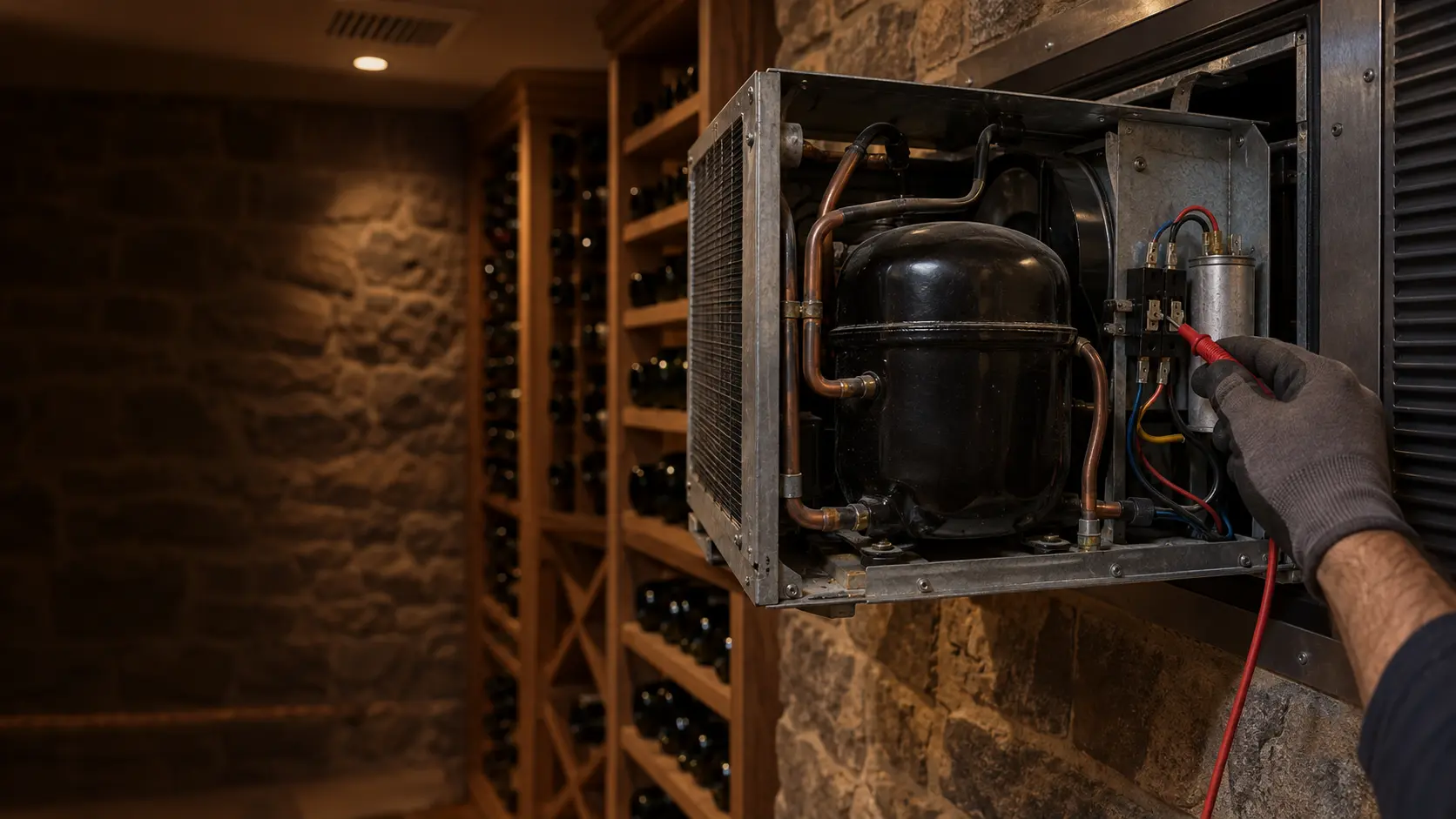
Every bit of heat the unit takes out of the cellar, plus the heat of its own motor, leaves by the exhaust side. A through-the-wall unit blows it into the next room, a ducted unit sends it down a duct, and a split system dumps it at an outdoor condenser. Makers set limits for that space: it should be at least as large as the cellar, open or well ventilated, and not much hotter than the high 80s. When the exhaust goes into a closet, a small mechanical room or a garage that bakes in summer, the unit breathes its own hot air back in, pressures climb, and it cools less while working harder. A dirty condenser coil or a slow hot-side fan causes the same heat at the source. Overheating is where many compressor failures begin, so it is worth fixing before it turns into a warm cellar.
 The 5 causes, cheapest first
Answer these first
What is in the room or space the exhaust blows into, and how big is it?
Is that space closed off, with a door that stays shut?
How warm does it get there on a summer afternoon?
Is the hot-side coil visibly dusty, and does the hot-side fan turn?
Does the unit stop and restart on its own during hot hours?
Check these
before you book.
Cellar cooling unit exhaust overheating: 5 checks, and none of them costs anything.
Open the door of the exhaust space, or prop it, and see whether the unit settles.
Clear boxes, coats or furniture away from the hot-side grille.
Check whether the hot-side fan turns while the unit runs.
Also worth checking
- On a split system, clear plants and debris from around the outdoor condenser.
- Tell us the make, the model number and what the exhaust space is.
How soon does it need a visit?
Not urgent while the cellar holds its temperature, but a unit overheating every afternoon is shortening its compressor's life. Book within a week or two.
The causes,
cheapest first.
5 things cellar cooling unit exhaust overheating turns out to be, from hot-side coil clogged to exhaust into a closed or small space.
The cost guide-
01 low
Hot-side coil clogged
Dust and pet hair on the condenser coil trap heat inside the unit. Cleaning it is routine maintenance and often lowers the exhaust temperature noticeably.
-
02 low to moderate
Hot-side fan slow or stopped
Without its fan the condenser cannot shed heat, and the unit trips on overload.
-
03 low to moderate
Exhaust duct crushed or too long
On a ducted unit, a flexible duct that is kinked, crushed or longer than the maker allows restricts the hot air and backs heat into the unit.
-
04 low
Outdoor condenser in sun or blocked
On a split system, a condenser crowded by plants, fences or debris, or sitting in full afternoon sun, runs hot and loses capacity.
-
05 varies
Exhaust into a closed or small space
A closet or small room fills with the unit's heat in an hour. The answer can be a louvered door, a vent, a duct to a larger space or relocating the exhaust, which a room check will lay out.
-
What it costs
Every repair on the site's cost scale, side by side
Open the cost guide
What else
it could be.
Most often confused with wine cellar too warm, then cellar cooling unit running constantly.
All problems


The makes
it happens on.
7 makes on this site; cellar cooling unit exhaust overheating can show up on any of them. Each mark opens that make's own page.
All 7 brandsCellar Cooling Unit Exhaust Overheating,
where we come out.
9 metros, each with its own page.
All service areasTampa BayFL · 31 areas
Miami / South FloridaFL · 47 areas
New York MetroNY · 75 areas
HoustonTX · 36 areas
ChicagoIL · 50 areas
Los AngelesCA · 95 areas
San DiegoCA · 31 areas

Questions about
cellar cooling unit exhaust overheating.
Can a through-the-wall cellar unit exhaust into a closet?
How hot can the exhaust side get before it matters?
Is it normal for the room next to the cellar to be warm?
Could we duct the exhaust somewhere else?
Back to your everyday
Still seeing cellar cooling unit exhaust overheating?
Book with what you checked above — 5 answers save the technician the first part of the visit.