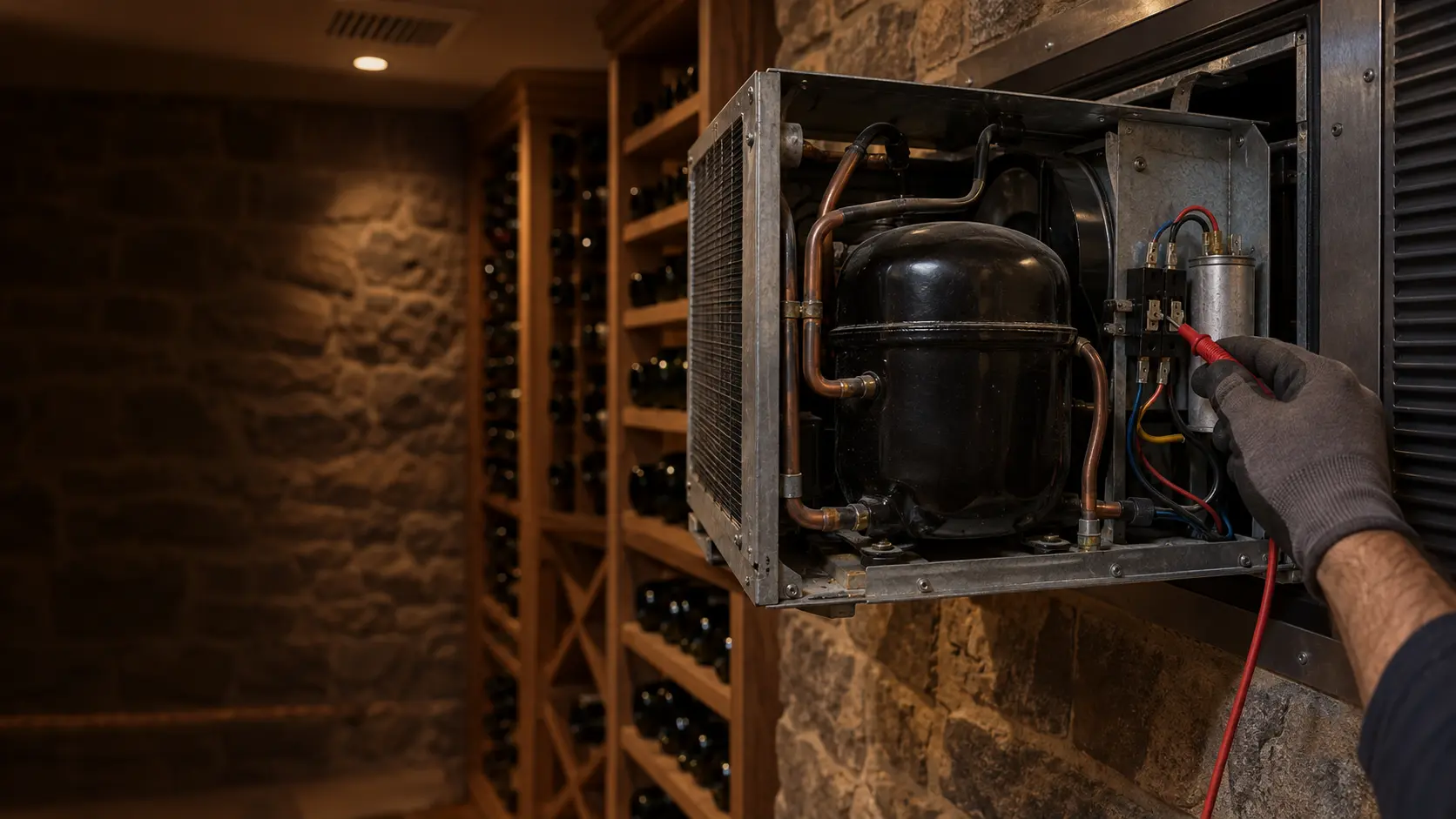


Cellar Compressor and Sealed System Repair
Getting the heart of the cellar unit pumping again, from the start capacitor, relay and contactor that give out first to a compressor or a sealed-system restriction.
Mon–Sat, 8am–8pm
- Moderate to highest cost band
- 5 steps on the visit
- 6 problems it answers
Book a visit
Three short steps, about a minute.
or call (844) 398-5977
Loading appointment form…
The appointment form couldn’t load. Please try again.
What the cellar compressor and sealed system repair
involves.
Every cellar cooling unit, whatever its layout, relies on a compressor to move refrigerant through a closed loop: cold at the coil in the cellar, hot at the condenser where the heat is thrown away. Cellar compressors run long, steady cycles against a small temperature difference, and they are often housed somewhere hot, which wears out the parts that help them start. So the first things measured are the start capacitor, the relay or contactor and the overload, along with the voltage at the unit while it tries to start. A weak capacitor or pitted contactor points look like a dead compressor and cost a fraction of one. When those pass, the compressor's windings and running current are read, the condenser is checked for the dirt or trapped heat that pushes pressures up, and the temperatures on the lines show whether refrigerant is moving. A restricted drier or capillary, or a compressor that no longer pumps, is sealed-system work: brazing, a new drier, a deep vacuum and a charge weighed to the maker's figure. Before that is booked you hear what the unit's age and the collection it protects make sensible.
How the visit goesWhat it usually costsModerate to highest · Start capacitor, contactor, compressor or sealed-system restriction
A capacitor, relay or contactor is a small part reached once the unit's panel is off. A new compressor, or clearing a restriction with brazing, a drier, a vacuum and a weighed charge, sits near the top of the scale, and more so when the unit must come out of a wall or a ceiling.
Answers 6 problemsWine Cellar Too Warm
Cellar Cooling Unit Running Constantly · Cellar Cooling Unit Short Cycling · Cellar Cooling Unit Tripping the Breaker · Cellar Cooling Unit Loud or Vibrating · Cellar Cooling Unit Exhaust Overheating
Comes up most onThrough-the-wall cellar cooling unit
Ducted cellar cooling unit · Split-system cellar cooling · Ceiling-mounted cellar cooling
Codes that lead here!1
Wine Guardian !1: the high-pressure switch has stopped the system.
Cellar compressor and sealed system repair,
step by step.
Watch the cellar begin to pull down, and explain what failed, how the unit sounds now and what keeps it from failing again.
Listen to the start attempt, feel the lines and the condenser, and read the temperature of the space where the unit exhausts.
Test the capacitor, the relay or contactor and the overload, and measure the voltage while the compressor tries to start.
Read the compressor windings, its current draw and the line temperatures, and look for oil at joints or signs of a restriction.
Replace the start parts, or open the sealed system to change the compressor or clear the restriction, then fit a drier, pull a vacuum and weigh in the charge.
Watch the cellar begin to pull down, and explain what failed, how the unit sounds now and what keeps it from failing again.
The problems
it answers.
6 of them, from wine cellar too warm to cellar cooling unit exhaust overheating.
All problems
Wine Cellar Too Warm
6 causes, cheapest first
Before you call
Tell us this when you book
- Whether the unit clicks and stops, hums without cooling, or runs its fans with no compressor sound at all
- How hot the room behind or above the unit gets, especially in the afternoon
- Whether a breaker or the unit's own reset has tripped, and how many times
- How old the unit is, from the install paperwork or the serial tag
It also answers
Moderate to highest,
on the site's scale.
A capacitor, relay or contactor is a small part reached once the unit's panel is off. A new compressor, or clearing a restriction with brazing, a drier, a vacuum and a weighed charge, sits near the top of the scale, and more so when the unit must come out of a wall or a ceiling.
Read the full cost guide| Repair | Relative cost |
|---|---|
| Start capacitor, contactor, compressor or sealed-system restriction | moderate to highest |
| Leak search, joint or coil repair and a weighed charge | |
| Evaporator or condenser fan motor, blade or capacitor | |
| Air or coil probe, display, transformer or control board | |
| Drain line, drain pan or condensate pump | |
| Thawing an iced coil and correcting its cause | |
| Line set section, insulation or control cable | |
| Humidifier module, humidity probe or settings | |
| Cooling load and room survey |
Where it
comes up most.
Most bookings: Through-the-wall cellar cooling unit, Ducted cellar cooling unit, Split-system cellar cooling, Ceiling-mounted cellar cooling.
All wine cellar cooling unit types


The makes
we see it on.
7 makes on this site, and the cellar compressor and sealed system repair on any of them. Each mark opens that make's own page.
All 7 brandsCellar compressor and sealed system repair,
where we come out.
The cellar, the climate and the building all change how the cellar compressor and sealed system repair goes. These notes are about that, metro by metro.
All service areasTampa BayFL · 31 areas
A through-the-wall unit in a Tampa Bay closet cellar may push its heat into a garage that passes 100 degrees in August, beyond what most units are rated to breathe, and years of that wear the compressor, so the repair tests start parts, windings and pressures before the compressor itself is judged.
OrlandoFL · 30 areas
In an Orlando rental with a wine room, guests who set the controller as low as it goes keep the compressor running around the clock, and the repair measures its amperage and head pressure to learn whether those seasons left it worn out or only overheated.
Miami / South FloridaFL · 47 areas
A South Florida split condenser on a balcony or a roof meets salt air that eats its coil fins, and the compressor pays for it with high head pressure, so the repair restores or replaces the coil before it condemns a compressor that was only fighting a blocked heat exchanger.
New York MetroNY · 75 areas
The compressor for a New York cellar may sit on a brownstone's back deck or a tower roof floors away from the room, and replacing it takes building approvals and an elevator slot, so the repair first proves the compressor is gone and not a capacitor or a contactor.
HoustonTX · 36 areas
When Hurricane Beryl cut power across Houston for days in 2024, cellars warmed and units restarted all at once on unsteady power, and the compressor repair looks for the hard start or the open winding that a brownout restart can leave behind.
ChicagoIL · 50 areas
A split system's outdoor condenser in Chicagoland faces winter nights below zero, and one without a low-ambient kit struggles to start or runs with its pressures too low, so the repair checks the crankcase heater and the head-pressure control along with the compressor.
Los AngelesCA · 95 areas
In a Los Angeles hillside house the cellar unit's compressor may run through a hundred-degree September afternoon with its exhaust in a hot mechanical room, and the repair reads amperage and discharge temperature to show whether the compressor is failing or its surroundings are simply too hot.
San DiegoCA · 31 areas
The mild San Diego coast lets a cellar unit idle for long stretches, so a compressor that sat through a cool season and then met a Santa Ana heat wave may hum without starting, and the repair tests the start capacitor and relay before the compressor itself is blamed.
San Francisco Bay AreaCA · 74 areas
Utility shutoffs on red-flag days leave Bay Area cellars without cooling for a day or more, and after power returns the repair checks whether the compressor restarted cleanly or now trips on overload from pulling a warmed room back down to 55.

Questions about
the cellar compressor and sealed system repair.
My cellar unit clicks every few minutes but never cools. Is the compressor gone?
Why do cellar compressors fail in summer?
Is it worth replacing the compressor on an older cellar unit?
Back to your everyday
Ready to book the cellar compressor and sealed system repair?
Have these to hand: whether the unit clicks and stops, hums without cooling, or runs its fans with no compressor sound at all, how hot the room behind or above the unit gets, especially in the afternoon, whether a breaker or the unit's own reset has tripped, and how many times, how old the unit is, from the install paperwork or the serial tag.