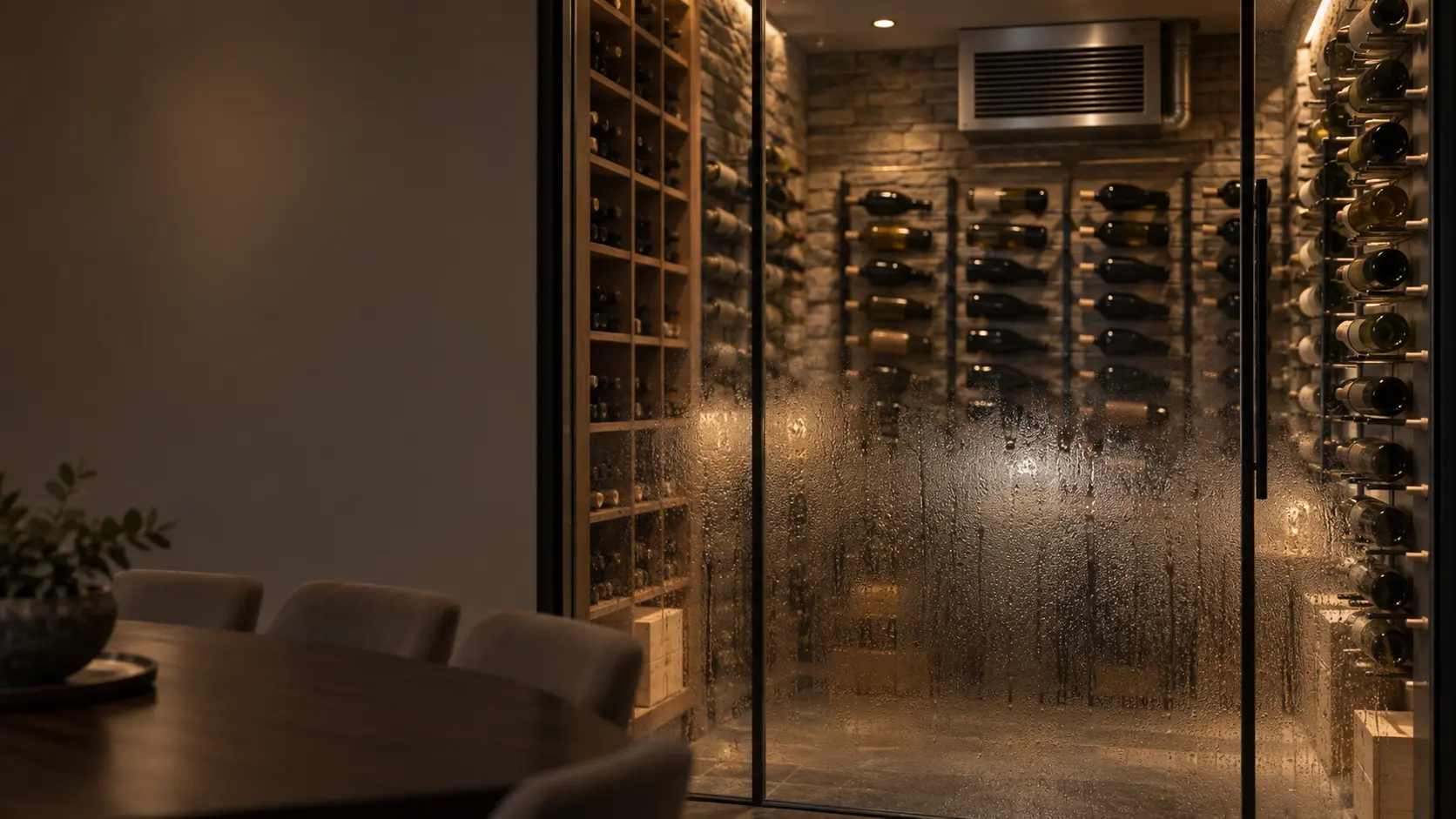


Condensation on Wine Cellar Walls or Glass
Condensation on wine cellar glass shows as a fog or beads of water on a glass wall or door, streaks running down to the frame, and in a cellar with poor walls, damp patches on the drywall or ceiling.
Mon–Sat, 8am–8pm
- 5 checks before you book
- 5 questions that narrow it
- 5 causes, cheapest first
Book a visit
Three short steps, about a minute.
or call (844) 398-5977
Loading appointment form…
The appointment form couldn’t load. Please try again.
What it
usually means.
Water appears on any surface that is colder than the dew point of the air touching it. In a cellar at 55°F, the cold side is inside, and the warm, often humid, house or outdoor air is on the other side of the glass or wall. Single glazing, a frameless glass wall, or a glass door without an insulated unit can drop below the house air's dew point on a humid day, and the water beads on the house side; on the cellar side, high humidity inside can wet the glass as well. On walls and ceilings, damp patches mean moisture is moving into the cellar through the construction and meeting cold surfaces, which is a vapor barrier problem rather than a unit problem. The cooling unit is involved when it runs the room colder than needed, or when its supply air blows straight at the glass and chills it.
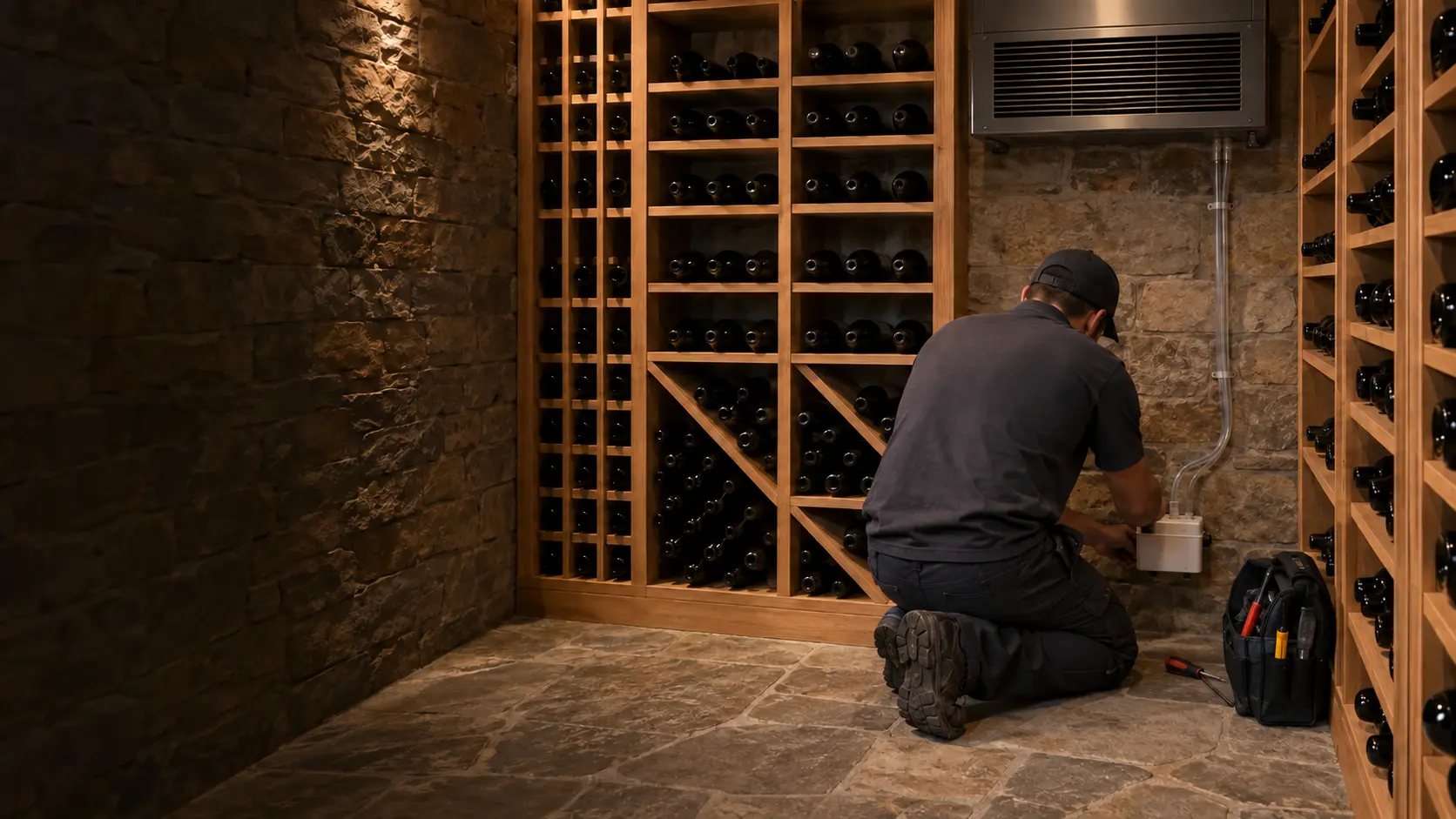 The 5 causes, cheapest first
Answer these first
Is the water on the house side of the glass, the cellar side, or both?
Is the glass single pane, double pane, or a frameless wall?
Does the unit's supply air blow across the glass?
Are there damp patches on walls or the ceiling, and are they near outlets, lights or corners?
Is it worse on humid summer days, or in winter when the house is heated?
Check these
before you book.
Condensation on wine cellar glass: 5 checks, and none of them costs anything.
Wipe the glass and note which side the water returns on first.
Check whether the unit's supply air reaches the glass.
Read the humidity inside the cellar and, if you can, in the room outside it.
Also worth checking
- Photograph any damp patches on walls and ceilings, with their position.
- Tell us how the glass is built, and the make and model of the unit.
How soon does it need a visit?
Not urgent, but water running onto a wooden floor or into a wall needs attention within a week or two.
The causes,
cheapest first.
5 things condensation on wine cellar walls or glass turns out to be, from cellar set colder than needed to gap in the vapor barrier.
The cost guide-
01 no repair
Cellar set colder than needed
Every degree below 55°F makes the glass colder. Setting the room back to the mid 50s may be enough on its own.
-
02 low
Supply air blowing on the glass
A grille or evaporator aimed at the glass chills it well below the room. Redirecting the air, or a deflector, often stops the fog.
-
03 low to moderate
High humidity inside the cellar
When the cellar air itself is too humid, water beads on the inside of the glass as well.
-
04 varies
Glass with too little insulation for the room
Single glazing or a glass door without an insulated unit cannot keep its house side above the dew point on a humid day. A room check shows whether better glass, air movement on the house side or a warmer setting will solve it.
-
05 varies
Gap in the vapor barrier
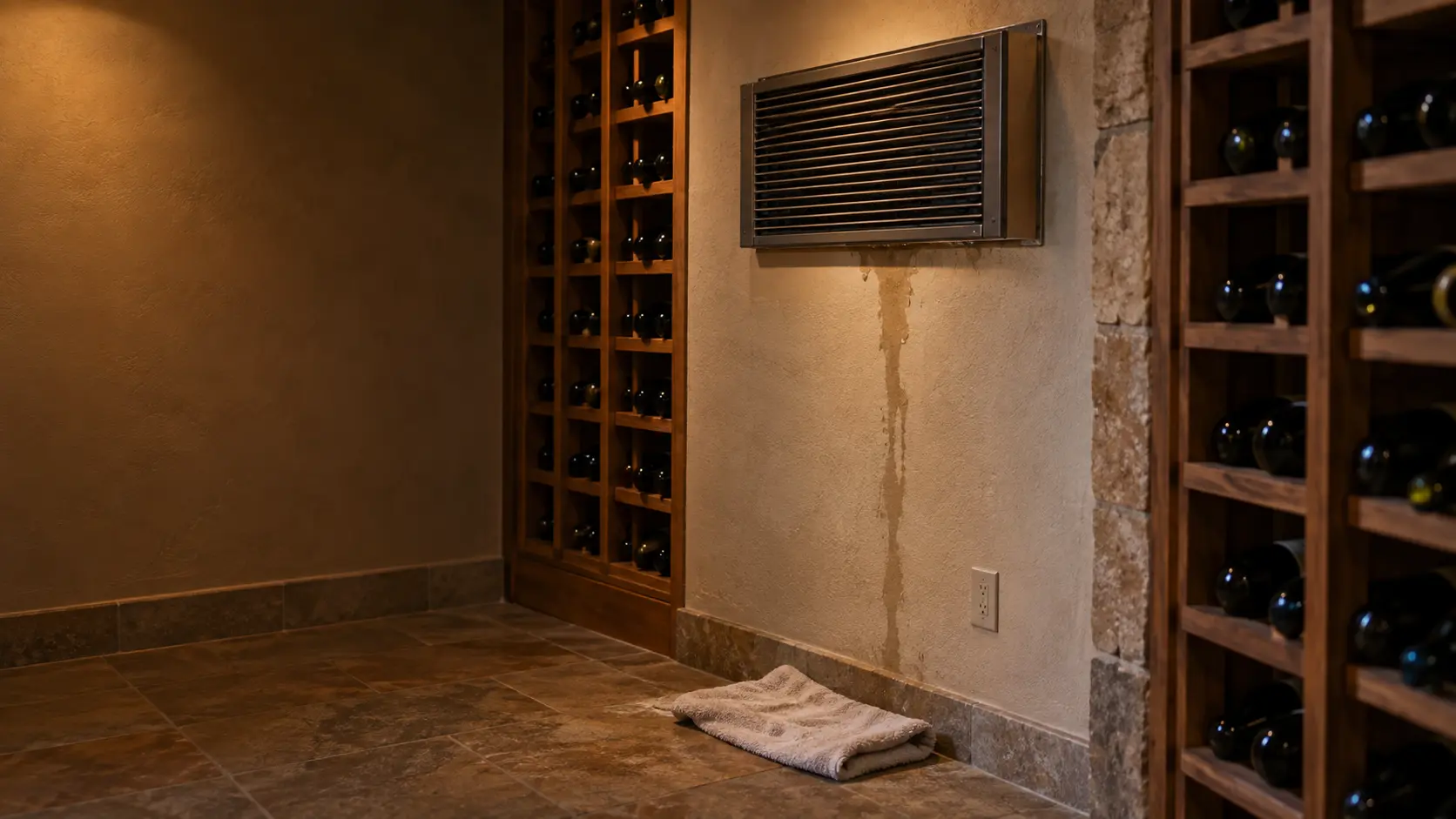
Damp patches on walls or ceiling show where humid air is getting into the construction and condensing on its way to the cold room.
-
What it costs
Every repair on the site's cost scale, side by side
Open the cost guide
What else
it could be.
Most often confused with wine cellar humidity too high or mold, then wine cellar too cold.
All problems
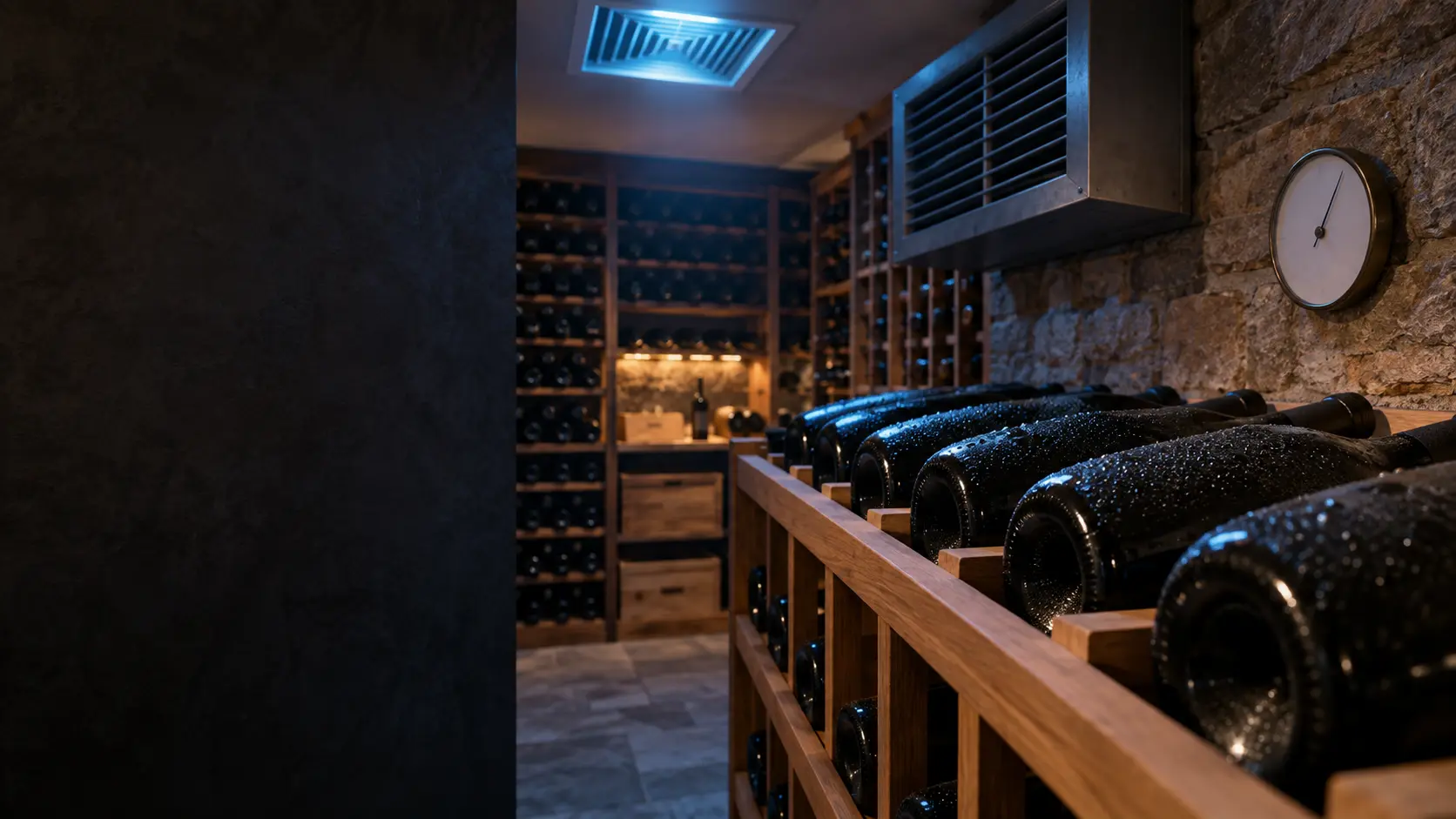
The makes
it happens on.
7 makes on this site; condensation on wine cellar walls or glass can show up on any of them. Each mark opens that make's own page.
All 7 brandsCondensation on Wine Cellar Walls or Glass,
where we come out.
9 metros, each with its own page.
All service areasTampa BayFL · 31 areas
Miami / South FloridaFL · 47 areas
New York MetroNY · 75 areas
HoustonTX · 36 areas
ChicagoIL · 50 areas
Los AngelesCA · 95 areas
San DiegoCA · 31 areas

Questions about
condensation on wine cellar walls or glass.
Why does my glass wine cellar wall fog up in summer?
Is condensation on the cellar walls a sign of a bad cooling unit?
Will a larger cooling unit fix foggy glass?
Can condensation damage the floor under a glass cellar wall?
Back to your everyday
Still seeing condensation on wine cellar walls or glass?
Book with what you checked above — 5 answers save the technician the first part of the visit.