
First settle whether the unit cools at all
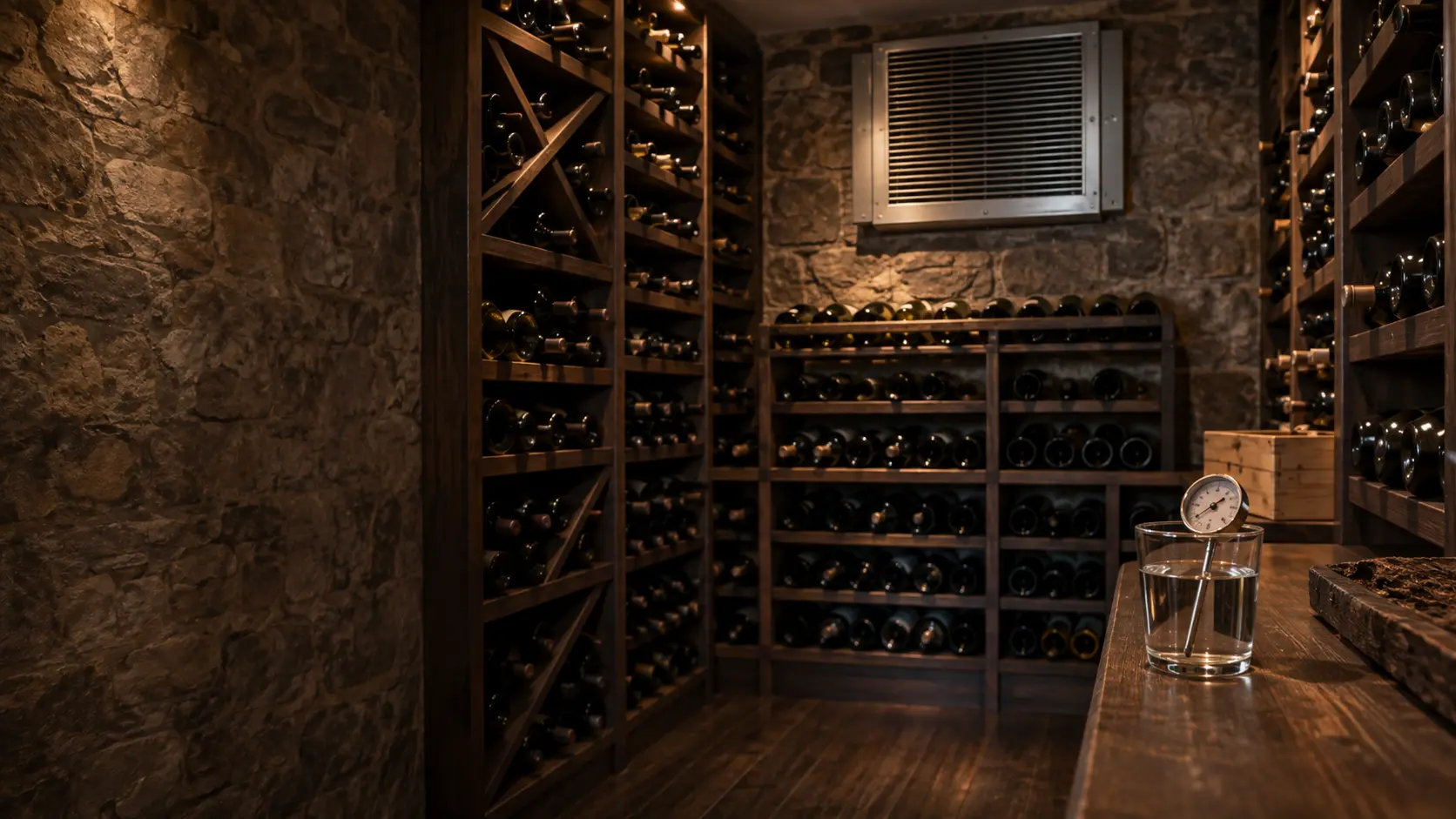
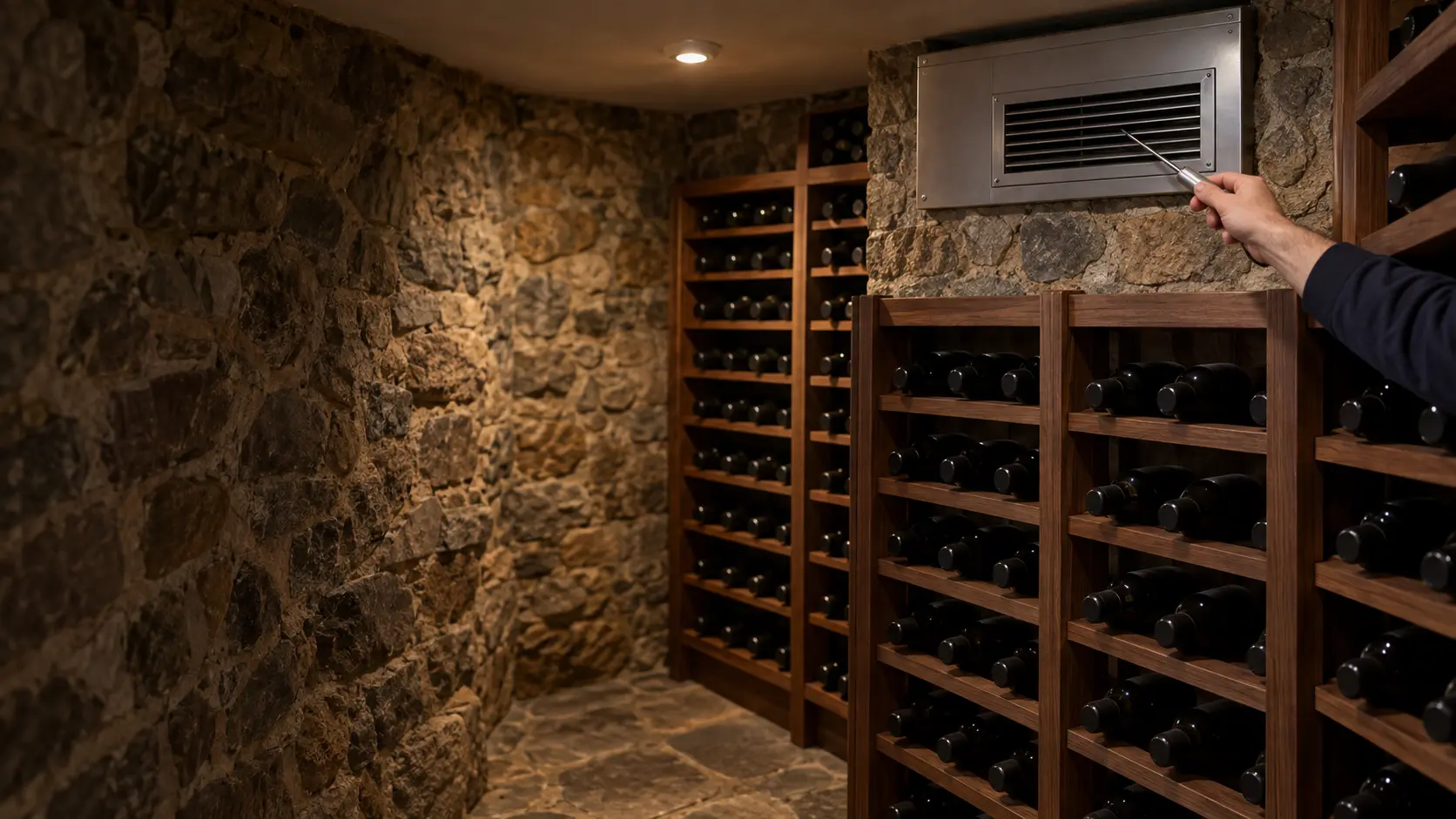
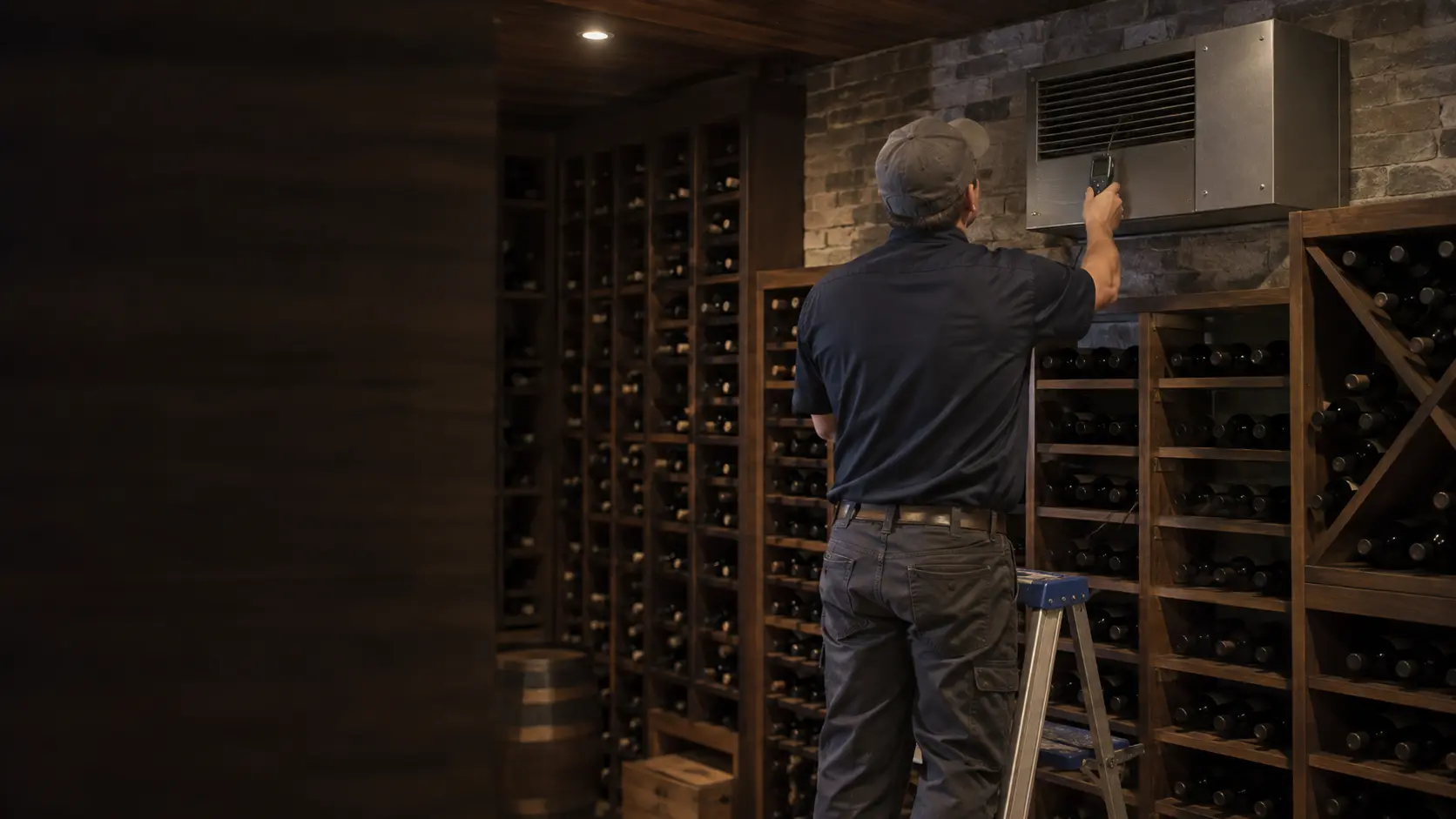
The quickest split takes two minutes and a probe thermometer. Breezaire's instructions ask owners to check the upper part of the warm-side exhaust grille: warm air leaving it means the refrigeration circuit is moving heat. Then compare the air entering the lower grille on the cellar side with the air leaving the upper one. A drop of 6°F or more means the unit itself is doing its job.
CellarPro gives a similar yardstick for its 1800 series, whose discharge at the bottom should run roughly 10°F colder than the number on the display. If the air coming out is barely cooler than the air going in, the trouble is inside the unit. If the drop is healthy and the cellar still drifts upward, heat is getting in faster than a sound unit can pump it out, and the rest of this guide is about finding where.
- Cold air out, warm air on the exhaust side, cellar still warm: look at the room, the door and the exhaust space.
- Fans turning, almost no difference between intake and discharge: the compressor, its start parts or the refrigerant charge.
- Nothing moving at all: the power and controller checks come before anything else.
- White frost or ice behind the cellar-side grille: read the icing guide, because a blocked coil moves very little heat.
Source: Breezaire — WKL Series installation instructions — Warm air at the exhaust grille and air leaving the cold side 6°F or more colder than it enters mean the unit works; unventilated laundry rooms, closets, bathrooms, garages, crawl spaces, attics and humid basements are poor exhaust locations; dark-room and paper tests reveal air leaks; new building materials release moisture; clean the condenser every 3 months; lowering the set point does not help a cellar that is not reaching it; do not change the setting for 3 days after start-up; CellarPro — 1800 series owner's manual — Discharge about 10°F colder than the display; exhaust space at least as large as the cellar unless ducted; check ducts for kinks and remove louvered grilles when the unit runs constantly; glass is at most R-3; capacity table by cellar size, insulation and ambient temperature; continuous running for up to a week after loading, then up to 75% run time
The exhaust side decides what the cellar can reach
A self-contained unit is a heat pump with its hot half in another room. WhisperKool and CellarCool both state that their through-the-wall units hold 55°F only while the air feeding the condenser stays at or below 85°F. In a storage room under a hot roof, a garage or a closet with its door kept shut, that limit is passed by early afternoon in July, and the cellar warms at the same hour every day.
Size matters on that side too. CellarPro wants the exhaust space to be no smaller than the cellar unless the unit is ducted, and Breezaire rules out garages, attics, crawl spaces, damp basements, and any closet, laundry or bathroom without ventilation as places to dump that air. A unit that breathes its own discharge runs hotter and hotter on the warm side, and the cellar pays for it.
Through-the-wall and ducted units
Stand in the exhaust room with the unit running and look at what the grille faces: boxes stacked within a few feet, a louvered door fitted after the build, a cabinet built around the housing. WhisperKool wants about 3 feet of open air in every direction on that side and warns against recessing the unit or hiding it behind an aftermarket grille. On a ducted unit, a crushed flexible duct above a ceiling or a louvered cover at the far end does the same damage out of sight; CellarPro's first steps for a unit that never stops include checking the ducts for kinks and removing louvered grilles.
Split systems and ceiling-mounted units
A split system moves the condenser outdoors or to a mechanical room, which raises the exhaust limit a long way; WhisperKool rates its Platinum split series to hold 55°F with ambient air up to 120°F. The weak points move with it: a condenser smothered by shrubs or leaves, a line set crossing a hot attic with its insulation torn, an outdoor unit that no longer starts. Ceiling-mounted evaporators add one more, a supply louver aimed into a rack face or a beam, which leaves the far corner several degrees warmer than the spot the sensor sees.
Source: Breezaire — WKL Series installation instructions — Warm air at the exhaust grille and air leaving the cold side 6°F or more colder than it enters mean the unit works; unventilated laundry rooms, closets, bathrooms, garages, crawl spaces, attics and humid basements are poor exhaust locations; dark-room and paper tests reveal air leaks; new building materials release moisture; clean the condenser every 3 months; lowering the set point does not help a cellar that is not reaching it; do not change the setting for 3 days after start-up; CellarPro — 1800 series owner's manual — Discharge about 10°F colder than the display; exhaust space at least as large as the cellar unless ducted; check ducts for kinks and remove louvered grilles when the unit runs constantly; glass is at most R-3; capacity table by cellar size, insulation and ambient temperature; continuous running for up to a week after loading, then up to 75% run time; WhisperKool — SC Pro series owner's manual — Holds 55°F only with intake air at or below 85°F; 3 feet of clearance around the unit, no recess or aftermarket grille; R-13 minimum, R-19 interior walls, R-30 ceilings and exterior walls, warm-side vapor barrier; stone, concrete and glass call for a larger unit; mount within 18 inches of the ceiling; a vent fan needs a fresh-air inlet; CellarCool — CX series owner's manual — The unit cannot keep the cellar at 55°F when the room it exhausts into exceeds 85°F

Heat that comes in through the room
Makers size their units for rooms built to a standard, and the numbers are specific. WhisperKool names R-13 as the minimum insulation, prefers R-19 for interior walls and R-30 for ceilings and exterior walls, and requires unbroken plastic sheeting as a vapor barrier on the side facing the house. CellarPro points out that glass panels, windows and doors reach R-3 at best, so a glazed wall or door gives the cellar a far larger heat load than its floor area suggests.
Breezaire describes two free tests for air leaks. Switch off the cellar light from inside, give your eyes a minute, and watch for daylight or lamplight creeping past the door, the unit or any fixture. Then shut a single sheet of paper in the door and tug it: paper that slips free means warm, damp air has the same way in.
- A door missing weather stripping along any edge, or missing its bottom sweep.
- Recessed can lights, which draw warm air in from the ceiling cavity.
- A newly finished room: fresh concrete, lumber and paint give off moisture for months, and the unit spends its effort removing it.
- Afternoon sun on a glass wall or on the outer face of a cellar wall.
Source: Breezaire — WKL Series installation instructions — Warm air at the exhaust grille and air leaving the cold side 6°F or more colder than it enters mean the unit works; unventilated laundry rooms, closets, bathrooms, garages, crawl spaces, attics and humid basements are poor exhaust locations; dark-room and paper tests reveal air leaks; new building materials release moisture; clean the condenser every 3 months; lowering the set point does not help a cellar that is not reaching it; do not change the setting for 3 days after start-up; CellarPro — 1800 series owner's manual — Discharge about 10°F colder than the display; exhaust space at least as large as the cellar unless ducted; check ducts for kinks and remove louvered grilles when the unit runs constantly; glass is at most R-3; capacity table by cellar size, insulation and ambient temperature; continuous running for up to a week after loading, then up to 75% run time; WhisperKool — SC Pro series owner's manual — Holds 55°F only with intake air at or below 85°F; 3 feet of clearance around the unit, no recess or aftermarket grille; R-13 minimum, R-19 interior walls, R-30 ceilings and exterior walls, warm-side vapor barrier; stone, concrete and glass call for a larger unit; mount within 18 inches of the ceiling; a vent fan needs a fresh-air inlet
When the unit itself falls short
Once the room checks out, a short list of mechanical causes remains. A dusty condenser coil is the most common and the easiest to correct; Breezaire's schedule is a look and a vacuum every three months, from the exhaust side. A condenser or evaporator fan that no longer spins, a compressor that hums, overheats and cuts out on its overload, and a slow refrigerant leak all produce the same warm cellar with different sounds. A leak is never an owner's top-up job: EPA's Section 608 program certifies the technicians who open refrigerant circuits, and a recharge without a repair lasts weeks.
A unit that was always too small
Some cellars never held 55°F through their first summer. WhisperKool treats an undersized unit as a cause in its own right and warns that stone, concrete and glass look solid but insulate poorly. CellarPro's capacity table for its 1800 series shows how thin the margins are: its smallest model handles a 100-cubic-foot cellar insulated to R-19 with 85°F air around it, but not the same room at 95°F, and a 300-cubic-foot cellar at 85°F with R-12 walls is beyond every model in the series while the same room at R-19 is not. If the trouble began the week the racks were filled, sizing belongs on the list before any part.
A unit mounted too low on the wall
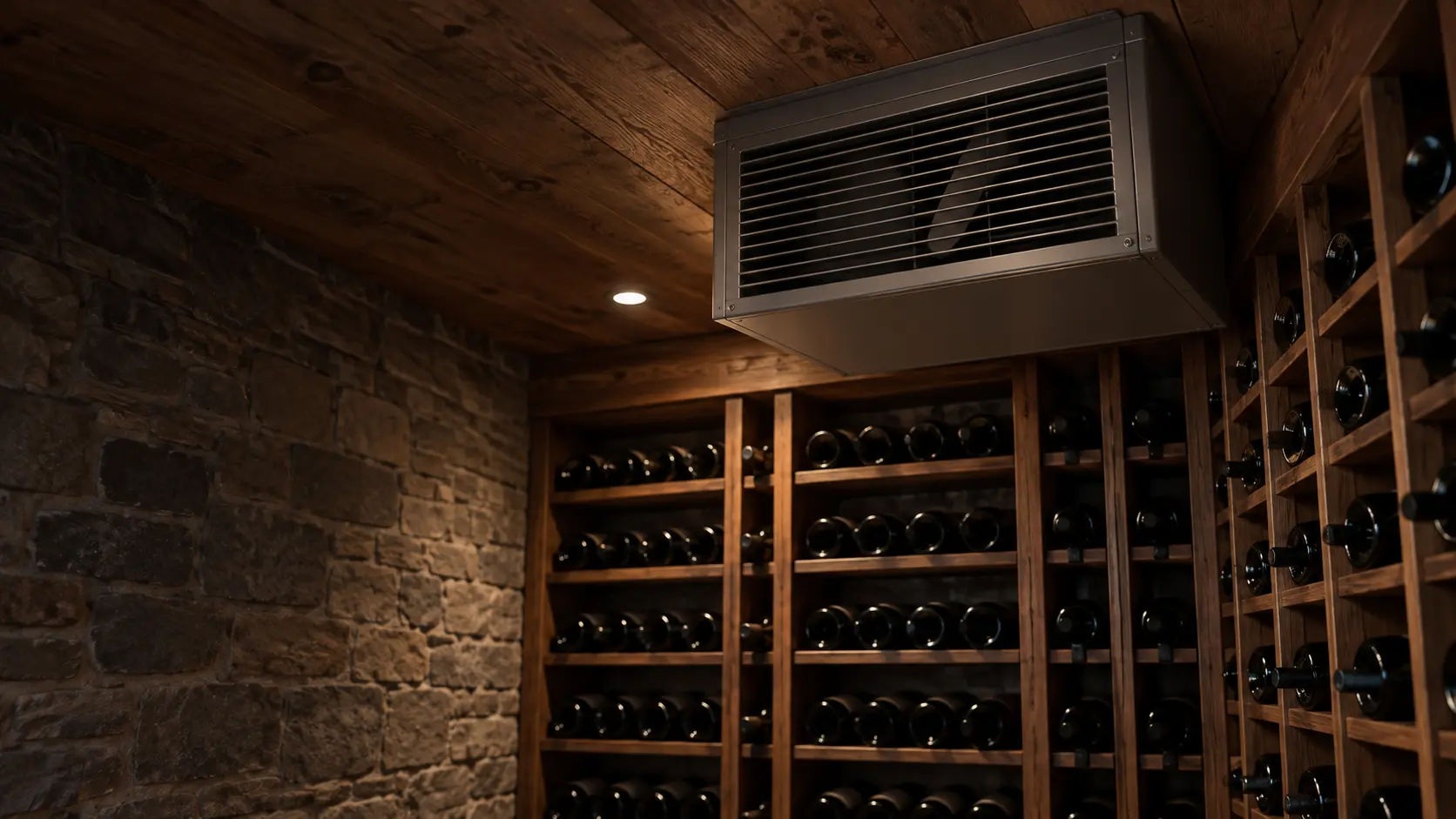
Cold air sinks and warm air pools under the ceiling. WhisperKool wants its through-the-wall units within 18 inches of the ceiling so they draw that warm layer first, and lists a low mounting as a direct cause of a warm cellar. A unit set halfway down a wall leaves the top rows of racking sitting in air it never reaches, and the top rows can run warmer than whatever the sensor reports.
Source: Breezaire — WKL Series installation instructions — Warm air at the exhaust grille and air leaving the cold side 6°F or more colder than it enters mean the unit works; unventilated laundry rooms, closets, bathrooms, garages, crawl spaces, attics and humid basements are poor exhaust locations; dark-room and paper tests reveal air leaks; new building materials release moisture; clean the condenser every 3 months; lowering the set point does not help a cellar that is not reaching it; do not change the setting for 3 days after start-up; US EPA — Section 608 technician certification — Technicians who service equipment that could release refrigerant are certified under Section 608 of the Clean Air Act