Where the water in a cellar unit comes from
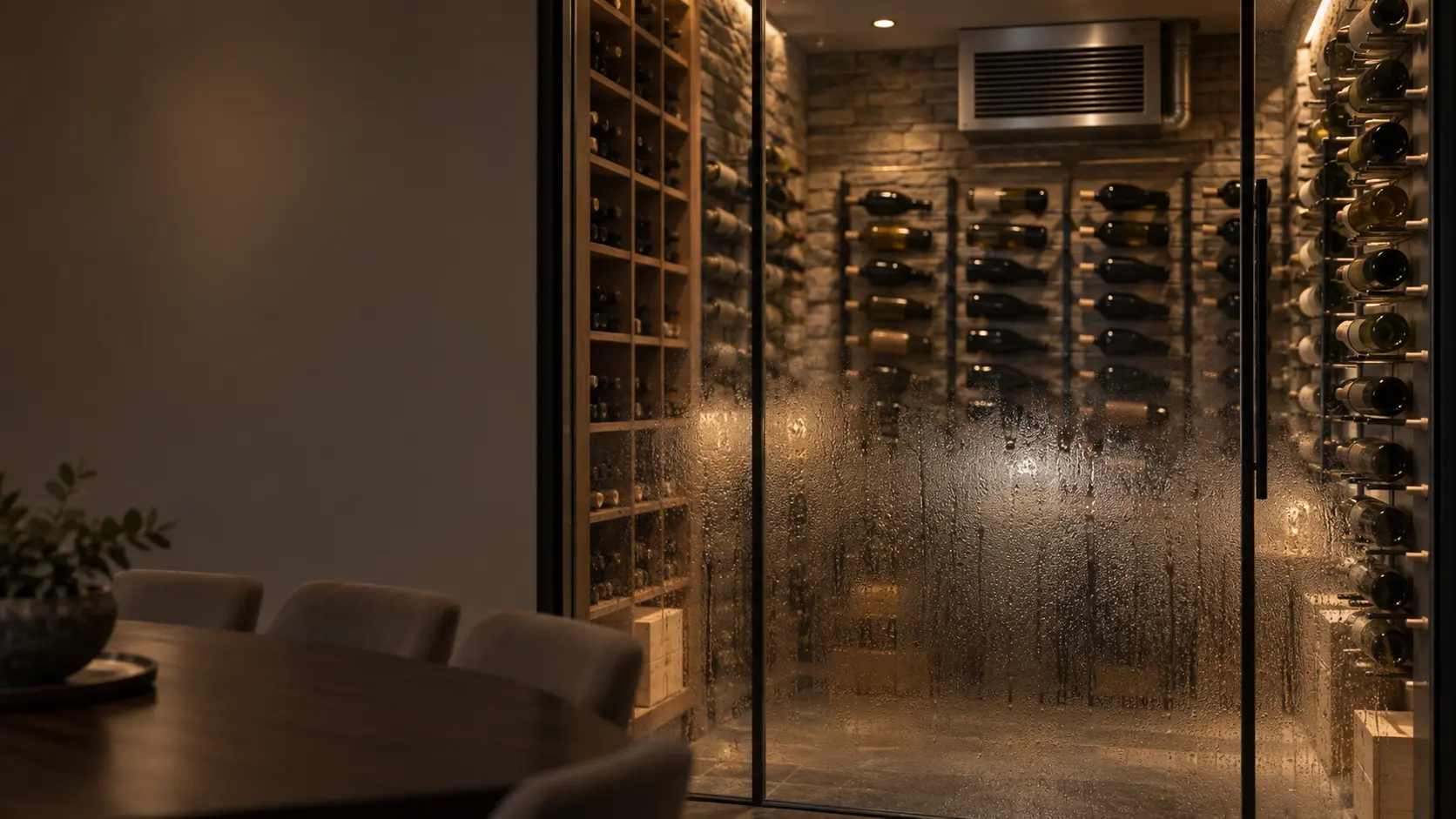
Any coil cold enough to keep a room at 55°F is colder than the dew point of typical indoor air, so water beads on its fins and runs into a pan underneath. In a tight room with a proper vapor barrier the amount is small and steady. When warm, humid air leaks in, the unit turns into a dehumidifier; CellarPro warns that a cellar without a moisture barrier and an airtight seal can have its unit produce buckets of water.
What happens next depends on the design. Some through-the-wall units evaporate part of the water on a heated element at the exhaust side; WhisperKool rates the one in its SC series at about 3 ounces an hour and makes a drain line mandatory for the rest. Other units rely entirely on a gravity line or a small pump. Any of these overflows once the incoming moisture outruns it.
Source: WhisperKool — SC Pro series owner's manual — The condensate evaporator removes about 3 oz of water per working hour and the drain line is mandatory; a unit not level in the wall leaks; the drain line must hang above the waterline; high humidity adds heat load; brush the interior drain line every six weeks, use pan tablets, pour a 50/50 bleach solution into the drain line every spring; no cleaning agents into the cooling system; CellarPro — 1800 series owner's manual — Without a moisture barrier and airtight room the unit may produce buckets of water; rear slightly lower than front so condensate does not drip through the evaporator fan cavity; the cellar modification drain needs a water-filled trap; for dripping raise the minimum set point to 58°F or above, seal the door and seal front ducting; humidity kept at 50 to 70 percent
Where it drips tells you what to check
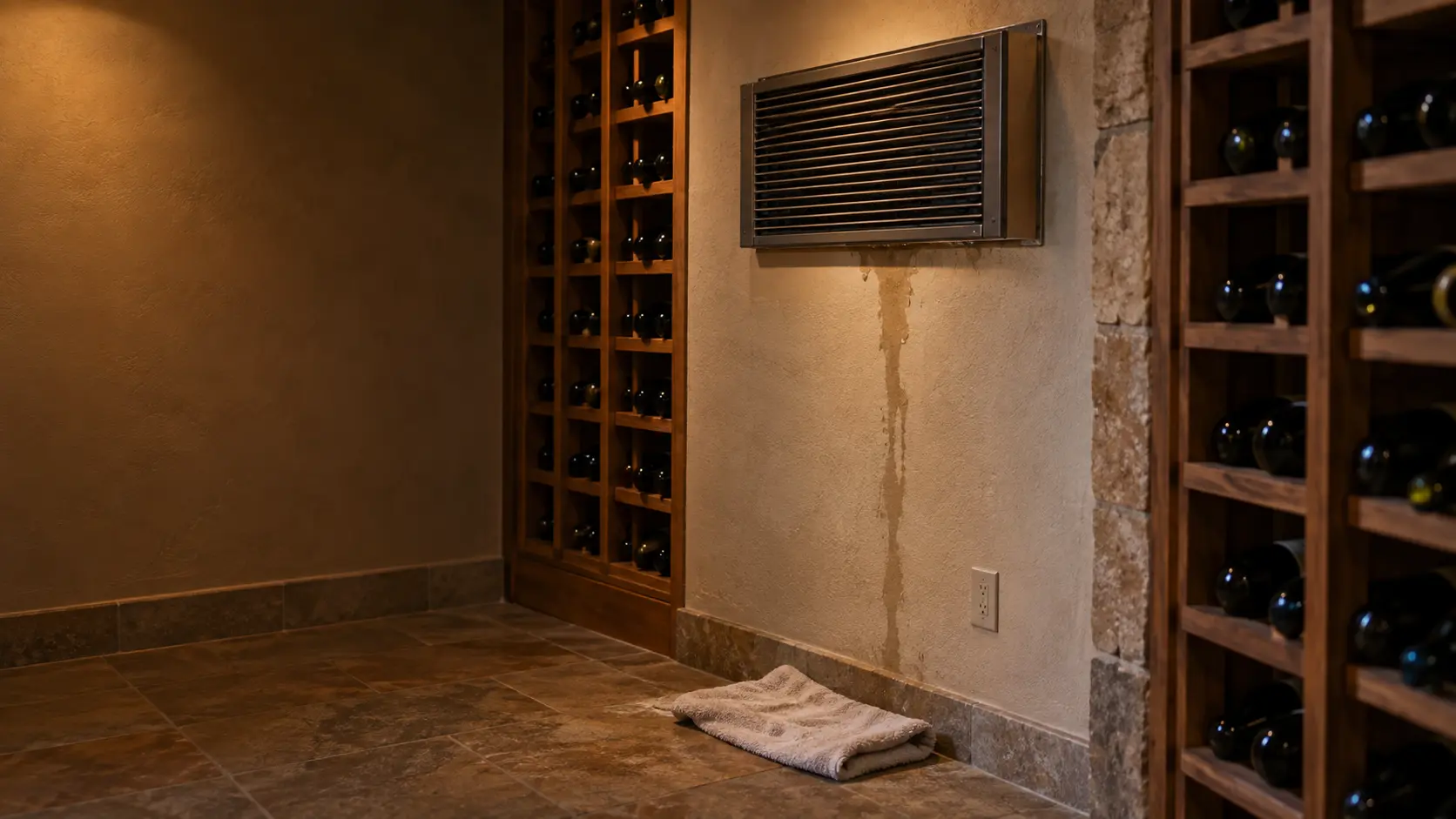
Before any cleaning, watch where the water shows up and at what hour. A puddle that shows up only in the afternoon behaves differently from a trickle that never stops, and water on the exhaust side of a wall points somewhere different from water inside the cellar.
- A slow drip only after long run times: humid air leaking in, more likely than a blockage.
- A sudden flood after hours of quiet: an iced coil that has just let go.
- Steady overflow while the line's outlet stays dry: the line itself, or the pump.
- Water only after the door stood open for a delivery or a party: the room, not the unit.
Water running down the cellar-side wall
Drips from the front of a through-the-wall unit usually mean the pan is spilling forward. CellarPro sets its 1800 series with the rear slightly lower than the front so condensate cannot run into the evaporator fan cavity, and WhisperKool lists a unit that is not level in the wall as the first cause of a leak. A unit that has settled on its shelf, or one refitted after cleaning without that slight backward tilt, sends water out the wrong side.
Water on the exhaust side or down an outside wall
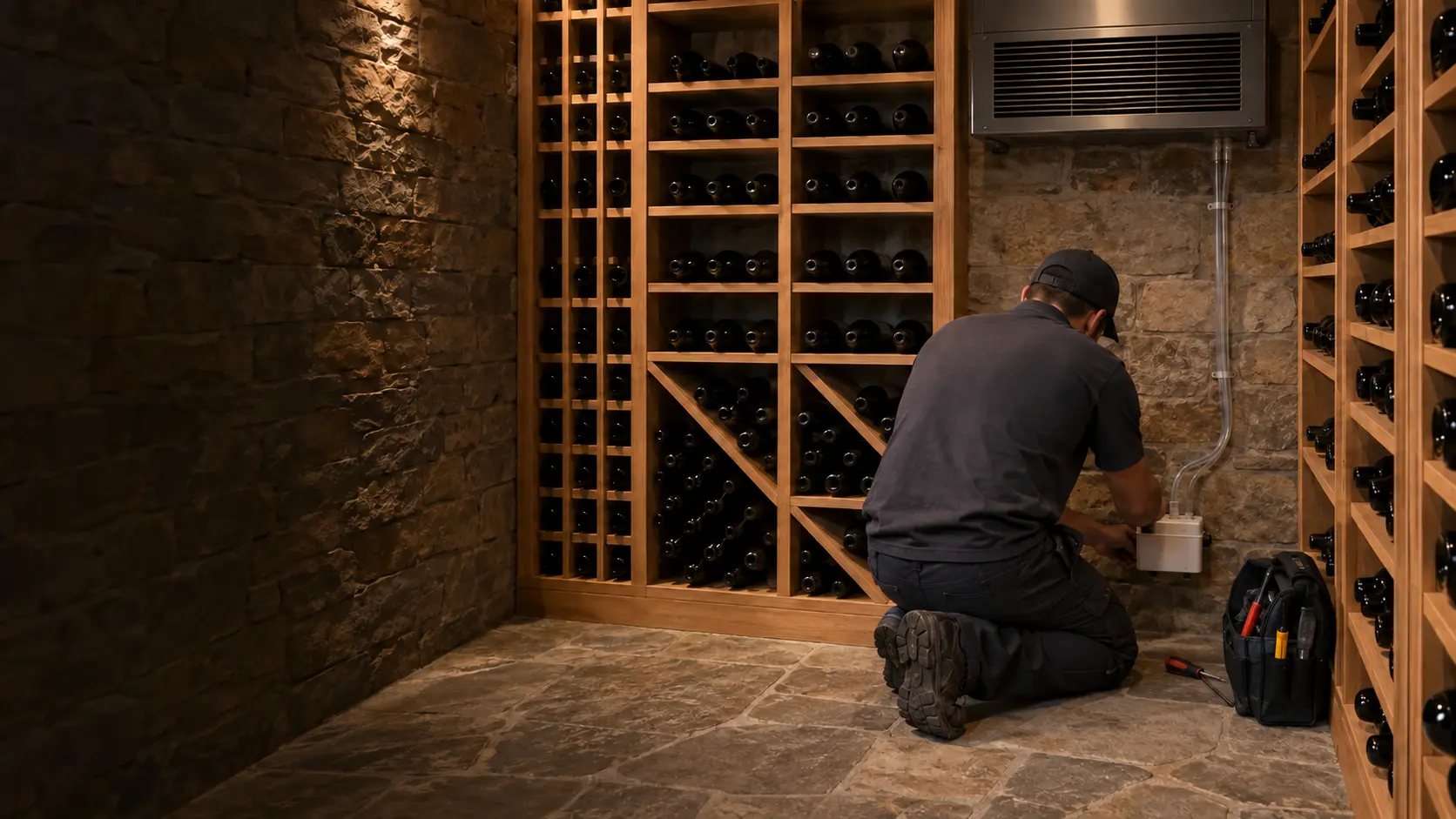
On the warm side, follow the drain line itself. A tube that climbs for part of its run, sags into a loop, or ends below the waterline of a bucket will back up; WhisperKool and CellarCool both show the line hanging above the water surface, never submerged in it. CellarPro adds the opposite case: on units with its cellar modification the line needs a water-filled trap, or the air pressure inside the unit holds the condensate back the way a finger holds water in a straw.
Water from a ceiling unit or a split evaporator
Ceiling-mounted and split evaporators hang above the racks, so a leak lands on bottles and wood rather than a floor. Many lift their water with a small pump; CellarCool fits one to its ceiling-mounted model and caps how far it may push water upward at 15 feet. A pump with a stuck float, a line pinched where it passes through the ceiling, or a pump that lost power when an outlet was replaced leaves the pan brimming within hours. Wine Guardian's controller carries a separate condensate-switch alarm that shuts the system down until the switch is cleared and reset.

When the room is the source of the water
Breezaire describes the signs of an unsealed room as a unit that runs all the time, lowers the temperature only slightly and overflows. It also notes that a newly built room releases moisture from fresh concrete, wood and paint for a while, which produces the same signs and fades by itself. WhisperKool adds that humid air raises the heat load as well as the water, which is why cellars in the Gulf and Southern states suffer most from a torn vapor barrier.
CellarPro's advice for a dripping unit starts with the setting: raise the minimum set point to 58°F or above, seal the door and any other leaks, and make sure any ducting at the front sits tight and sealed against the unit. A lower set point keeps the coil colder for longer, and a colder coil pulls more water out of every leak in the room. For this case Breezaire builds a pull-down drain tube into its WKL units, meant only as a stopgap until whatever lets the damp air in has been found and sealed.
Source: WhisperKool — SC Pro series owner's manual — The condensate evaporator removes about 3 oz of water per working hour and the drain line is mandatory; a unit not level in the wall leaks; the drain line must hang above the waterline; high humidity adds heat load; brush the interior drain line every six weeks, use pan tablets, pour a 50/50 bleach solution into the drain line every spring; no cleaning agents into the cooling system; CellarPro — 1800 series owner's manual — Without a moisture barrier and airtight room the unit may produce buckets of water; rear slightly lower than front so condensate does not drip through the evaporator fan cavity; the cellar modification drain needs a water-filled trap; for dripping raise the minimum set point to 58°F or above, seal the door and seal front ducting; humidity kept at 50 to 70 percent; Breezaire — WKL Series installation instructions — An unsealed enclosure makes the unit run all the time with little temperature drop and overflow; new building materials release moisture; the pull-down drain tube is for temporary use while the moisture source is eliminated
What an owner can clear, with the power off
The makers expect owners to keep the drain path clean. WhisperKool and CellarCool supply a drain line brush and ask for the interior line to be brushed every six weeks, with a pan tablet dropped into the drip tray through the access port to slow the slime that forms there. WhisperKool also calls for a 50/50 bleach solution poured into the drain line each spring. Unplug the unit before any of it and keep a towel under the drain port.
- Disconnect the exterior line and flush it into a bucket.
- Run the supplied brush through the drain port toward the tray.
- Check that the line falls the whole way to its outlet, with no rise and no kink.
- Make sure the end hangs above the water in any bucket or basin it empties into.
- Look through the access port with a flashlight for ice or sludge in the tray.
Source: WhisperKool — SC Pro series owner's manual — The condensate evaporator removes about 3 oz of water per working hour and the drain line is mandatory; a unit not level in the wall leaks; the drain line must hang above the waterline; high humidity adds heat load; brush the interior drain line every six weeks, use pan tablets, pour a 50/50 bleach solution into the drain line every spring; no cleaning agents into the cooling system; CellarCool — CX series owner's manual — The drain line must hang above the water surface; every six weeks clean the drain port and brush the interior drain line, dropping a pan tab into the drip tray