
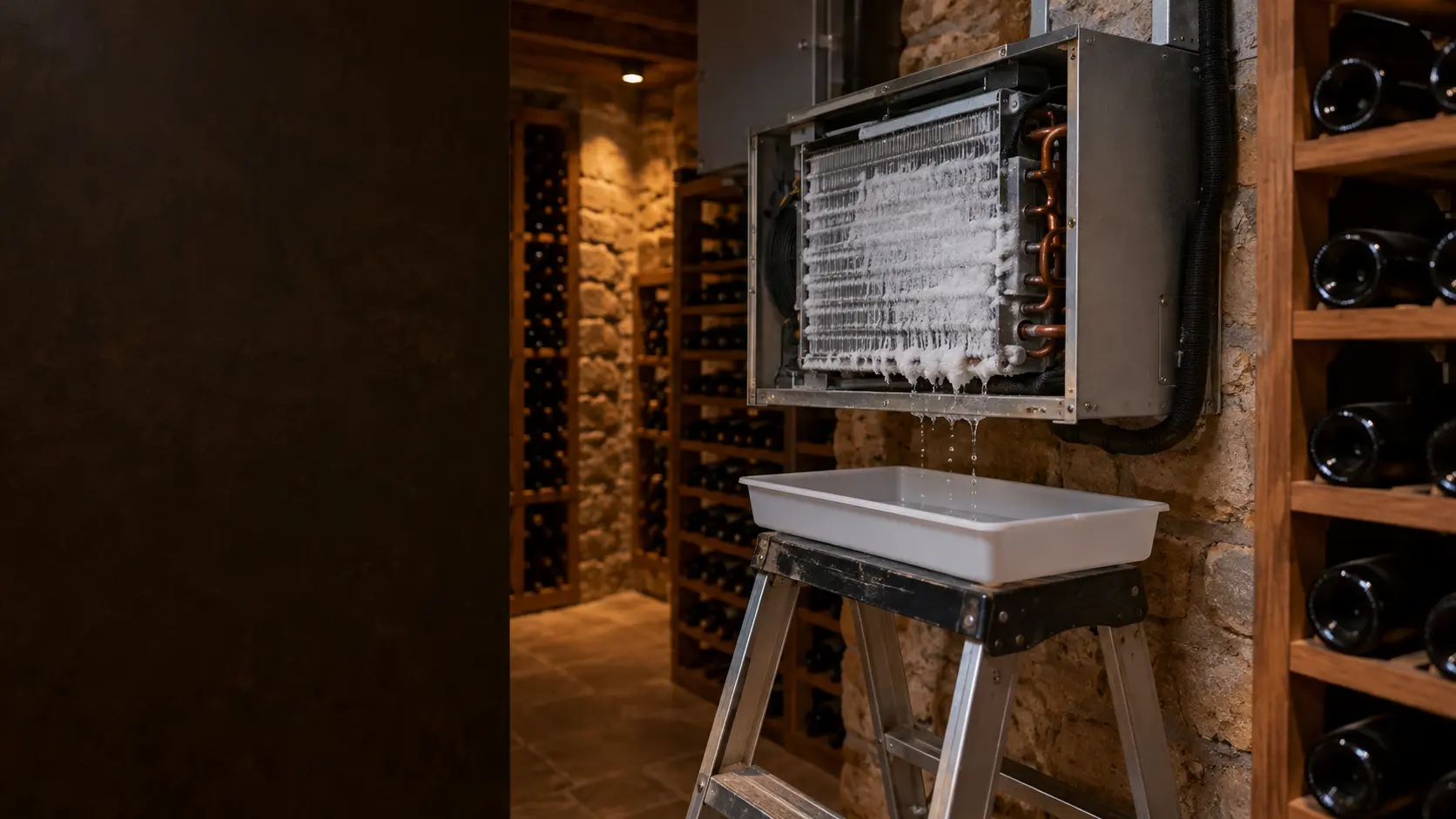
Frost that comes and goes, ice that stays
The coil behind the cellar-side grille runs below freezing for part of each cycle, so a thin frost is expected, and controllers clear it on a schedule or by a sensor. CellarPro's remote display runs a 20-minute defrost every 16 hours with the evaporator fan on. WhisperKool's SC series watches a coil probe instead and stops the compressor once the coil has sat at 26°F for five minutes, letting the fans clear it until it reaches 40°F.
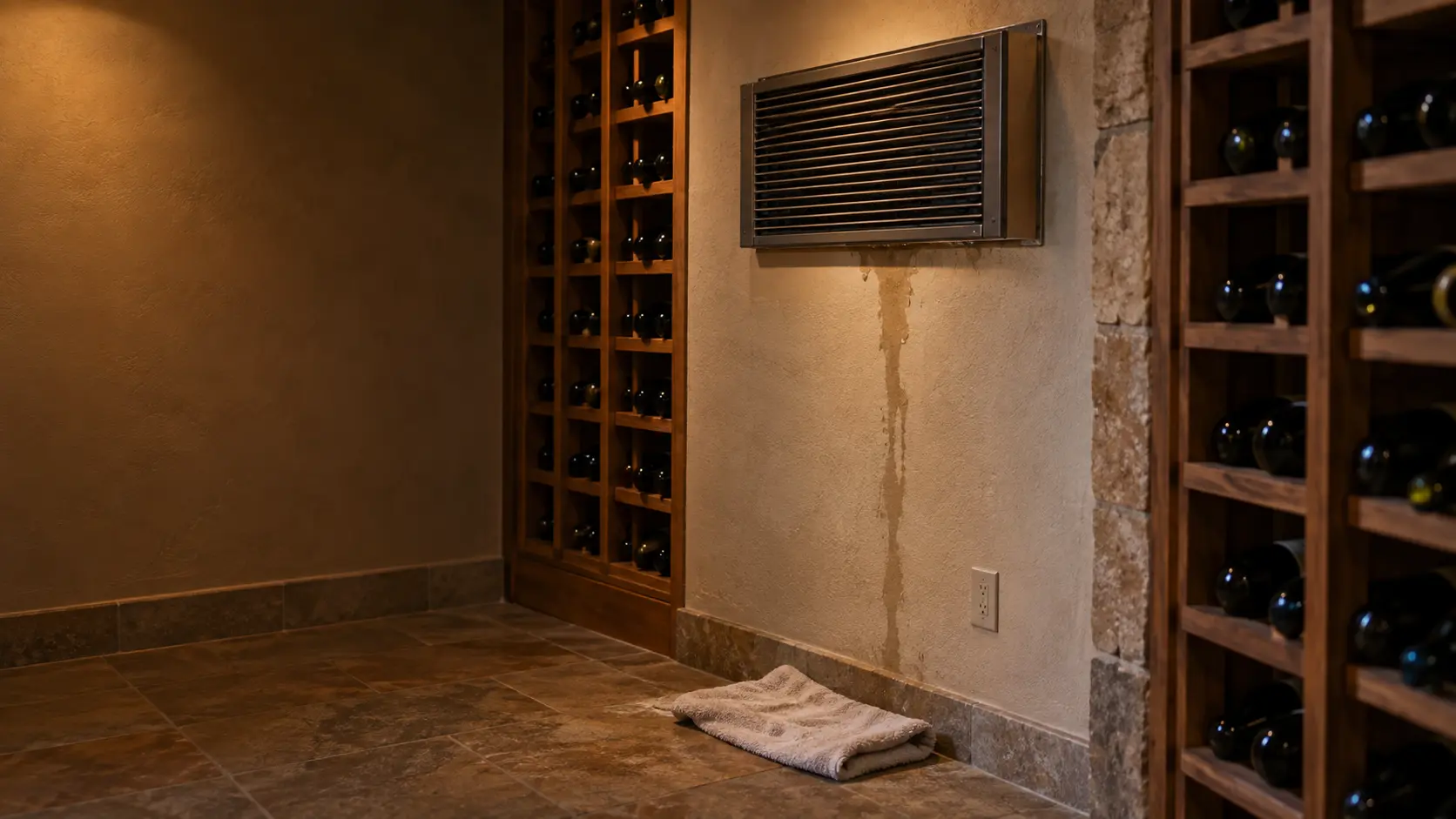
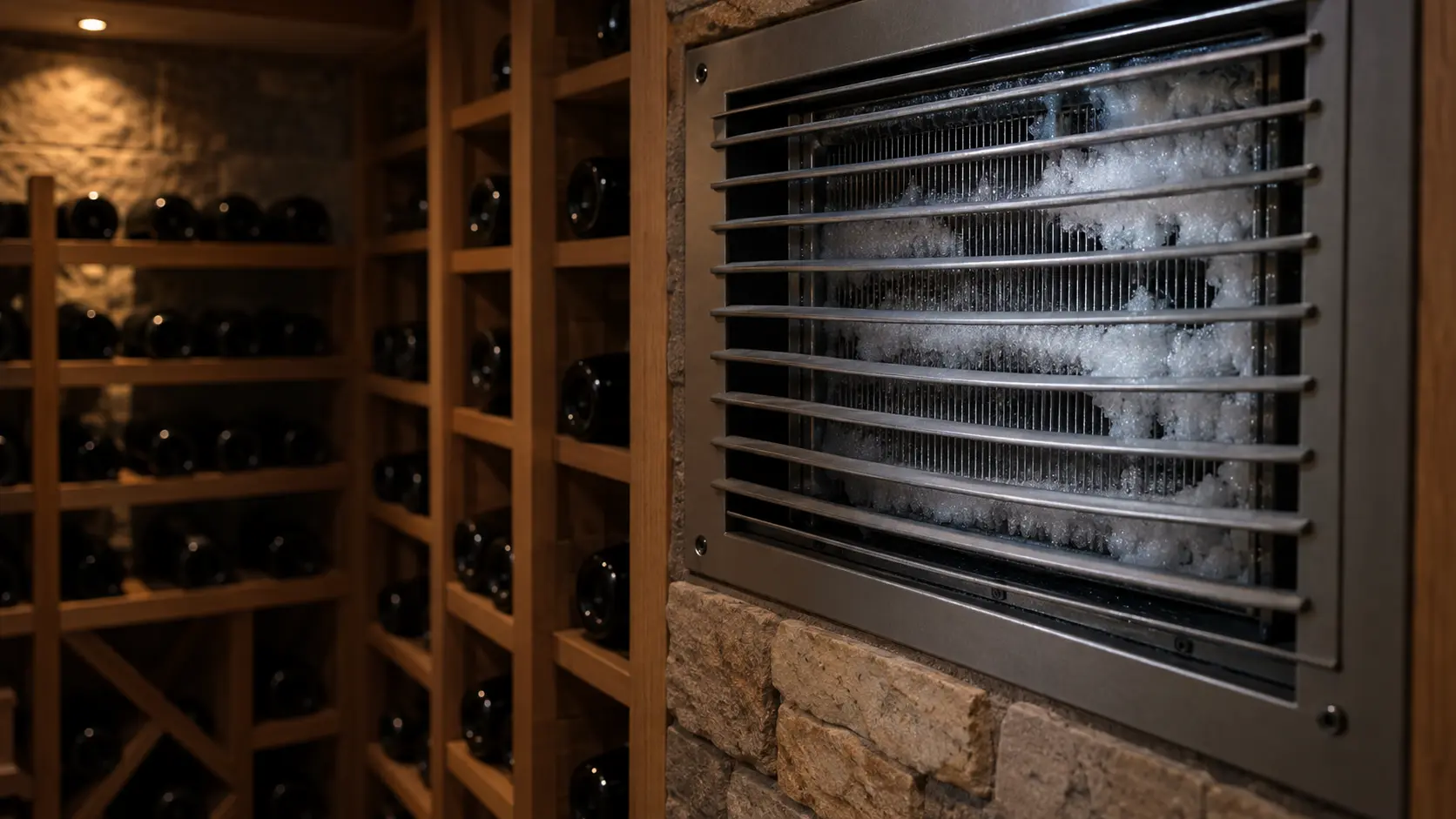
Ice is the frost those cycles failed to remove. It bridges the gaps between fins, chokes the airflow, and then grows faster, because less cellar air reaches the metal to warm it. The cellar warms while the unit sounds busier than ever, so plenty of owners learn about it only when the unit is switched off for some reason and a sheet of meltwater follows.
- A dull white film that vanishes within an hour of the compressor stopping: normal.
- Solid ice you cannot see through between the fins: not normal.
- Water in the tray frozen into a slab: the drain and the coil together.
- A defrost symbol lit for most of the day: the controller is losing ground.
Source: WhisperKool — SC Pro series owner's manual — Anti-frost starts when the coil probe reads 26°F for five minutes and ends at 40°F or ten minutes; ice causes are a dirty coil, blocked airflow and a stopped evaporator fan; clean the coil by vacuum or weak detergent spray flushed after 5 minutes; for the Ad3 alarm make sure intake air is not below 60°F; ice part way up the coil can mean low refrigerant, all the way up a dirty coil or blocked air; holding the up arrow about five seconds starts anti-frost only below 40°F; CellarPro — 1800 series owner's manual — Remote display units defrost every 16 hours for 20 minutes, manual defrost by holding the key 3 seconds; 3 inches clear in front and 8 inches below the cold air discharge, free of bottles and racks; optional air filter replaced every 3 to 9 months; raise the minimum set point to 58°F or above when dripping
Airflow is the first thing to rule out
The cellar-side coil needs a steady stream of room air to stay above freezing, and anything that thins that stream drives the coil colder. The troubleshooting tables for WhisperKool's and CellarCool's through-the-wall units open with the same three airflow causes: a dirty coil, something blocking the supply or return air, and an evaporator fan that has stopped.
Racks, cases and bottles in front of the grille
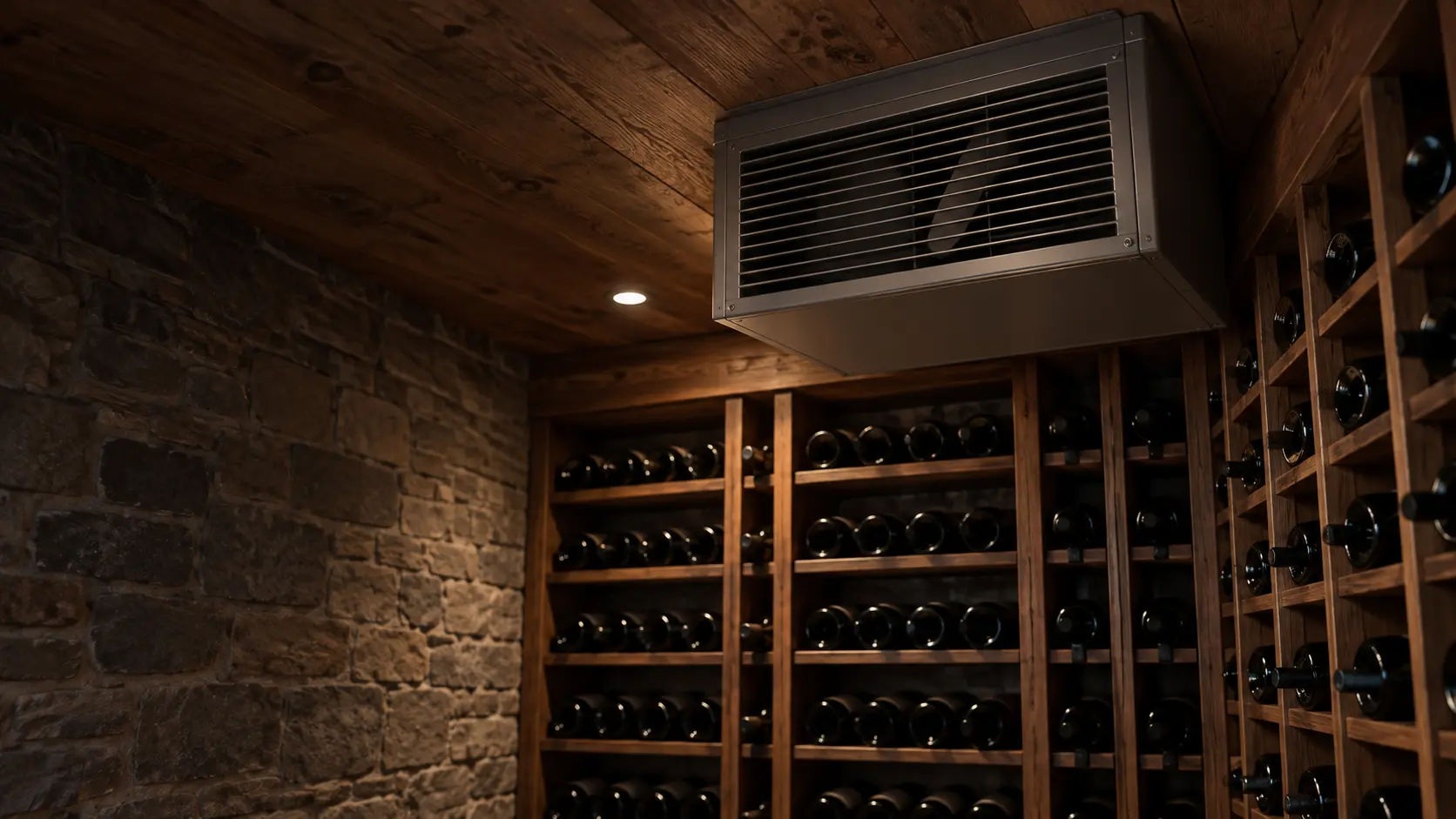
CellarPro wants a minimum of 3 inches free before the face of its 1800 units and 8 inches below the cold air discharge, with no bottles or racking in that space. A case parked on top of a rack, a new run of racking fitted close under the unit, or a decorative panel placed over the grille can halve the airflow without anyone noticing the change.
A dusty coil or a clogged filter
Cellars collect cardboard dust and fine lint from wooden racking, and it settles on the cellar-side coil. WhisperKool's instruction is to vacuum that coil and, when it is very dirty, mist it with a weak dish detergent solution, wait five minutes and flush with fresh water. Do it only with the unit unplugged, and only on the coil face you can reach through the grille. Units with an intake filter need it changed on schedule; CellarPro quotes 3 to 9 months for its optional rear filter depending on conditions.
An evaporator fan that has stopped
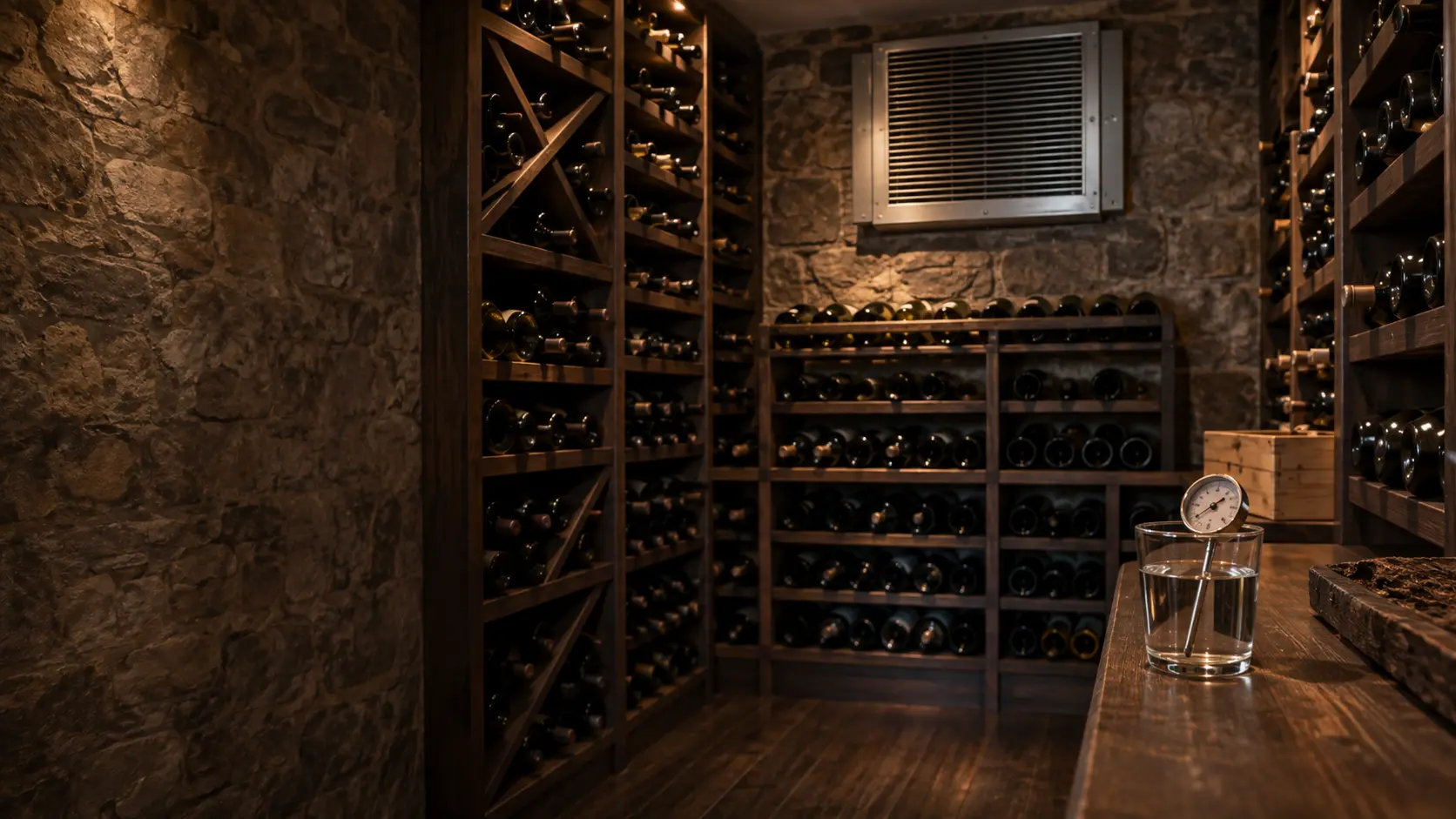
Hold a hand near the cellar-side grille while the compressor runs and you should feel a steady draft of cold air. If the compressor hums and the fan on that side is still, the coil freezes solid within hours. WhisperKool sends that case straight to a technician, since the motor, its capacitor or the controller output can each be responsible.
Source: WhisperKool — SC Pro series owner's manual — Anti-frost starts when the coil probe reads 26°F for five minutes and ends at 40°F or ten minutes; ice causes are a dirty coil, blocked airflow and a stopped evaporator fan; clean the coil by vacuum or weak detergent spray flushed after 5 minutes; for the Ad3 alarm make sure intake air is not below 60°F; ice part way up the coil can mean low refrigerant, all the way up a dirty coil or blocked air; holding the up arrow about five seconds starts anti-frost only below 40°F; CellarCool — CX series owner's manual — Ice forms when the coil is dirty, air is blocked, the evaporator fan is off, or the exhaust room drops below 50°F; ice only part way up the coil face may mean low refrigerant

When the exhaust room is too cold
Icing is a winter complaint as often as a summer one. A through-the-wall unit relies on the air at its exhaust side to keep refrigerant pressure up; when that air turns cold, pressure falls and the cellar coil drops further below freezing. CellarCool names an exhaust room below 50°F as a cause of ice on its CX series, and WhisperKool's defrost alarm instructions ask owners to make sure the intake air is not below 60°F.
Unheated garages, northern basements and exterior walls in January are where this shows up. Split systems handle cold outdoor air with low-ambient controls, and Wine-Mate tells buyers to add a low-ambient kit to its split condensing units where the installation area drops below 50°F. If the icing began with the first cold week, the answer may be heat in the exhaust space or a low-ambient kit rather than a repair.
Source: WhisperKool — SC Pro series owner's manual — Anti-frost starts when the coil probe reads 26°F for five minutes and ends at 40°F or ten minutes; ice causes are a dirty coil, blocked airflow and a stopped evaporator fan; clean the coil by vacuum or weak detergent spray flushed after 5 minutes; for the Ad3 alarm make sure intake air is not below 60°F; ice part way up the coil can mean low refrigerant, all the way up a dirty coil or blocked air; holding the up arrow about five seconds starts anti-frost only below 40°F; CellarCool — CX series owner's manual — Ice forms when the coil is dirty, air is blocked, the evaporator fan is off, or the exhaust room drops below 50°F; ice only part way up the coil face may mean low refrigerant; Wine-Mate (Vinotemp) — WM-2500 to 6500 SSR split system owner's manual — If the installation area will be below 50°F, purchase a low ambient condition kit
Reading the pattern: airflow or refrigerant
After a thaw, watch where the ice forms again. WhisperKool and CellarCool give the same rule of thumb: ice that climbs the whole face of the coil points to dirt or blocked air, while ice that stops part way up suggests the unit is low on refrigerant. With a short charge only the first rows of tubing get cold enough to freeze, and the rest of the coil runs warm.
A shortage means a leak, because a sealed circuit does not use its refrigerant up. Finding the leak, repairing it and recharging to the maker's weight is work for a refrigeration technician holding EPA Section 608 certification, and on a split system that includes testing the line set between the two rooms.
- Ice across the full face, fan turning, filter clean: recheck what sits in front of the grille and how clean the fins are.
- Ice on the lower rows only, back after each thaw: a refrigerant question.
- Ice only in the coldest months: the exhaust room temperature.
- Ice together with a defrost alarm on the display: write the code down before resetting anything.
Source: WhisperKool — SC Pro series owner's manual — Anti-frost starts when the coil probe reads 26°F for five minutes and ends at 40°F or ten minutes; ice causes are a dirty coil, blocked airflow and a stopped evaporator fan; clean the coil by vacuum or weak detergent spray flushed after 5 minutes; for the Ad3 alarm make sure intake air is not below 60°F; ice part way up the coil can mean low refrigerant, all the way up a dirty coil or blocked air; holding the up arrow about five seconds starts anti-frost only below 40°F; CellarCool — CX series owner's manual — Ice forms when the coil is dirty, air is blocked, the evaporator fan is off, or the exhaust room drops below 50°F; ice only part way up the coil face may mean low refrigerant; US EPA — Section 608 technician certification — Technicians who service equipment that could release refrigerant are certified under Section 608 of the Clean Air Act
Thawing the coil without soaking the cellar
Unplug the unit, lay towels under the cellar-side grille and the drain port, and let the coil thaw by itself; a fan blowing room air at the grille speeds it up. The makers mention warming a stubborn coil with a hair drier, but with meltwater running close to the unit's own cord a fan is the safer tool. Restart only when the fins look clear, and check that the tray and the drain line are running before the first full cycle.
WhisperKool's SC controller also lets an owner start an anti-frost cycle by holding the up arrow for about five seconds, but only while the coil is below 40°F; above that the display blinks three times and carries on. That clears light frost. It will not shift a solid block, and repeating it on an iced coil only delays finding the cause.
Source: WhisperKool — SC Pro series owner's manual — Anti-frost starts when the coil probe reads 26°F for five minutes and ends at 40°F or ten minutes; ice causes are a dirty coil, blocked airflow and a stopped evaporator fan; clean the coil by vacuum or weak detergent spray flushed after 5 minutes; for the Ad3 alarm make sure intake air is not below 60°F; ice part way up the coil can mean low refrigerant, all the way up a dirty coil or blocked air; holding the up arrow about five seconds starts anti-frost only below 40°F