
What the number on the display measures
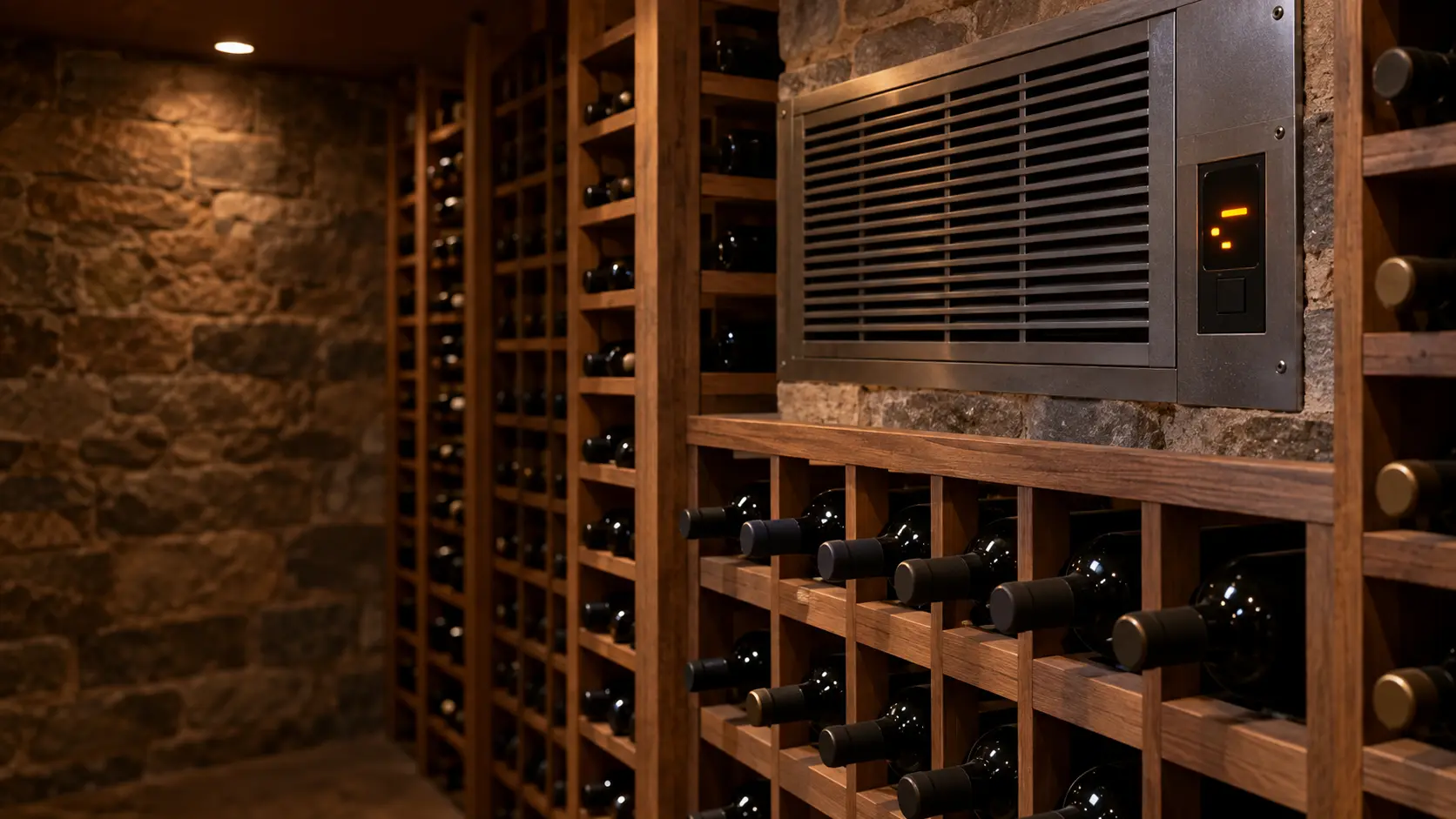
Controllers on cellar units show one of three things by default, and the manual says which. Breezaire's Sentry III shows the air entering the unit's intake unless the optional bottle probe is plugged in, in which case it shows the probe. CellarPro's display reads a sensor behind the front grille, again overridden by a bottle probe. WhisperKool's SC controller shows its bottle probe by default and can be set to show the set point, the coil or the condenser instead, while CellarCool's CX controller opens on the set point.
Those differences explain most of the worry owners bring to a visit. A steady 55 on a display that shows the setting says nothing about the room until the reading is called up, and an air sensor at the grille moves far more than the bottles do.
An air sensor at the unit
Air readings run warm just before the compressor starts and cold just after it stops. A cellar held correctly by an air sensor can show a few degrees either side of the setting within an hour and be entirely healthy. What matters is the average, and whether the number returns to the setting every cycle.
A bottle probe in liquid
A probe in a bottle of water lags the air by hours, which is the point: it follows what the wine feels. CellarPro recommends cutting the differential from 4 degrees to 1 when its bottle probe sits in liquid, because the slow reading would otherwise let the air swing much further. WhisperKool asks for the bottle to stand about three feet from the air outlet and out of its stream, and lists a probe in the cold blast as a cause of short cycling.
Stepping through the probes
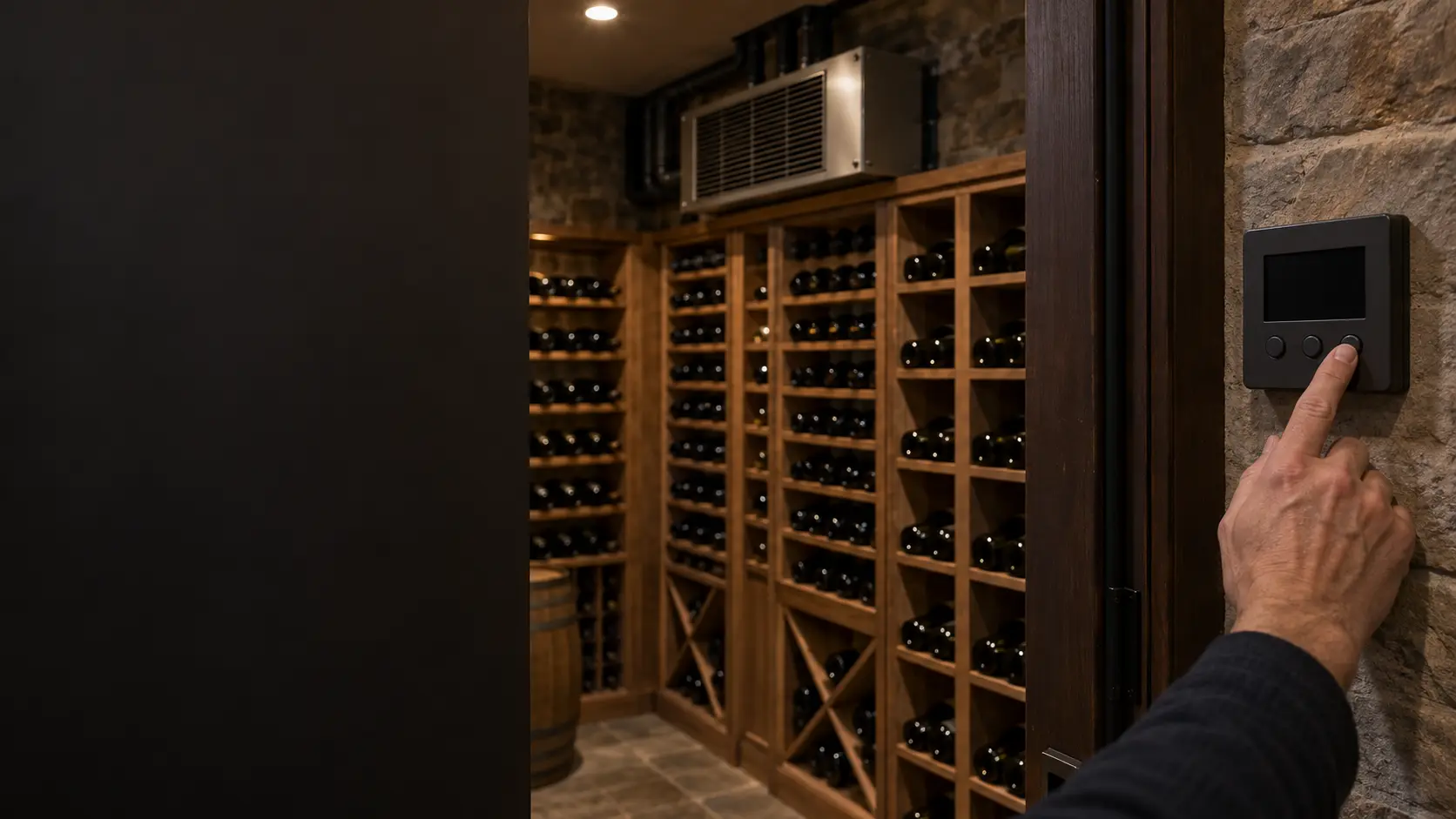
When the display shows the setting rather than a reading, a press of SET or an arrow usually steps through the sensors. On WhisperKool's SC controller they are listed as Pb1 for the bottle, Pb2 for the coil and Pb3 for the condenser. Noting all three while a problem is happening gives a technician a picture of both sides of the circuit before the visit.
Source: Breezaire — WKL Series installation instructions — The Sentry III shows the intake air temperature, or the bottle probe when fitted; do not change the setting for at least 3 days after start-up; CellarPro — 1800 series owner's manual — Display reads probe P1 behind the front grille unless a bottle probe overrides it; cut the differential from 4 to 1 with a probe in liquid; factory 58°F minimum set point and 4°F differential; wait 14 days before changing settings; Energy Saver adds 4°F; Quick Chill runs up to 6 hours; P1/P3 probe alarms, HA above 70°F, LA below 45°F, HA2 condenser above 140°F for 2 hours; HA and LA disabled for 23 hours after power-up; most collectors store at 55–60°F; WhisperKool — SC Pro series owner's manual — Bottle probe shown by default, ddd selects setpoint, bottle, coil or condenser; bottle about three feet from the air output; probe in the air stream causes short cycling; Pb1, Pb2, Pb3; cooling starts 1°F above setpoint, setpoint 50–70°F in 1°F steps; blinking snowflake is the five-minute anti-short-cycle wait, dripping snowflake and Def mean anti-frost; loc locks the keypad; CA1 calibrates ±12°F; E1–E3, AH1, AL1, COH at 125°F, Ad3; ON/OFF does not disconnect power; CellarCool — CX series owner's manual — The setpoint is displayed by default
How the setting turns cooling on and off
Most cellar controllers switch cooling off when the reading reaches the set point and back on when it climbs past the set point plus a differential. CellarPro ships its 1800 series at a 58°F minimum set point with a 4°F differential, so the unit starts above 62°F, stops below 58°F and averages about 60°F. Wine-Mate's self-contained units ship at 55°F with a 4-degree differential, and WhisperKool's SC begins cooling once its probe reads 1°F above the setting.
So the cellar averages above the number you set by roughly half the differential, and a wide differential looks like a problem on an air-reading display. Change one value at a time and give it days rather than hours: Breezaire asks for three days after start-up before touching the setting, and CellarPro suggests a 14-day break-in before changing anything.
- Set point: where cooling stops.
- Differential, shown as Hy on many controllers: how far above the set point cooling restarts.
- Anti-short-cycle delay: the minutes the compressor must rest between runs.
- Fan-on time after the compressor stops (Fdc on WhisperKool, Fon on CellarPro and Wine-Mate): used to return moisture to the room.
Source: Breezaire — WKL Series installation instructions — The Sentry III shows the intake air temperature, or the bottle probe when fitted; do not change the setting for at least 3 days after start-up; CellarPro — 1800 series owner's manual — Display reads probe P1 behind the front grille unless a bottle probe overrides it; cut the differential from 4 to 1 with a probe in liquid; factory 58°F minimum set point and 4°F differential; wait 14 days before changing settings; Energy Saver adds 4°F; Quick Chill runs up to 6 hours; P1/P3 probe alarms, HA above 70°F, LA below 45°F, HA2 condenser above 140°F for 2 hours; HA and LA disabled for 23 hours after power-up; most collectors store at 55–60°F; WhisperKool — SC Pro series owner's manual — Bottle probe shown by default, ddd selects setpoint, bottle, coil or condenser; bottle about three feet from the air output; probe in the air stream causes short cycling; Pb1, Pb2, Pb3; cooling starts 1°F above setpoint, setpoint 50–70°F in 1°F steps; blinking snowflake is the five-minute anti-short-cycle wait, dripping snowflake and Def mean anti-frost; loc locks the keypad; CA1 calibrates ±12°F; E1–E3, AH1, AL1, COH at 125°F, Ad3; ON/OFF does not disconnect power; Wine-Mate (Vinotemp) — WM-1500/2500HTD owner's manual — Factory Set 55 and Hy 4; flashing compressor LED is the anti-short-cycle delay, defrost LED on during defrost; POF and PON lock and unlock the keys; P1, HA, LA alarms, HA and LA clear when temperature returns; start-up alarm delay dAO 23 hours; Fon raises humidity; ot calibrates the air probe

Symbols and modes that are not alarms
Several indicators look alarming and are only the controller at work. A blinking snowflake on WhisperKool's SC means cooling is wanted but the five-minute rest between runs has not ended. A dripping snowflake, or Def on the display, means an anti-frost cycle: compressor off, fans running to clear the coil. On Wine-Mate's controllers a flashing compressor light marks the same kind of rest, and a steady defrost light a defrost in progress.
Modes can also move the temperature on purpose. CellarPro's Energy Saver adds 4°F to the set point, and its Quick Chill runs the compressor for up to six hours after warm bottles are loaded. A keypad lock, shown as POF and PON on Wine-Mate controllers and set through a loc parameter on WhisperKool's, explains a setting that refuses to change.
Source: CellarPro — 1800 series owner's manual — Display reads probe P1 behind the front grille unless a bottle probe overrides it; cut the differential from 4 to 1 with a probe in liquid; factory 58°F minimum set point and 4°F differential; wait 14 days before changing settings; Energy Saver adds 4°F; Quick Chill runs up to 6 hours; P1/P3 probe alarms, HA above 70°F, LA below 45°F, HA2 condenser above 140°F for 2 hours; HA and LA disabled for 23 hours after power-up; most collectors store at 55–60°F; WhisperKool — SC Pro series owner's manual — Bottle probe shown by default, ddd selects setpoint, bottle, coil or condenser; bottle about three feet from the air output; probe in the air stream causes short cycling; Pb1, Pb2, Pb3; cooling starts 1°F above setpoint, setpoint 50–70°F in 1°F steps; blinking snowflake is the five-minute anti-short-cycle wait, dripping snowflake and Def mean anti-frost; loc locks the keypad; CA1 calibrates ±12°F; E1–E3, AH1, AL1, COH at 125°F, Ad3; ON/OFF does not disconnect power; Wine-Mate (Vinotemp) — WM-1500/2500HTD owner's manual — Factory Set 55 and Hy 4; flashing compressor LED is the anti-short-cycle delay, defrost LED on during defrost; POF and PON lock and unlock the keys; P1, HA, LA alarms, HA and LA clear when temperature returns; start-up alarm delay dAO 23 hours; Fon raises humidity; ot calibrates the air probe
Alarms that do need attention
Real alarms usually arrive with a red light, a buzzer or a flashing reading, and the characters on screen name a sensor or a limit. The table in your own manual is the authority. The examples below come from the makers' published manuals and show the families most controllers share; the error codes section of this site groups them the same way.
Before clearing any alarm, write it down exactly, including whether it flashes and what reading sits beside it. Some clear themselves once conditions return, as Wine-Mate's high and low alarms do, and an alarm that clears and returns every afternoon tells a clearer story than one that was wiped once.
- Probe alarms (E1 to E3 on WhisperKool's SC, P1 and P3 on CellarPro, P1 on Wine-Mate): a sensor is unplugged, damaged or out of bounds, and most units fall back to a timed on-off cycle to protect the wine.
- High temperature (AH1 on WhisperKool, HA on CellarPro and Wine-Mate): the cellar is warmer than the alarm limit; check the door, the exhaust room and the coil first.
- Low temperature (AL1, LA): the cellar is colder than the limit, often a cold house in winter, since these units have no way to add heat.
- Hot condenser (COH on WhisperKool at 125°F, HA2 on CellarPro above 140°F for two hours): the exhaust side is not shedding heat; clean the condenser and clear its airflow.
- Anti-frost timed out (Ad3 on WhisperKool): the coil did not warm during defrost; thaw it and read the icing guide.
- Condensate switch (!2 on Wine Guardian's remote interface): the drain pan is full and the system stays off until the switch is cleared and reset.
Source: CellarPro — 1800 series owner's manual — Display reads probe P1 behind the front grille unless a bottle probe overrides it; cut the differential from 4 to 1 with a probe in liquid; factory 58°F minimum set point and 4°F differential; wait 14 days before changing settings; Energy Saver adds 4°F; Quick Chill runs up to 6 hours; P1/P3 probe alarms, HA above 70°F, LA below 45°F, HA2 condenser above 140°F for 2 hours; HA and LA disabled for 23 hours after power-up; most collectors store at 55–60°F; WhisperKool — SC Pro series owner's manual — Bottle probe shown by default, ddd selects setpoint, bottle, coil or condenser; bottle about three feet from the air output; probe in the air stream causes short cycling; Pb1, Pb2, Pb3; cooling starts 1°F above setpoint, setpoint 50–70°F in 1°F steps; blinking snowflake is the five-minute anti-short-cycle wait, dripping snowflake and Def mean anti-frost; loc locks the keypad; CA1 calibrates ±12°F; E1–E3, AH1, AL1, COH at 125°F, Ad3; ON/OFF does not disconnect power; Wine-Mate (Vinotemp) — WM-1500/2500HTD owner's manual — Factory Set 55 and Hy 4; flashing compressor LED is the anti-short-cycle delay, defrost LED on during defrost; POF and PON lock and unlock the keys; P1, HA, LA alarms, HA and LA clear when temperature returns; start-up alarm delay dAO 23 hours; Fon raises humidity; ot calibrates the air probe; Wine Guardian — Remote interface controller guide — !2 is the condensate switch alarm, which shuts the system down until resolved and reset; high voltage remains at the main control board when the system is switched off at the interface