Measure the wine, not the air
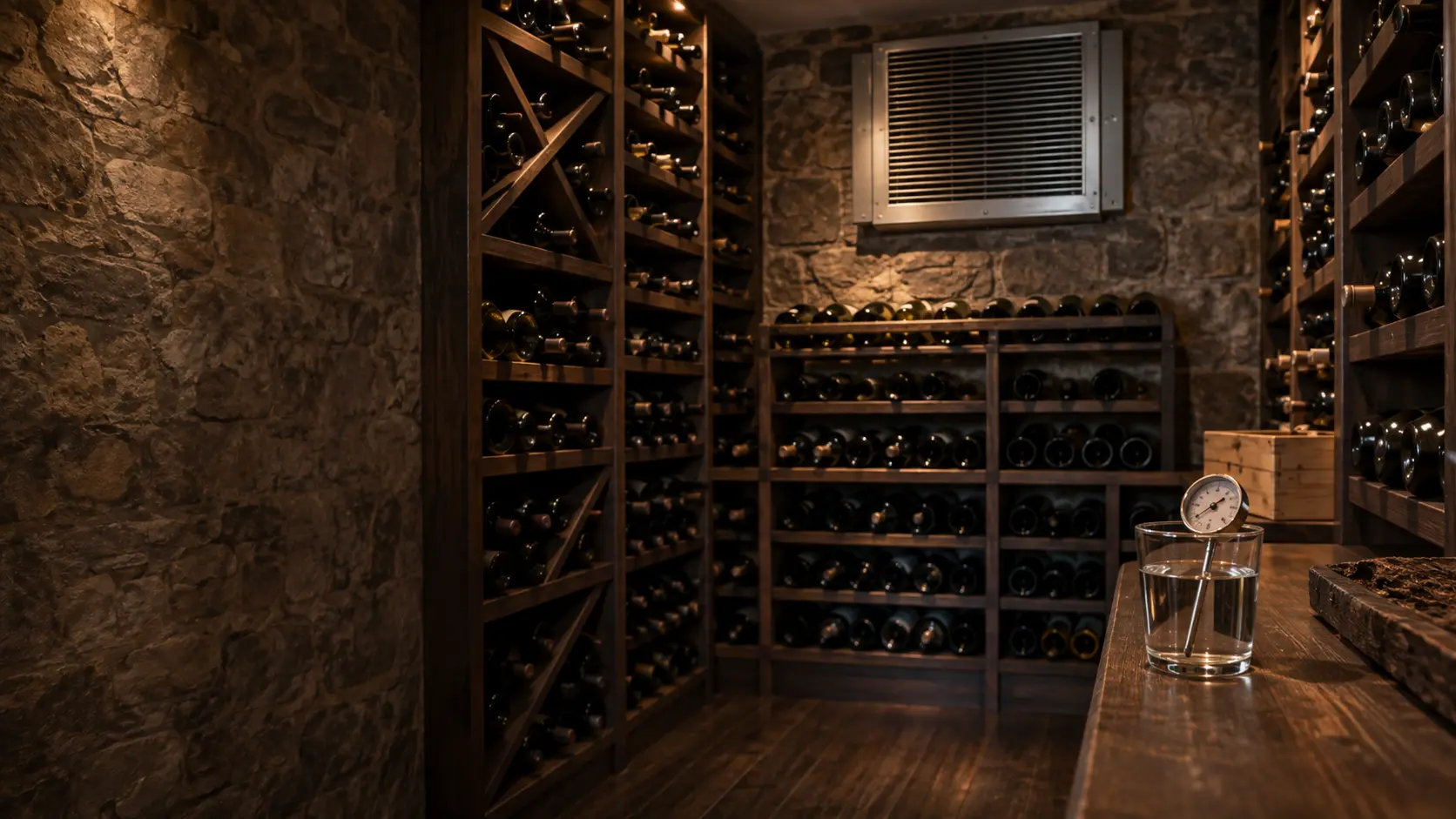
Air near a cellar unit swings several degrees with each cycle, and a quick reading at the doorway means little. Fill an empty wine bottle about three-quarters full of water, as WhisperKool describes for its bottle probe, push a thermometer probe into it and stand it on a middle rack out of the unit's airflow. Read it the next morning, before anyone opens the door.
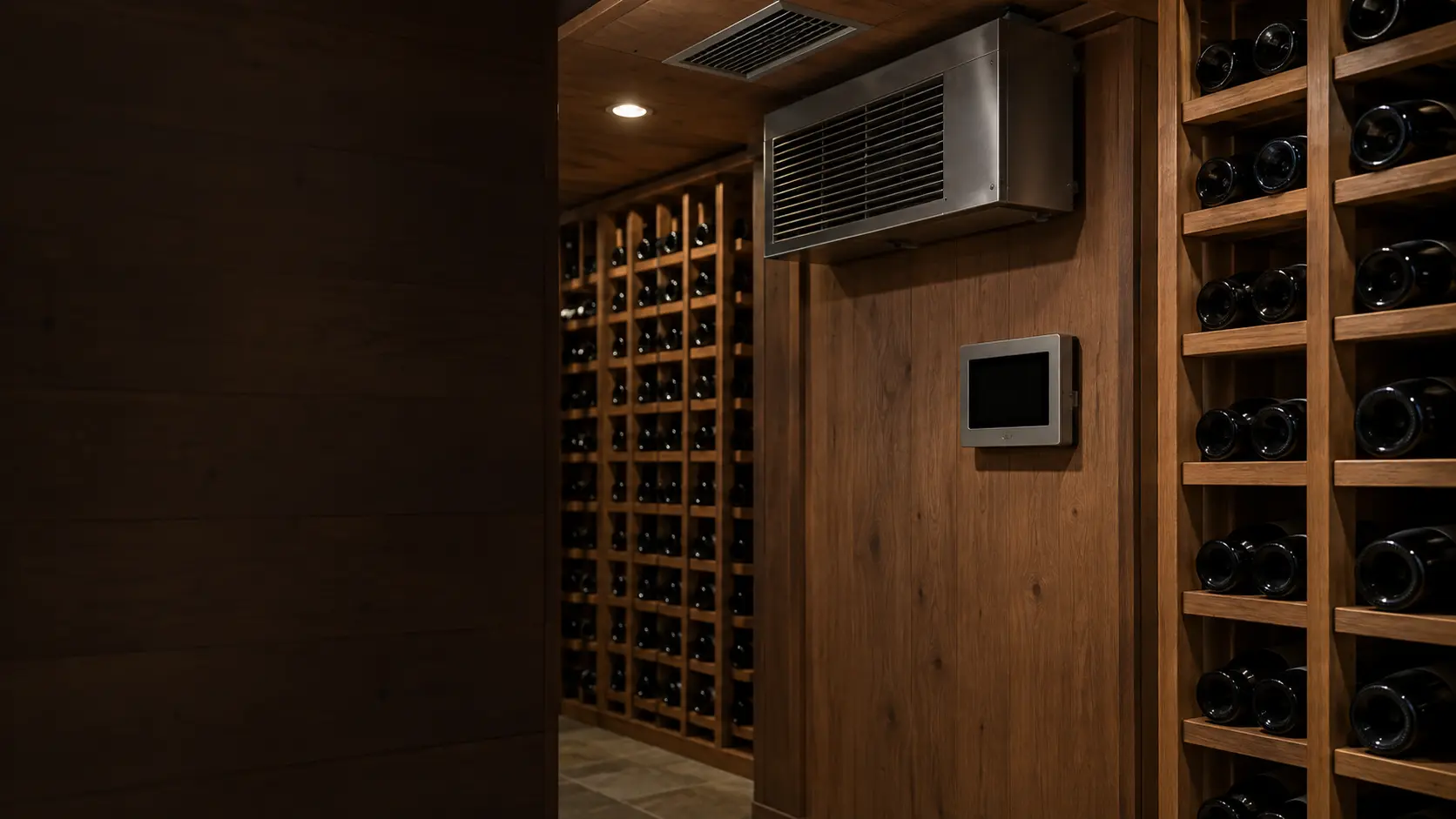
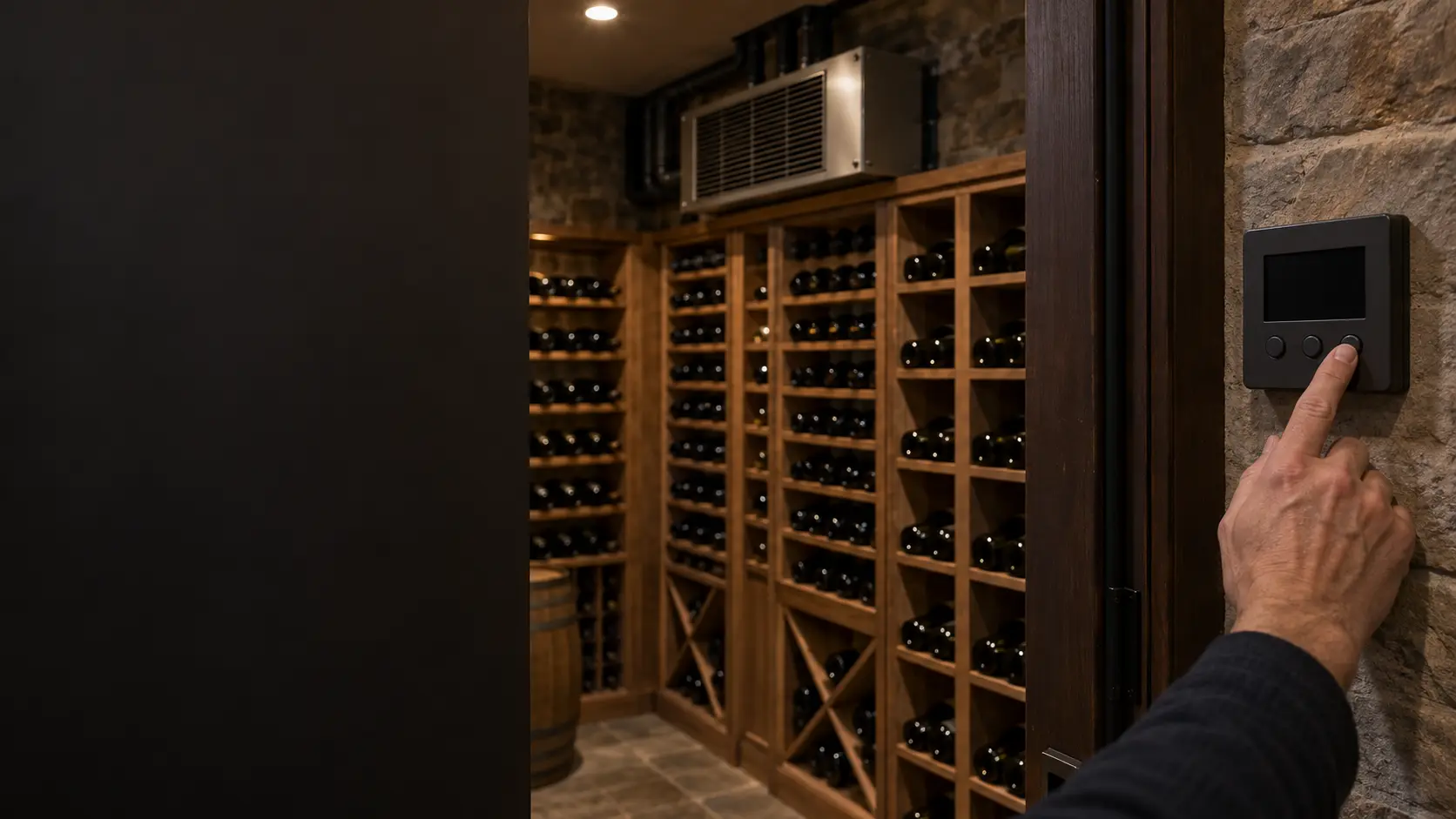
Then compare it with the controller. Some displays show air at the unit's intake, some show a bottle probe, and a few show the set point until a key is pressed. WhisperKool reminds owners that the air in a cellar that is still cooling reads colder than the liquid, so a display that looks right on the first day can be several degrees ahead of the bottles.
Source: WhisperKool — SC Pro series owner's manual — Bottle probe in an empty bottle filled 75% with water; air in a cooling cellar reads colder than the liquid; do not use a GFI; a blinking snowflake marks the five-minute anti-short-cycle wait; a selector switch picks the front or rear power inlet; 55°F only with intake air at or below 85°F; a poorly sealed door makes the unit run continuously
Power, breaker and controller
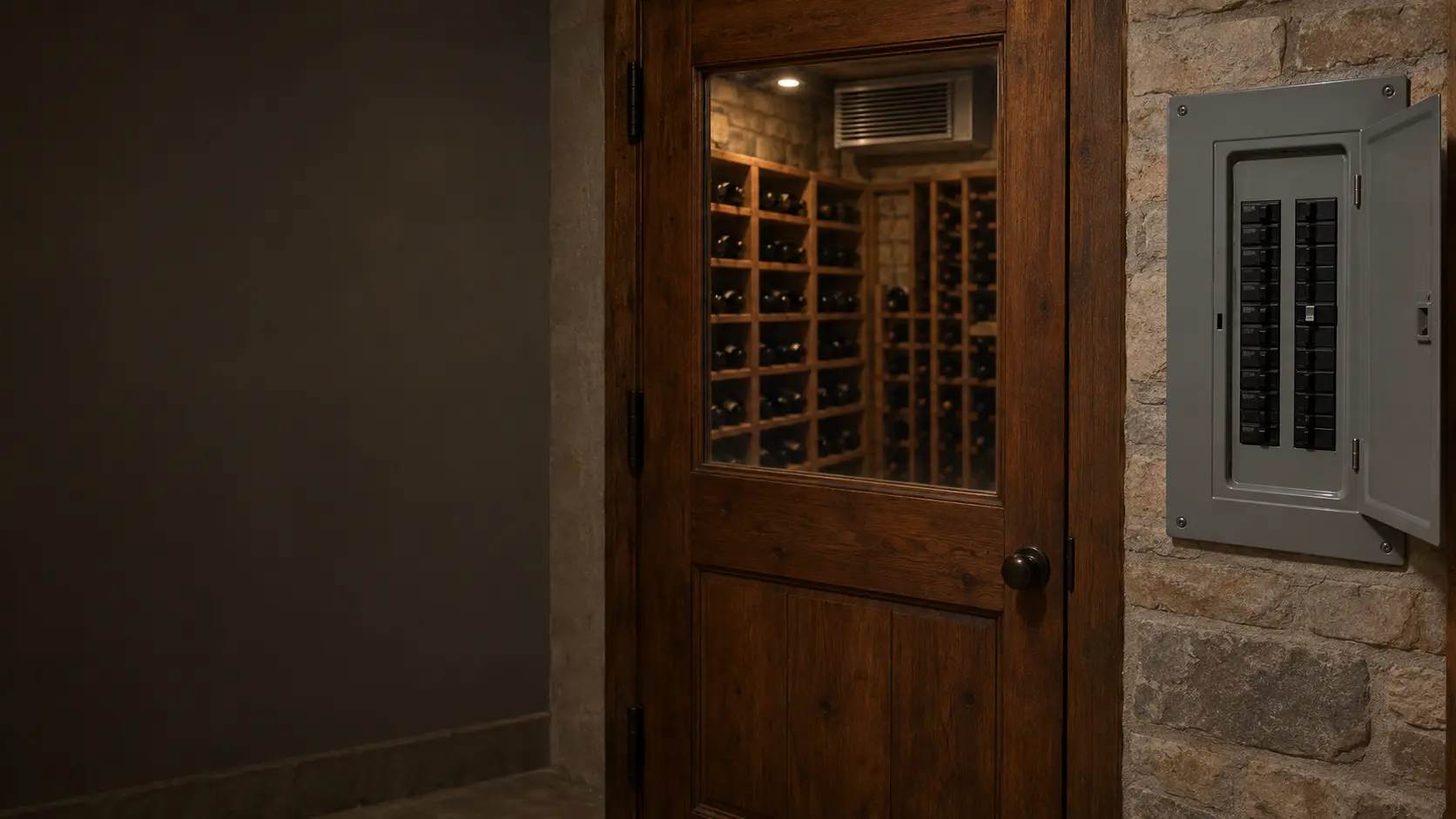
A unit that is completely silent needs its power path checked first. Look at the panel for a tripped breaker and reset it a single time with dry hands and dry feet; a second trip means it stays off. Note whether the unit plugs into a GFCI outlet and read your own manual on that point, because the makers disagree: Breezaire asks for a GFCI outlet on its own circuit, while WhisperKool, CellarCool and Wine-Mate tell owners not to use one with their units at all.
If there is power and no cooling, wait before deciding anything. CellarPro and Breezaire controllers hold the compressor off for about three minutes after power returns, and WhisperKool's blinks its snowflake symbol through a five-minute rest between runs. A unit waiting out that delay looks broken to anyone standing beside it.
Nothing lit, nothing running
Start at the outlet by plugging in a lamp. On WhisperKool's SC units, check the selector switch on the side of the housing, which chooses between the front and rear power inlets; with the cord in the rear inlet and the switch set to front, the unit stays dark. On a split system the outdoor condenser often has its own breaker and a disconnect box beside it, and both have to be on.
Display on, compressor idle
Compare the set point with the reading. If the cellar already sits at or below the setting, the controller has nothing to do. Look for a mode indicator too: CellarPro's Energy Saver raises the set point by 4°F, and a lit defrost symbol on most controllers means the compressor is paused on purpose while the fan clears the coil.
Source: WhisperKool — SC Pro series owner's manual — Bottle probe in an empty bottle filled 75% with water; air in a cooling cellar reads colder than the liquid; do not use a GFI; a blinking snowflake marks the five-minute anti-short-cycle wait; a selector switch picks the front or rear power inlet; 55°F only with intake air at or below 85°F; a poorly sealed door makes the unit run continuously; Breezaire — WKL Series installation instructions — Plug into a GFCI outlet on its own circuit; about a three-minute restart delay after an outage; do not change the setting for 3 days after start-up; air leaving the cold side 6°F or more colder than it enters means the unit works; paper and dark-room tests for leaks; CellarPro — 1800 series owner's manual — 3-minute delay at startup; Energy Saver raises the minimum set point by 4°F; HA and LA alarms disabled for the first 23 hours after power-up; CellarCool — CX series owner's manual — Do not use a GFI with the unit; the cellar warms when the exhaust room exceeds 85°F; Wine-Mate (Vinotemp) — WM-1500/2500HTD owner's manual — Do not use a GFI; ambient temperature no higher than 78°F for the WM-1500HTD and 95°F for the WM-2500HTD

Both grilles, both rooms
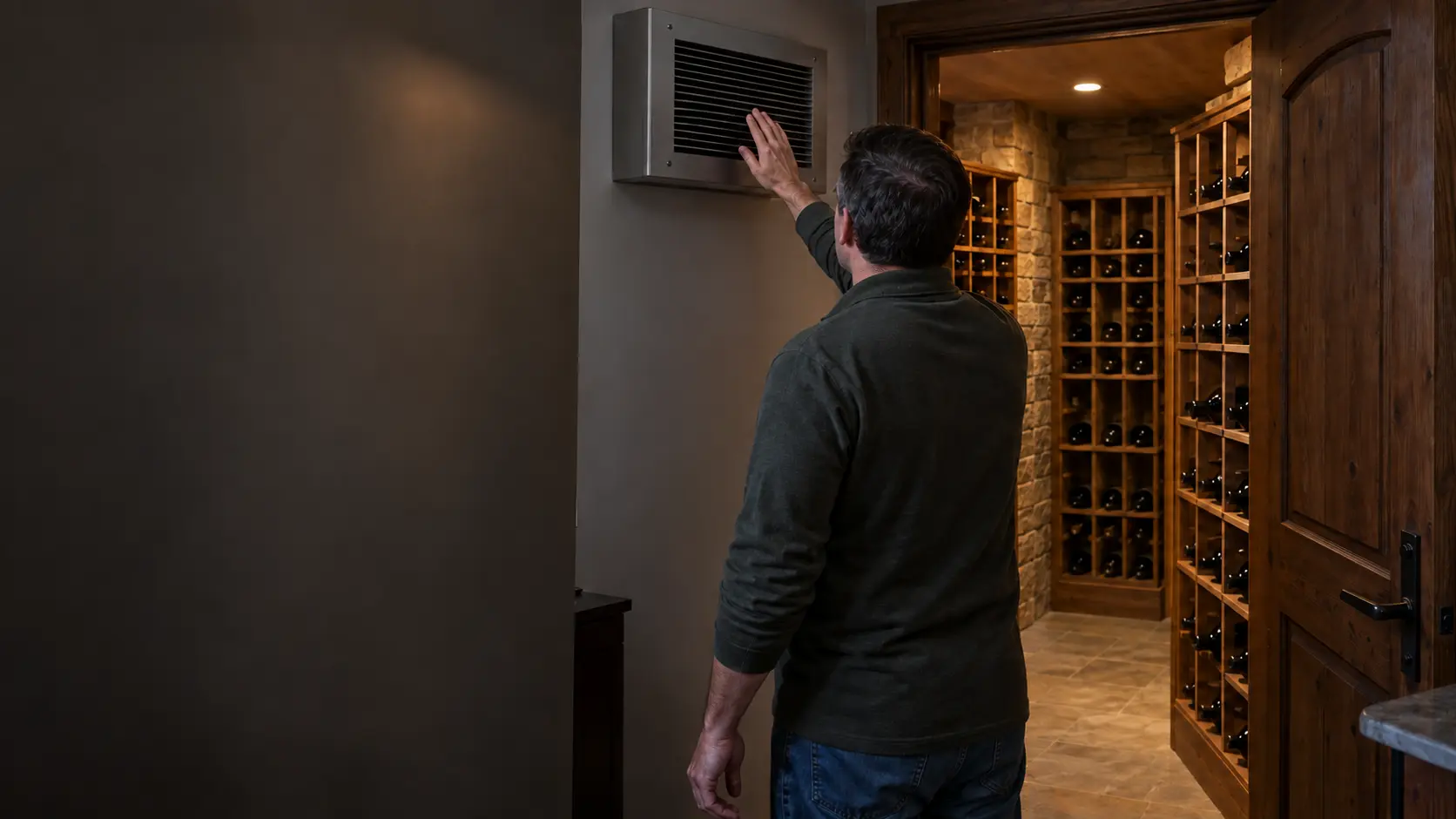
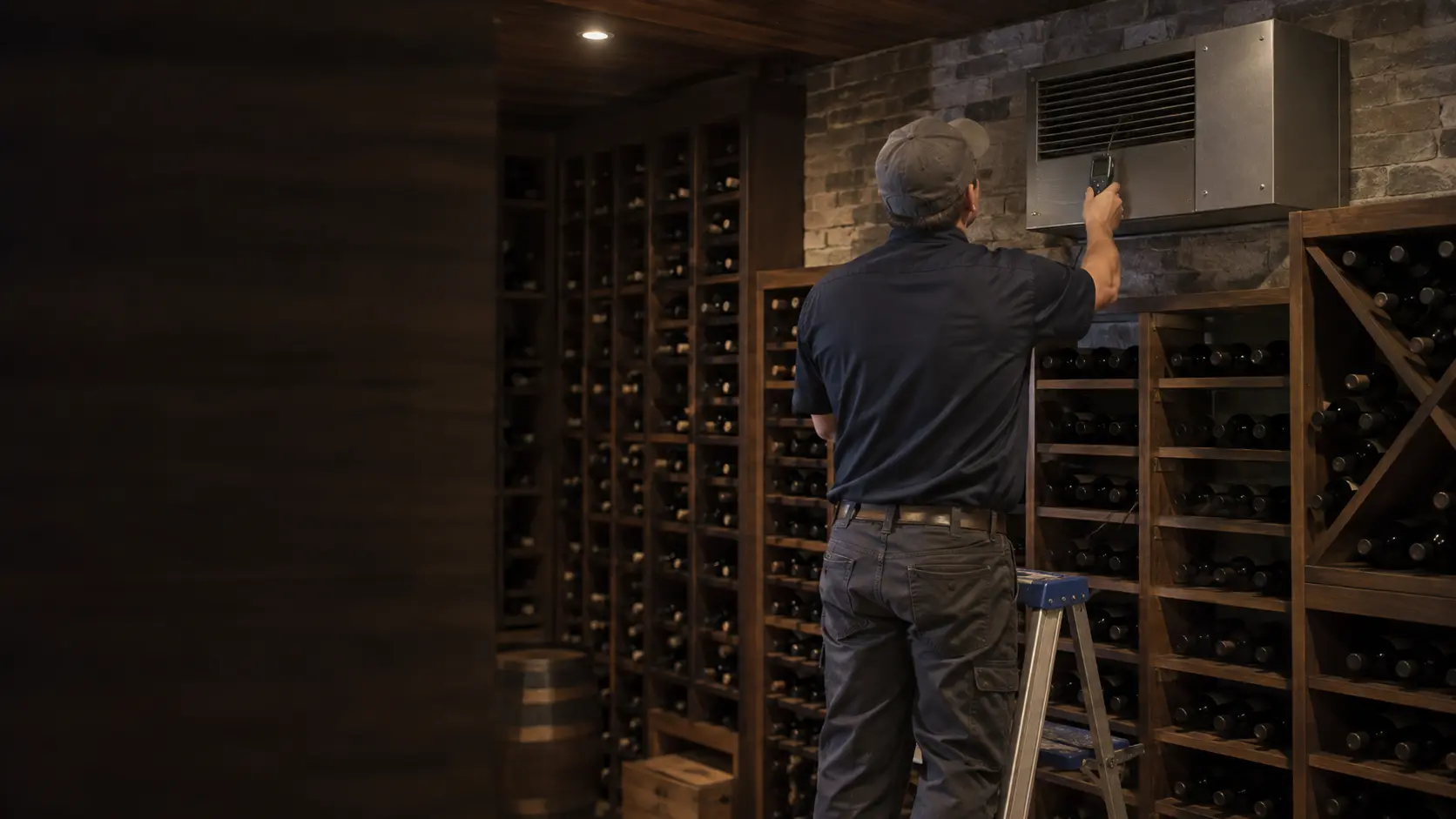
With the unit running, hold a thermometer in the air entering the cellar-side grille and then in the air leaving it. Breezaire treats a drop of 6°F or more as proof that the unit is cooling. Then walk round to the exhaust side and feel for warm air leaving that grille; if the exhaust side is cool and still while the cellar side hums, the condenser fan or the compressor has stopped.
The exhaust room on a hot afternoon
Leave a thermometer in the room the unit exhausts into through a warm afternoon. Self-contained units lose the ability to hold 55°F once that air passes the maker's limit, which is 85°F for WhisperKool's and CellarCool's through-the-wall units and between 78°F and 95°F for the two self-contained models in one Wine-Mate manual. A room that passes its limit only on hot days explains a cellar that warms only on hot days.
A flashlight on both coils
With the power off, shine a light through each grille. Gray felt on the exhaust-side condenser, or white ice on the cellar-side coil, can each explain a warm cellar by itself, and each has its own guide on this site. Do not remove panels for a better view; that is where the wiring and the refrigerant tubing sit.
Source: Breezaire — WKL Series installation instructions — Plug into a GFCI outlet on its own circuit; about a three-minute restart delay after an outage; do not change the setting for 3 days after start-up; air leaving the cold side 6°F or more colder than it enters means the unit works; paper and dark-room tests for leaks
Door, seals and the room
Shut the cellar door on a sheet of paper four times, at the head, the latch edge, the hinge edge and the threshold; in Breezaire's version of the test, paper that pulls out with no drag marks a leak. Then switch the cellar light off, wait for your eyes to adjust, and look for light at the door edges and around the housing of the unit. WhisperKool warns that a door without a good seal keeps the unit running continuously.
- A bottom sweep that is missing or flattened.
- Weather stripping that stops short of a corner.
- A new light fixture, outlet or pipe through a cellar wall with no sealant around it.
- Glass added to a wall or the door since the unit was chosen.
Source: WhisperKool — SC Pro series owner's manual — Bottle probe in an empty bottle filled 75% with water; air in a cooling cellar reads colder than the liquid; do not use a GFI; a blinking snowflake marks the five-minute anti-short-cycle wait; a selector switch picks the front or rear power inlet; 55°F only with intake air at or below 85°F; a poorly sealed door makes the unit run continuously; Breezaire — WKL Series installation instructions — Plug into a GFCI outlet on its own circuit; about a three-minute restart delay after an outage; do not change the setting for 3 days after start-up; air leaving the cold side 6°F or more colder than it enters means the unit works; paper and dark-room tests for leaks
The drain outlet, and what to write down
Find where the drain line ends: a floor drain, a bucket, a pump reservoir or the outside of the house. It should hang above any water, run downhill the whole way and show signs of recent drips. A dry outlet on a unit that runs for hours through a humid season means the water is going somewhere else.
Before calling, collect the readings in one place. The next guide in this section shows where the model plate sits on each kind of unit.
- The bottle reading and the display reading, with the time of each.
- The exhaust room temperature on a warm afternoon.
- Any code, letter or blinking symbol on the controller, copied exactly.
- Whether a breaker tripped, and how many times.
- Photos of the model plate and of both grilles.