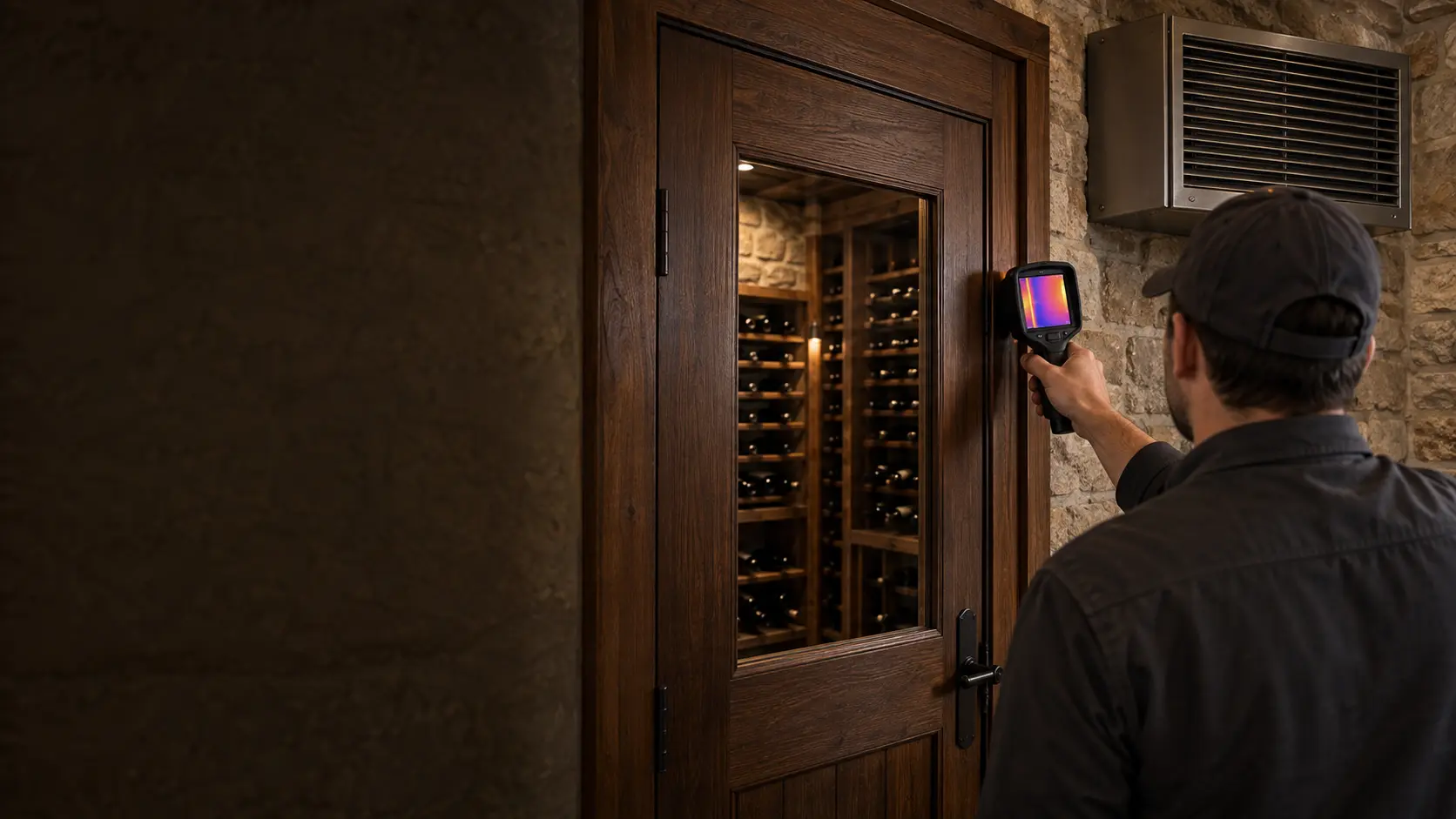
Start with the room
The unit can only hold what the room lets it hold, so the round begins at the cellar door. WhisperKool asks for an exterior-grade door, weather stripping on all four sides of the jamb and a sweep or threshold at the bottom. Close the door on a strip of paper at several points; where the paper slides out without drag, the seal has gone flat. A strip of light under the door is a gap you can see.
Walk the walls and ceiling next. Look at switch plates, outlets, pipe penetrations and light fixtures, which CellarPro says must all be sealed; recessed light cans are a familiar leak. On the warm side of the walls, dampness, peeling paint or a musty smell point to a vapor barrier that has been breached.
- Door: gasket on four sides, sweep at the bottom, latch that pulls it tight.
- Openings: outlets, switches, lights, pipes and the unit's own frame sealed.
- Surfaces: no sweating on glass, walls or racks.
- Exhaust side: nothing stored against the unit, no new heat source nearby.
Source: WhisperKool — Ceiling Mount H.E. owner's manual — Exterior-grade door with weather stripping on four sides and a sweep; yearly corrosion check and monthly debris clearing at the outdoor condenser; technician service of the condensing unit; CellarPro — 1800 Series owner's manual — Seal outlets, switches, pipes and light fixtures; probe behind the front grille; 58°F setting with 4°F differential averages 60°F; 50–70 percent humidity; 30–50 minutes of runtime an hour
Read the true temperature and humidity
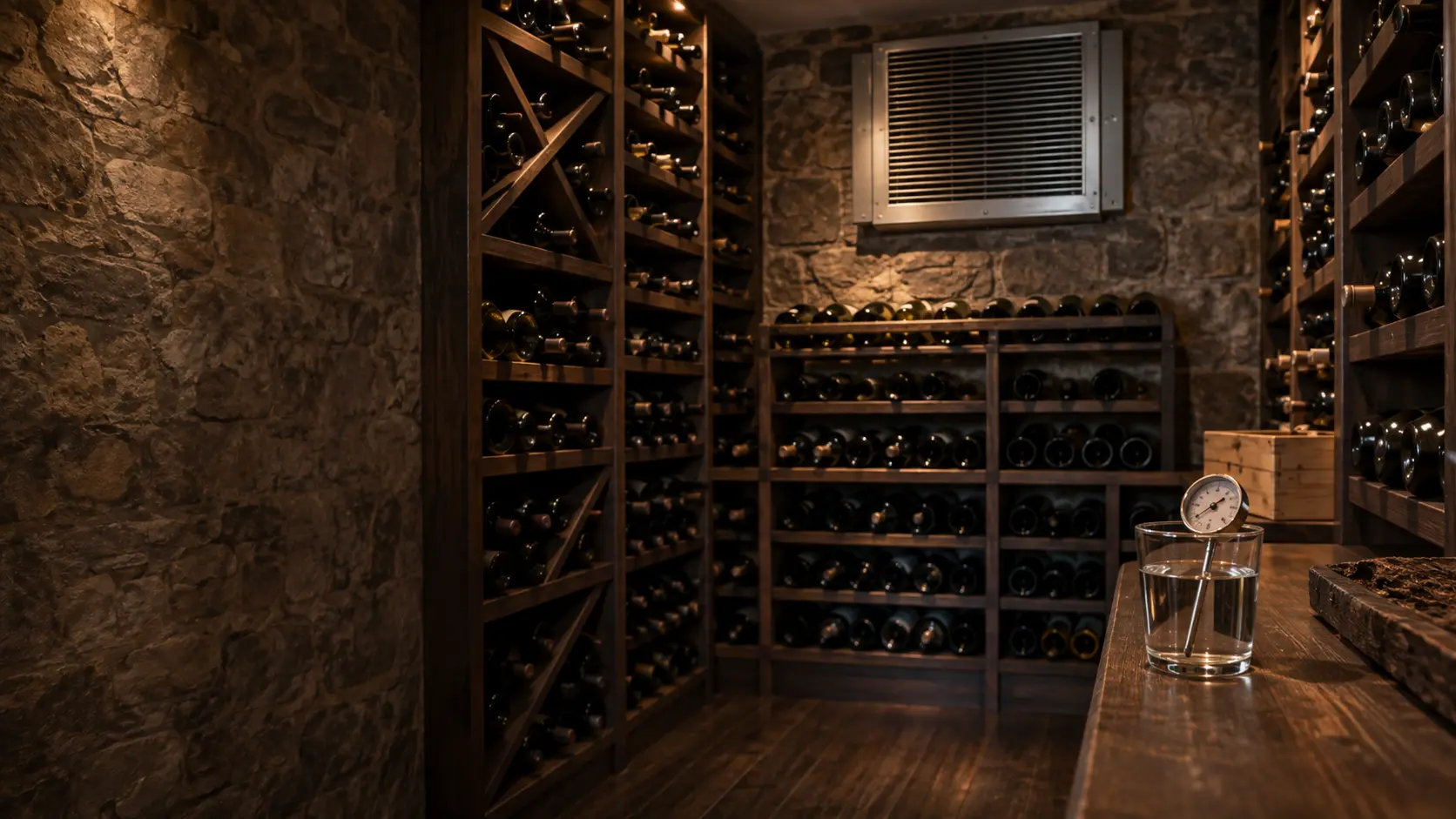
The number on the controller is usually air temperature measured near the unit; on CellarPro's through-the-wall units it comes from a probe behind the front grille unless a bottle probe is plugged in. The bottles in the middle of the room may be a degree or two away from that. Put a separate thermometer in a closed bottle of water on a middle rack, leave it a day, and compare.
Remember how the controller works before calling a difference a problem. CellarPro's example: with the setting at 58°F and a 4°F differential, the unit starts above 62°F and stops below 58°F, so the room averages about 60°F. A hygrometer placed away from the supply air should read roughly 50 to 70 percent; much drier and corks suffer, much wetter and labels and racks begin to mildew.
When the numbers disagree
A steady offset of a degree or two is common and can often be adjusted in the controller's settings. A probe that reads several degrees off, or jumps around, is a part worth replacing before it misleads the unit through a summer.
Source: CellarPro — 1800 Series owner's manual — Seal outlets, switches, pipes and light fixtures; probe behind the front grille; 58°F setting with 4°F differential averages 60°F; 50–70 percent humidity; 30–50 minutes of runtime an hour

Watch the unit run for an afternoon
Sit with a notebook for two or three hours and write down when the compressor starts and stops. CellarPro puts normal runtime at about 30 to 50 minutes in an hour once a cellar is settled. Wine Guardian's schedule asks owners to check for short-cycling, which it defines as more than eight compressor starts an hour, and to listen for new noise or vibration.
Compare this year's notes with last year's. A unit that now runs noticeably longer in the same weather has lost ground somewhere, whether in a dusty coil, a slipping door seal or a fan starting to tire, and the afternoon's other checks usually show which.
Sounds worth noting
Rattles often come from a loose grille or a duct touching a joist. A rising whine or a grinding from a fan motor, or a compressor that clicks repeatedly without starting, deserves a visit before it fails in July.
Source: CellarPro — 1800 Series owner's manual — Seal outlets, switches, pipes and light fixtures; probe behind the front grille; 58°F setting with 4°F differential averages 60°F; 50–70 percent humidity; 30–50 minutes of runtime an hour; Wine Guardian — Ducted split installation, operation and maintenance manual — Monthly checks for noise and short-cycling (more than eight starts an hour); yearly checks of insulation, fasteners, gaskets, ducts, wiring and cords
Service the machine side
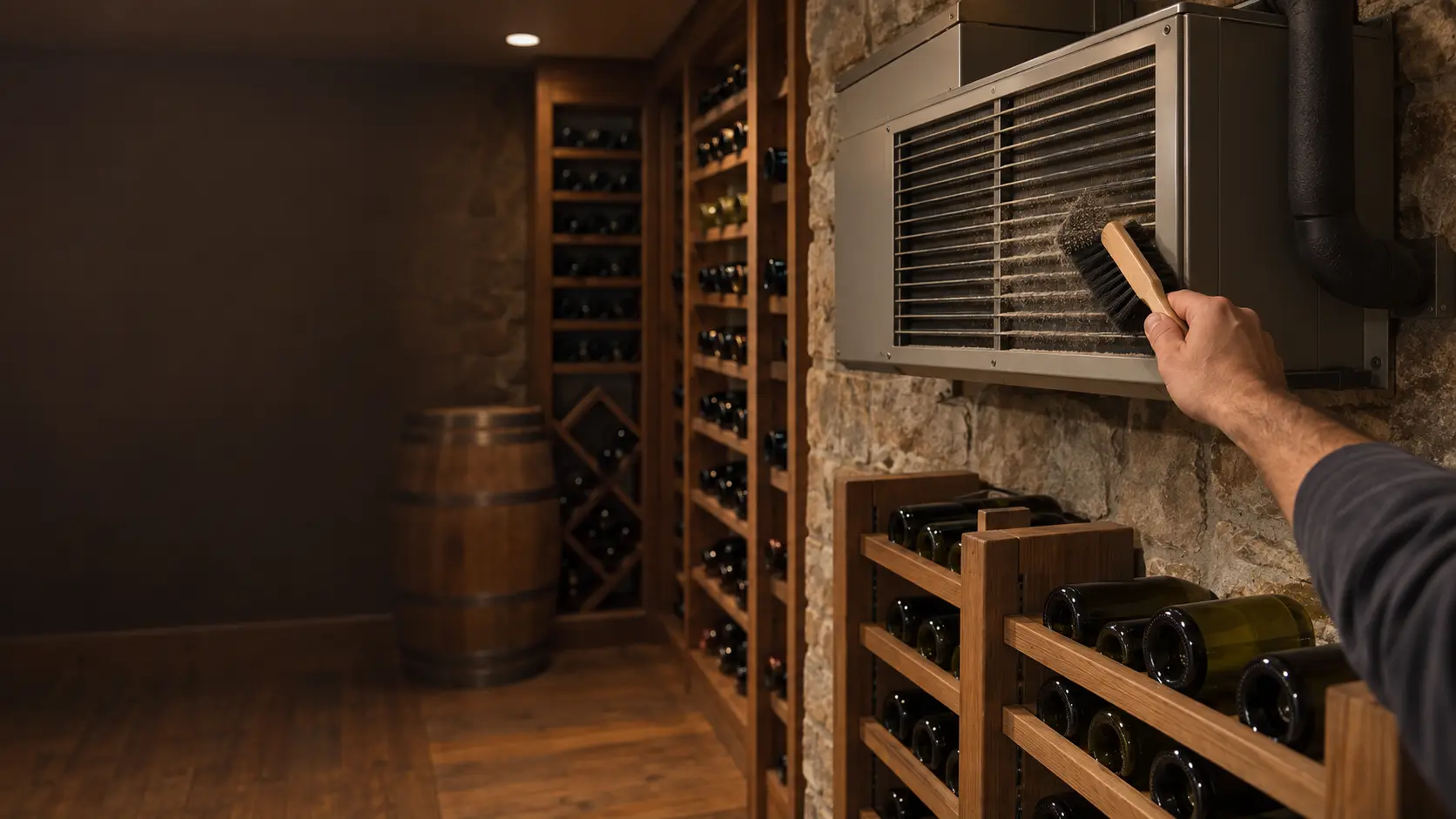
This is where the separate guides on the coil and the drain come in; the yearly check is a good day to do both. Wine Guardian's yearly list adds items that are easy to forget: loose insulation, gaskets and fasteners on the unit, cracks in ducts, and the condition of wiring connections and cords.
Split systems have an outdoor half. WhisperKool asks for the outdoor condenser to be inspected for corrosion each year and for debris around it to be cleared every month. Trim plants back from it, clear leaves from the fins and make sure nothing has been stacked against it since last season.
What to look for outdoors
Rust on the cabinet, a pad that has settled and tilted the unit, and chewed or cracked insulation on the refrigerant lines where they enter the house are all worth photographing and mentioning when you book a visit.
Source: WhisperKool — Ceiling Mount H.E. owner's manual — Exterior-grade door with weather stripping on four sides and a sweep; yearly corrosion check and monthly debris clearing at the outdoor condenser; technician service of the condensing unit; Wine Guardian — Ducted split installation, operation and maintenance manual — Monthly checks for noise and short-cycling (more than eight starts an hour); yearly checks of insulation, fasteners, gaskets, ducts, wiring and cords
Keep a one-page record
Note the date, the controller setting, the thermometer and hygrometer readings, the run times, what you cleaned and anything that looked worse than last year. A page like that turns a vague sense that the cellar feels warmer into evidence, and a technician who sees it can skip half the questions on arrival.
Over a few years the record becomes the best guide to wine cellar cooling maintenance for your own room, because it shows which jobs actually changed something and which season tends to bring trouble.
- Date and outside weather.
- Controller setting, thermometer and hygrometer readings.
- Compressor starts and run lengths over the timed hours.
- What was cleaned, replaced or found worn.