
Load against output, not volume against a label
A cooling unit is rated for how much heat it can remove each hour at a stated cellar temperature. The room, meanwhile, leaks heat in through its walls, ceiling, floor, door and any glass, and adds its own from lights and people. The unit is the right size when its output at your chosen setting is at least equal to that load on the hottest days the surrounding space will see.
Makers publish charts that do this arithmetic for common cases. CellarPro's owner's manual for its 1800 series is a clear example: it lists the load for cellars of 100 to 400 cubic feet at two insulation levels and three surrounding temperatures, next to the output of each model at 55°F and 60°F.
| Surrounding air | Load with R-12 walls | Load with R-19 walls |
|---|---|---|
| 75°F | 1,380 | 1,253 |
| 85°F | 1,538 | 1,349 |
| 95°F | 1,699 | 1,446 |
Reading that chart as an example
The smallest model in that family delivers 1,065 BTU per hour at 55°F, which covers none of the rows above. The next one up delivers 1,380, enough for the well-insulated room at 85°F but not for the thinly insulated one. The same cellar, the same bottles, and the answer changes with seven points of wall insulation and ten degrees of summer heat outside the door.
Source: CellarPro — 1800 Series owner's manual — Thermal load chart by volume, insulation and ambient; model outputs at 55°F and 60°F; glass at most R-3; R-11 walls minimum; recessed lights leak air; 30–50 minutes of runtime an hour; up to a week of initial running
What adds heat that volume does not show
Most mistakes in sizing a wine cellar cooling unit come from features the floor plan hides. A wall shared with a garage or an attic, a ceiling under a sunny roof, or an exterior wall facing west all raise the load. So does air leaking in around a door without weather stripping, or through recessed light cans, which CellarPro specifically warns can let air into the cellar.
- Glass walls, doors and windows, which insulate far less than a framed wall.
- A surrounding space that climbs above 85°F in summer.
- Exterior walls and a ceiling with attic or roof above.
- Lighting left on for display, and frequent door openings in a tasting room.
- Humid air slipping in through gaps, which adds moisture the coil must condense.
Glass-fronted cellars
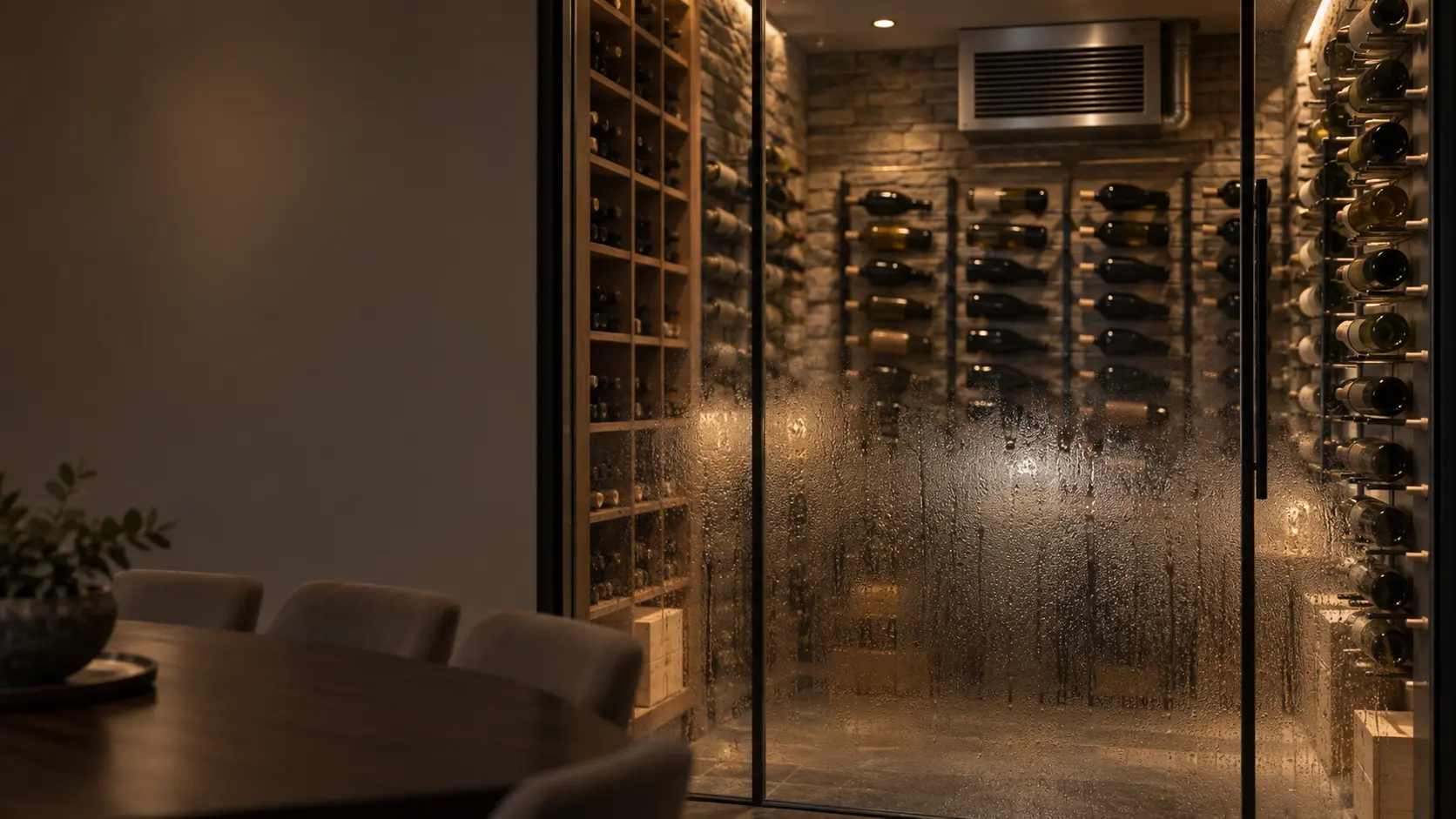
CellarPro puts glass at no better than R-3, against R-11 or more for a properly built cellar wall. WhisperKool's rule of thumb is simple: if glass is used and the room is close to a model's rated size, step up to the next larger system.
Humid regions
WhisperKool notes that high humidity significantly increases the load on the system. In Gulf Coast and Southern homes a complete vapor barrier matters twice: once for the wood and drywall, and once for the capacity it saves.
Source: CellarPro — 1800 Series owner's manual — Thermal load chart by volume, insulation and ambient; model outputs at 55°F and 60°F; glass at most R-3; R-11 walls minimum; recessed lights leak air; 30–50 minutes of runtime an hour; up to a week of initial running

Signs a unit is too small, or too big
An undersized unit runs and runs. CellarPro describes a settled cellar as one where the unit runs about 30 to 50 minutes in any given hour, and it notes that a new cellar being pulled down with fresh bottles can run nonstop for up to a week. Past that first week, a unit that never rests on a mild day, or a cellar that drifts above its setting every summer afternoon, is telling you the load is larger than the output.
An oversized unit has the opposite habit. It reaches the setting quickly, stops, and starts again soon after, and each short run removes little moisture from the air. Wine Guardian's maintenance list treats more than eight compressor starts an hour as short-cycling worth investigating. Oversizing is less common than undersizing, but it happens when a large unit is bought for a small room to be on the safe side.
- Too small: long or continuous runs after the first week, a cellar that creeps up on hot afternoons, a condenser alarm in summer.
- Too big: frequent short runs, a room that feels clammy, humidity that swings more than the temperature does.
- Neither: a clean coil, a sealed door and runs that stay near the maker's normal share of each hour.
Source: CellarPro — 1800 Series owner's manual — Thermal load chart by volume, insulation and ambient; model outputs at 55°F and 60°F; glass at most R-3; R-11 walls minimum; recessed lights leak air; 30–50 minutes of runtime an hour; up to a week of initial running; Wine Guardian — Ducted split installation, operation and maintenance manual — Short-cycling defined as the compressor turning on and off more than eight times an hour
When the room changes after the unit was chosen
A unit that was right on day one can become too small without anything failing. The usual causes are a solid door replaced with a glass one, a neighboring storage room finished into a heated office, an exhaust space turned into a closet, or new display lighting. If the cellar started struggling after one of these, the room is the first thing to look at, not the compressor.
Recalculating is the same exercise as the original sizing, done with the room as it now is. Sometimes the answer is a larger unit; often it is cheaper to restore what was lost, by adding insulation, sealing the door or giving the exhaust side more air.