
Four layouts that do one job
Inside every one of these machines is the same loop: an evaporator coil that runs cold and a condenser coil that runs hot, with a compressor pushing refrigerant between them. The layouts differ only in how far apart those two coils sit and what connects them. That distance decides the noise in the cellar, the work needed to put the system in and who can service it later.
Owners often compare the types of wine cellar cooling systems by capacity first. Capacity matters, and a separate guide deals with it, but a unit of the right size in the wrong layout still fails the room: the heat it removes has to land in a space that can absorb it.
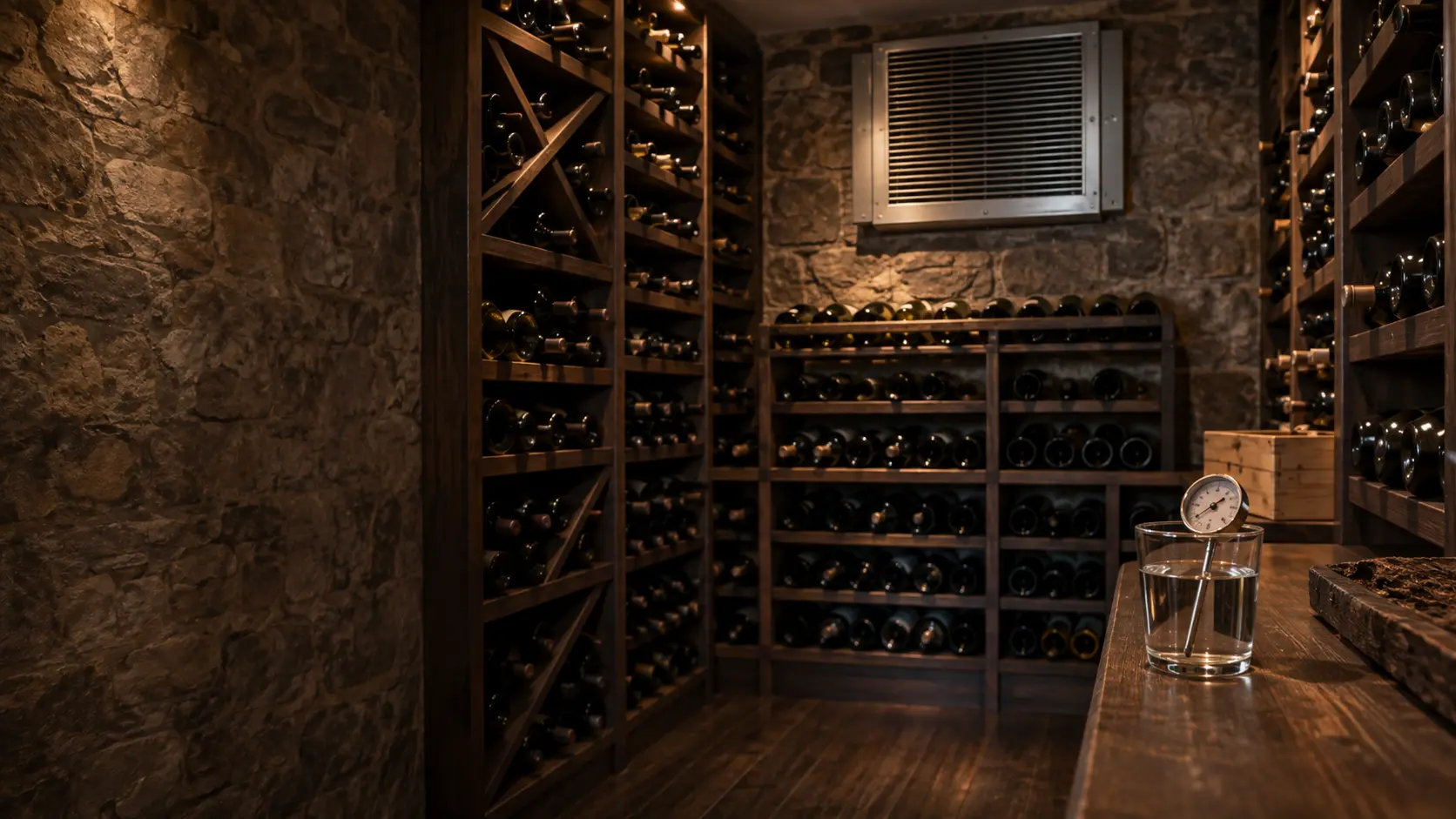
- Through-the-wall: one box set into an opening in a cellar wall, cold face in the cellar, hot face in the adjoining room.
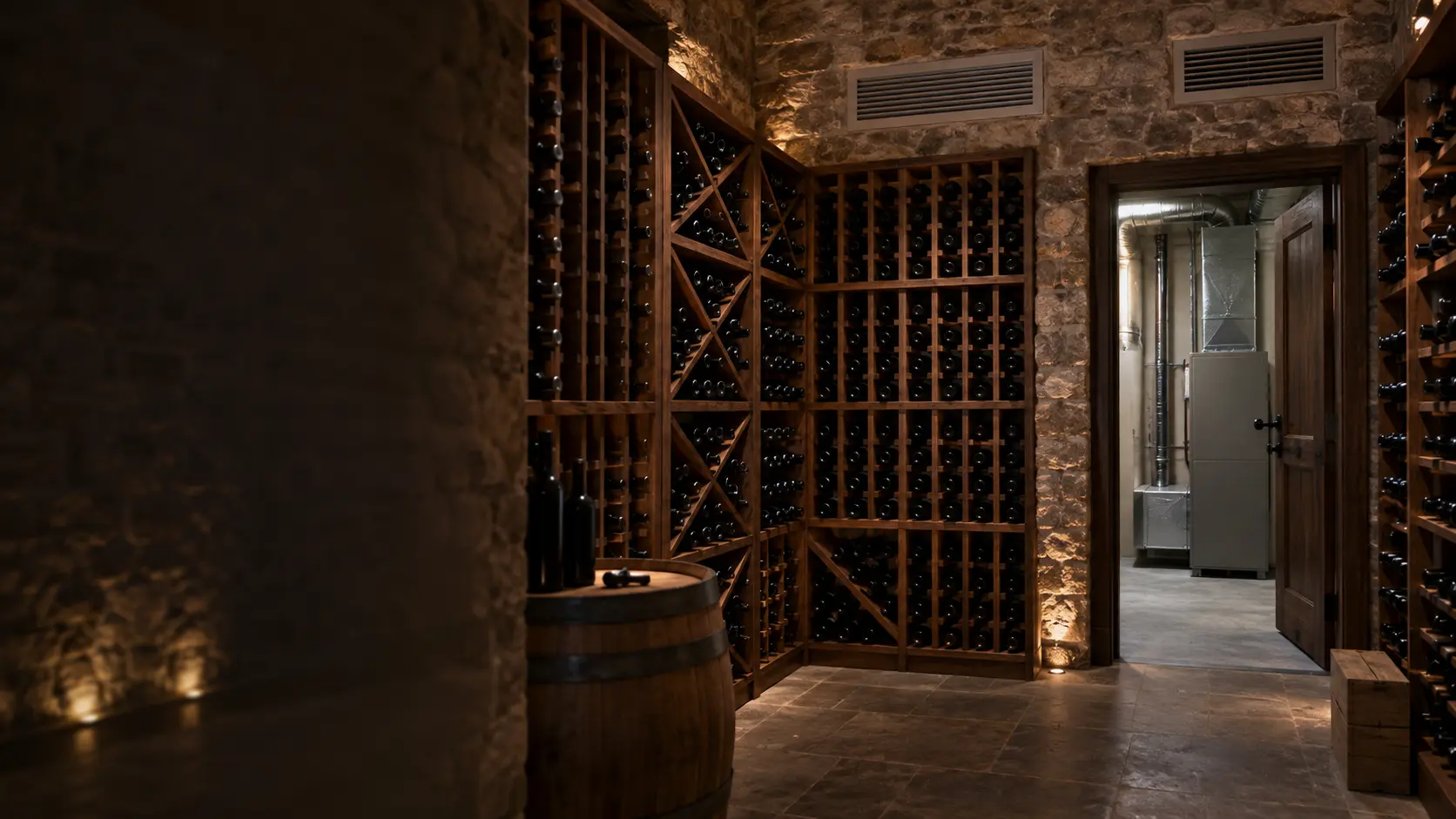
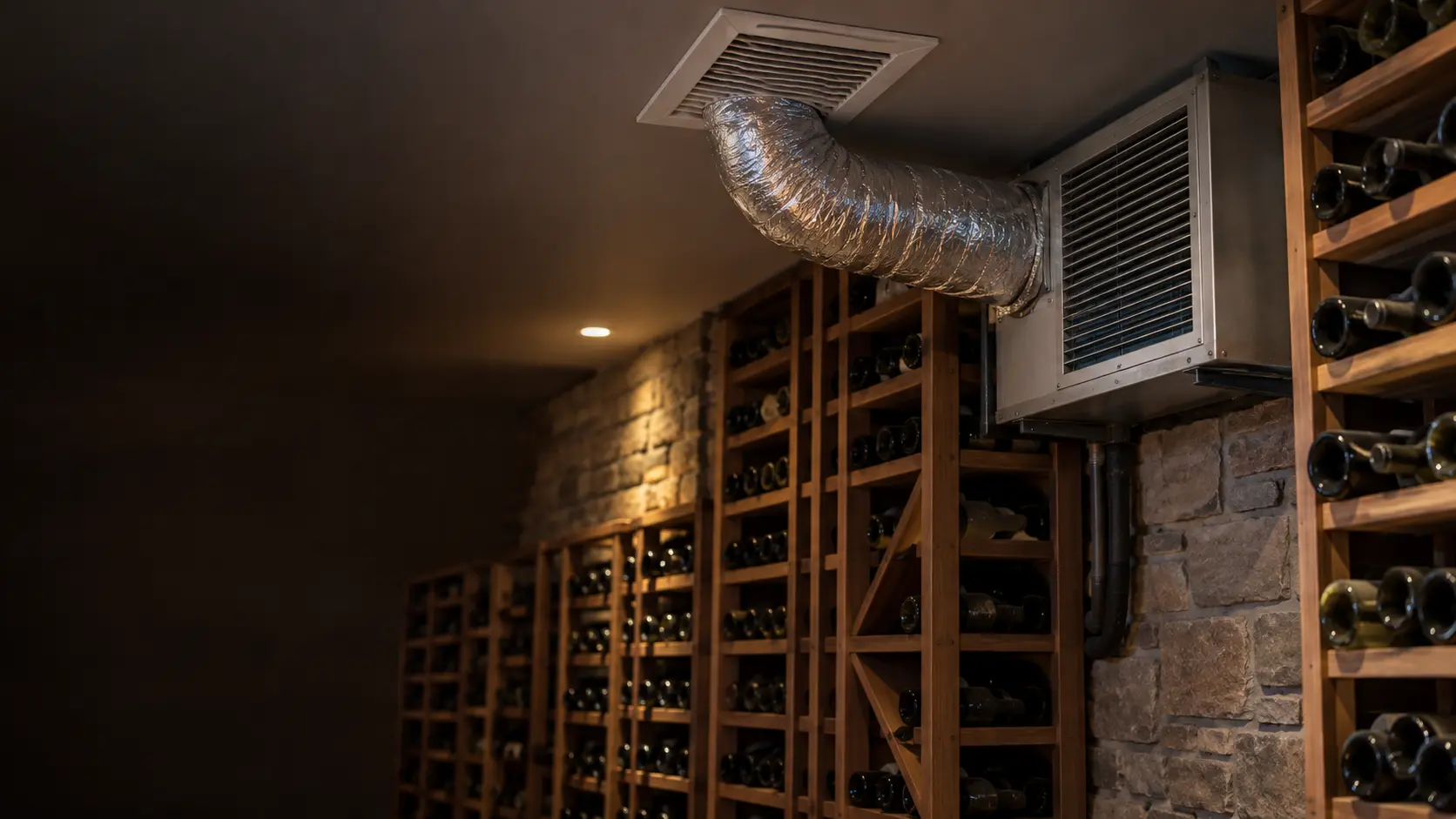
- Ducted self-contained: one box in a mechanical room, attic or next-door space, with insulated ducts carrying cellar air to it and back.
- Split: a fan coil inside or near the cellar and a separate condensing unit outdoors or in a ventilated room, joined by copper refrigerant lines.
- Ceiling-mounted: usually the in-cellar half of a split, a flush evaporator in the ceiling with its own condensate pump.
Through-the-wall in practice
This is the layout most small cellars start with. CellarPro's 1800 series, for example, goes into a hole cut a quarter inch larger than the unit, needs a dedicated 15-amp circuit and at least 8 inches of clear space in front and behind. The trade-off is that the compressor lives in the cellar wall, so its hum and fan noise reach the bottles and whoever is standing among them.
Ducted units in practice
A ducted unit moves the whole machine out of sight and leaves a supply and a return grille in the cellar. Wine Guardian recommends keeping the combined supply and return duct length, bends included, to about 25 feet, and asks for insulated ductwork so the cold air does not sweat or pick up heat on the way.
Split systems in practice
A split system is the only layout that can send the heat outdoors without a long duct. WhisperKool's ceiling-mount split, for instance, is rated to hold 55°F in the cellar while its condensing unit sits in air up to 120°F, and it asks for separate dedicated circuits for the evaporator and the condensing unit.
The room that receives the heat
A self-contained through-the-wall unit is only as good as the room at its back. CellarPro asks that the space behind the unit be at least as large as the cellar itself unless its intake and exhaust are ducted, and it rates the unit to work only while that space stays between 45°F and 95°F. In practical terms the air coming out of the cellar face can be about 30°F cooler than the air the condenser breathes, so a hot utility room directly limits how cold the cellar can get.
Split systems relax that limit because the condensing unit can go outside, on a side yard pad or a roof, where the heat simply leaves. Ducted units sit between the two: the machine itself needs a ventilated space, but a duct can carry its exhaust further, and the cellar sees none of it. WhisperKool warns plainly against putting any condensing side in a closet or a small room, where the exhaust soon heats the very air the unit needs.
Source: CellarPro — 1800 Series owner's manual — Hole 1/4 inch larger than the unit, dedicated 15-amp circuit, 8-inch clearances, rear space at least as large as the cellar, 45–95°F ambient, air about 30°F below intake, 60 lb unit; WhisperKool — Ceiling Mount H.E. owner's manual — Holds 55°F with the condensing unit in air up to 120°F, dedicated circuits, no closet installs, 3 feet of clearance (5 ideal)
Noise, looks and where the water goes
In a tasting room or a glass-fronted cellar off a dining area, sound and sight matter as much as capacity. A through-the-wall unit shows a grille on the cellar side and makes its noise there. A ducted unit shows two grilles and can be dampened with flexible duct and rubber pads under the cabinet, both suggested in Wine Guardian's manual. A split system leaves the quietest cellar, with only the evaporator fan moving air inside.
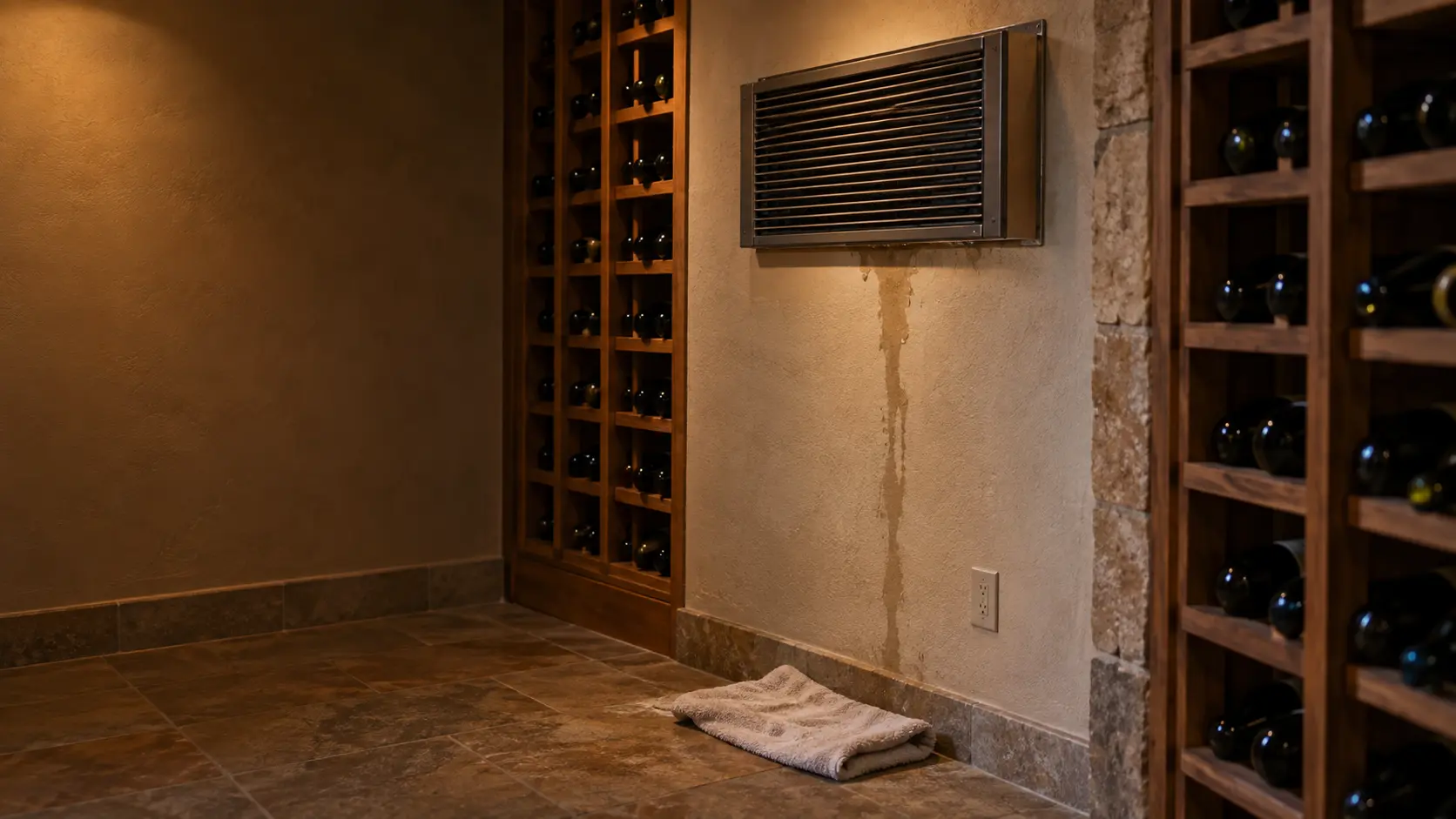
Each layout also produces water from the air it cools, and each handles it differently. Some through-the-wall units let most of it evaporate and offer a condensate fitting as an option; ducted units drain by gravity through a built-in trap to a floor drain or a pump; ceiling evaporators rely on a small pump that lifts the water out.
- Ask where the drain line will run before choosing a layout, especially over finished rooms.
- A condensate pump adds one more part to check each season.
- Ducted and split installs usually need a service opening big enough to reach filters and coils.
Source: Wine Guardian — Ducted split installation, operation and maintenance manual — About 25 feet of combined supply and return duct, insulated ductwork, rubber pads and flexible duct for noise, built-in drain trap
What each layout means for service years later
A through-the-wall unit weighs around 60 pounds in the CellarPro 1800 class and slides out of its opening, so a failed one can be examined on the bench or swapped for a unit with the same footprint. A ducted unit stays in its mechanical space, and the question becomes whether a technician can reach its panels; WhisperKool asks for at least 3 feet of clearance around its equipment, 5 being better.
A split system is closest to central air conditioning. Any work that opens the refrigerant circuit, from a leak repair to replacing the condensing unit, falls under EPA's Section 608 rules, which require the technician doing it to hold that certification. Plan for access to the line set where it passes through walls and ceilings, because that is where a technician will need to look.
Matching a layout to a cellar you already have
A basement cellar with a large unfinished room next door suits a through-the-wall unit. A cellar surrounded by living space, or one with glass on several sides, usually points toward ducted or split equipment so the heat and the noise go elsewhere. A cellar built under a stair or in a closet-sized room often has nowhere for exhaust at all, and only a split system solves that.
Source: CellarPro — 1800 Series owner's manual — Hole 1/4 inch larger than the unit, dedicated 15-amp circuit, 8-inch clearances, rear space at least as large as the cellar, 45–95°F ambient, air about 30°F below intake, 60 lb unit; WhisperKool — Ceiling Mount H.E. owner's manual — Holds 55°F with the condensing unit in air up to 120°F, dedicated circuits, no closet installs, 3 feet of clearance (5 ideal); US EPA — Section 608 technician certification — Technicians who maintain, service, repair or dispose of refrigerant-containing equipment must be certified under Section 608