

What does the sensor actually measure?
The controller's sensor reads the temperature at one point and treats it as the temperature of the whole room. Where that point sits decides how well the room holds its setting.
An air sensor
Most controllers ship with a small probe on a lead that reads the air where it is mounted. Air changes temperature fast, so an air sensor reacts to anything that disturbs it: a door opening, the cold blast from the unit, warm exhaust. It is accurate for the air at its spot and for nowhere else.
A bottle or liquid probe
Some controllers accept a probe that sits in a liquid, usually a bottle of water or a glycol mixture, so the reading follows the temperature of stored wine rather than the air. A liquid reacts slowly, which smooths the cycling and shows what the bottles are feeling. Check the controller's manual to see whether yours supports that kind of probe or only air.
Where in the room does it belong?
Place it at mid-height among the bottles, on a wall away from the door, the supply air and any heat source, where the air is calm and representative of the stored wine.
- Mid-height on the racks, where the wine actually sits.
- At least some distance from the unit's supply and return openings; the manual states the clearance.
- Away from the door, whose edge sees warm air whenever it opens.
- Away from lights, a wall that touches an exterior or a hot pipe, and the sun.
- Not behind a rack panel that blocks air movement.
The supply air trap
A sensor in the cold stream coming from the unit sees a low temperature almost at once and tells the unit it is done. The unit shuts off, the room warms, the sensor warms and the unit restarts. That loop is short cycling, and the cellar unit short cycling page describes how it looks.
The door trap
A sensor near the door reads warm every time someone walks in, so the unit runs hard for a spike that the bottles never feel. It can also read cold in winter if the door leaks, and the room sits warmer than the display says. The cellar door that seals shows why the edge matters.

How do you check that the reading is right?
Compare it with a separate thermometer that has been in the room for a while, and watch both over a day.
An independent check
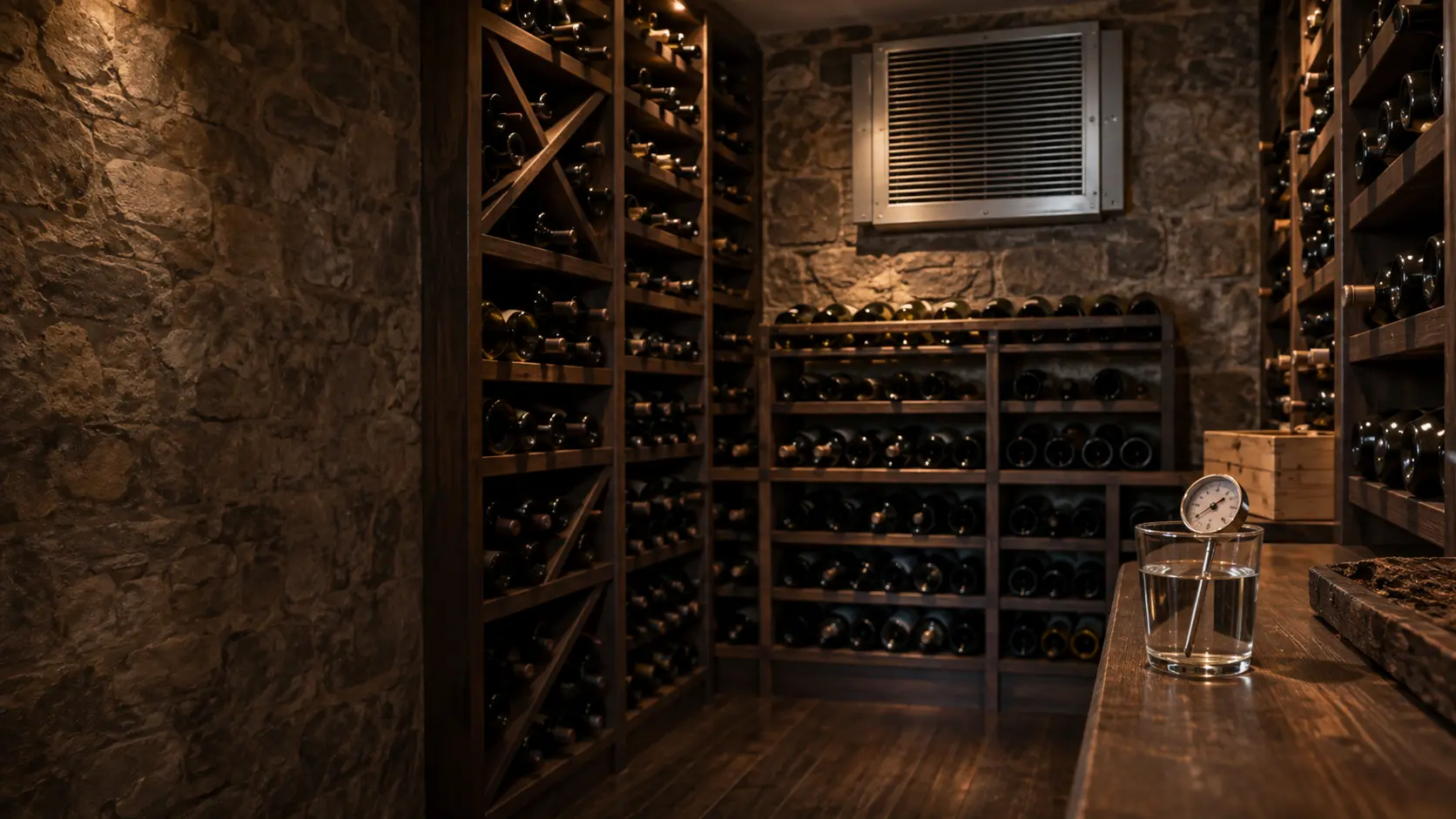
Put a second thermometer or a probe in a glass of water beside the sensor, in the same spot, and leave it for several hours without opening the door. A simple digital thermometer is enough, and one that stores its minimum and maximum readings shows the swings you would otherwise miss. Note both readings and a few at other spots around the racks.
What the gap tells you
- Both agree: the sensor is reading the room correctly.
- The display is a little off but steady: note the difference and, if the controller allows an offset, set it.
- The display swings far more than the thermometer: the sensor is in a draft or in the supply air; move it.
- The display never moves: check the sensor lead and its connection; a failed sensor is a part, not a placement problem.
Our guide to reading the cellar controller helps with the display and its settings, and why the cellar will not hold 55 degrees shows what a real temperature problem looks like once the reading is trusted.
How do you move or fix the sensor?
Move the probe on its lead to a better spot, secure it so it cannot swing or fall, and leave the controller's wiring to a technician.
Fixing the lead
Keep the lead away from the unit's power wiring and its fans, and do not kink it or cut and splice it unless the manual says how. Secure it with soft clips or tape, and leave a small loop so that bumping a rack does not pull it out. A lead run through a wall or the vapor barrier is for whoever sealed the room.
Setting up at installation
When a new unit goes in, place the sensor before the room is stocked, as part of the cellar cooling unit installation checklist. Our note on wine cabinet vs wine cellar explains why the room adds this step.
When the sensor is the problem
If a sensor in a good spot reads far from the thermometer, will not read at all, or jumps around, the sensor may have failed or the controller may be the part that is not working. The controller and sensor repair service covers testing and replacing it, and a diagnostic visit checks the whole control path.