
How long a closed cellar keeps its cool
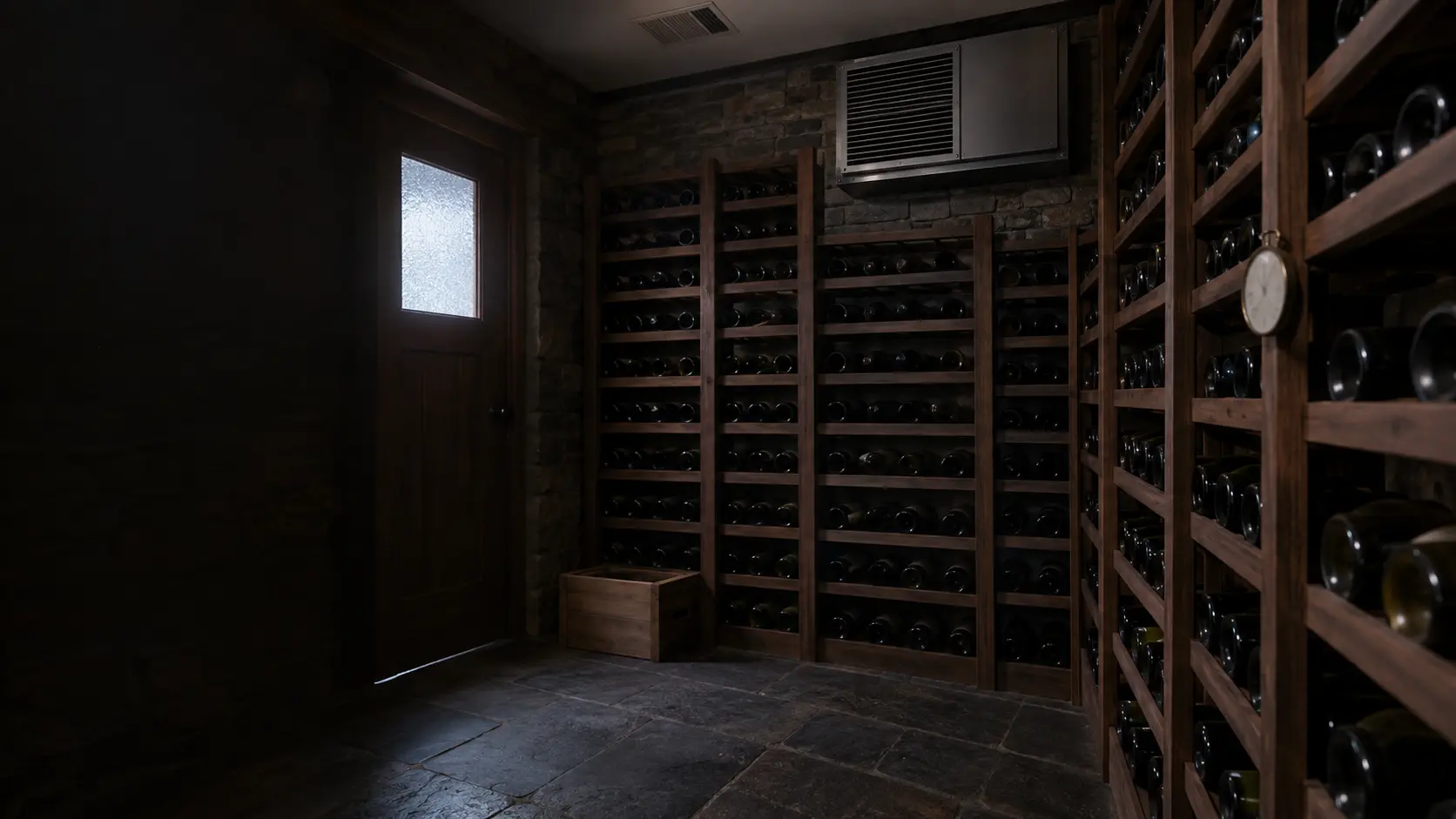
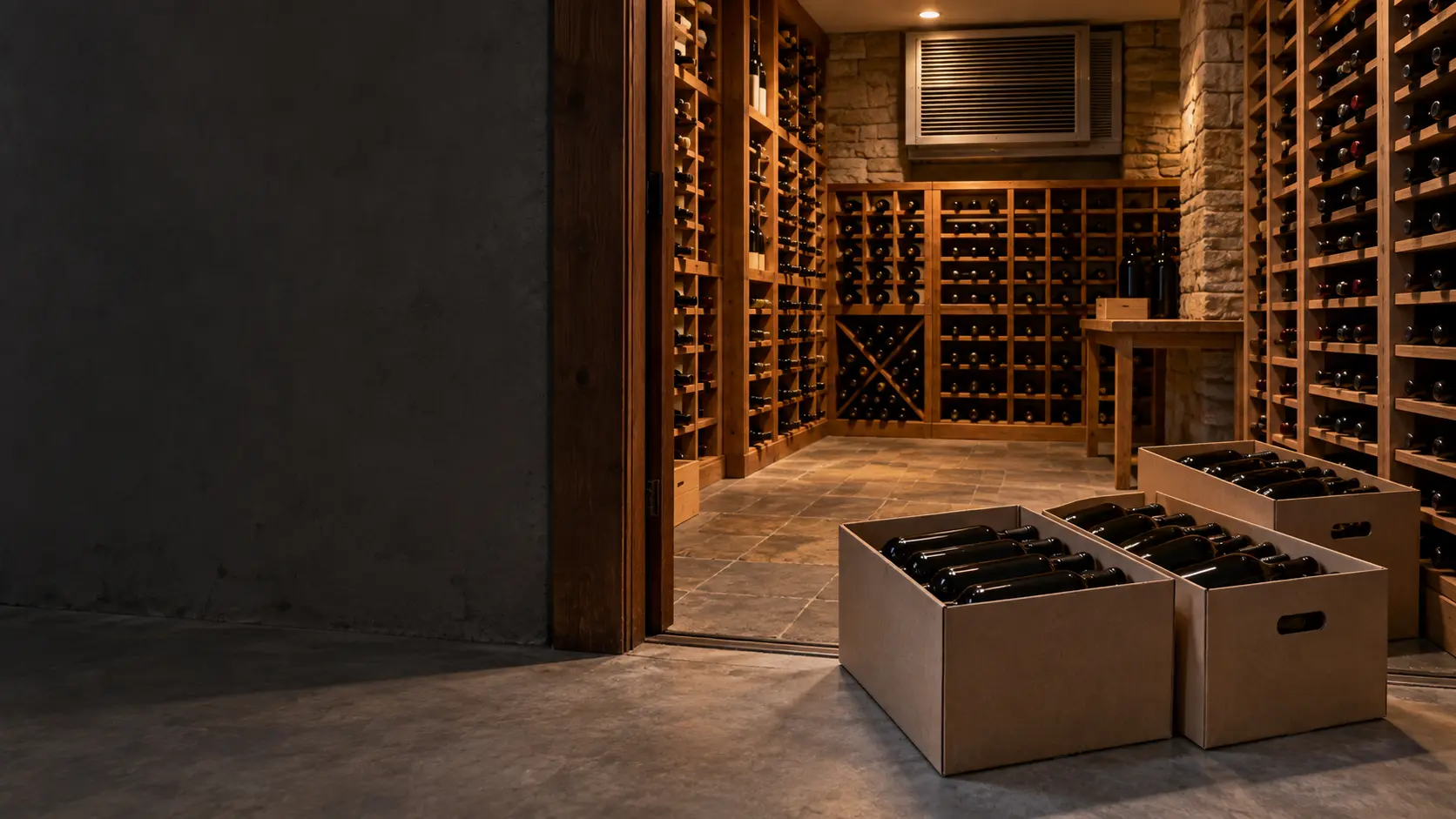
A cellar room built to the makers' specifications is wrapped in insulation and a vapor barrier, and it is full of liquid. Breezaire's service notes point out that liquid mass is what keeps a cellar steady: the more bottles in the room, the less the unit runs and the slower the air drifts when it stops. A packed cellar at 55°F in an air-conditioned house may climb only a few degrees over a full day without power.
The room does not warm evenly. Breezaire's construction guide describes how heat entering through walls and ceiling rises and collects as a warm layer under the ceiling, which thickens downward while the unit is off. The bottles on the floor racks are the last to feel it.
The top racks warm first
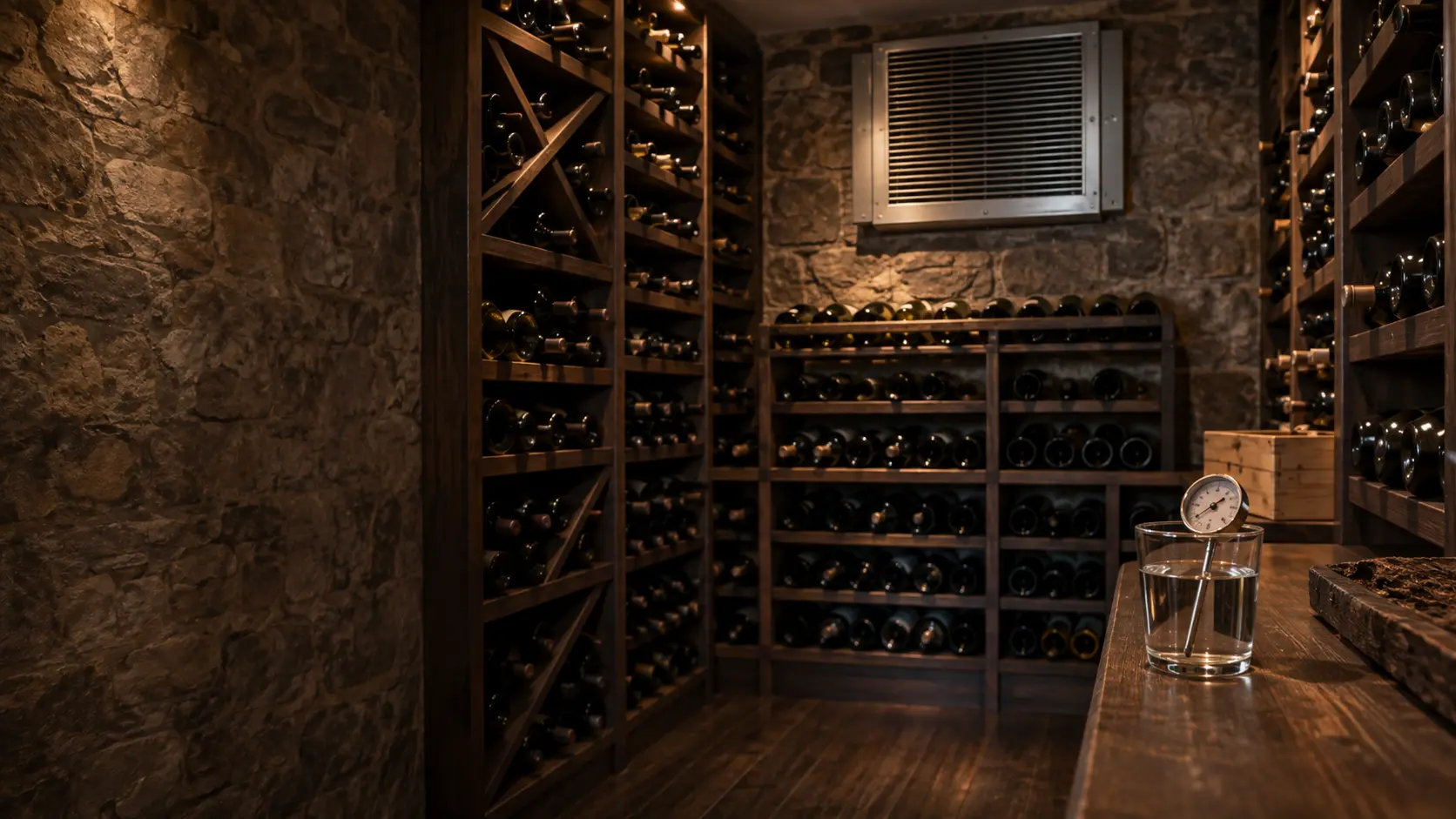
Hang a thermometer at shoulder height and another near the floor before storm season. During an outage, comparing the two readings shows how far the warm layer has crept down, and which rows would need to move first if the day turns into a week.
A half-empty cellar drifts faster
A new cellar with a few cases in it has little liquid to hold the temperature, so it follows the house more closely. Breezaire suggests filling empty space with capped bottles of water for exactly this reason, and it helps during an outage as much as it does in ordinary running.
Source: Breezaire — Wine Cellar Dynamics and Construction Guide — Heat entering a cellar rises and forms a warm layer under the ceiling that grows downward while the unit is off; Breezaire — Service Q and A — Liquid mass keeps a cellar at a steady temperature; fill empty space with capped bottles of water
The temperatures that decide whether to act
Purdue Extension's wine storage guidelines give long-term cellar conditions as 50°F to 60°F and set shorter windows for warmer air. Those windows are generous compared with food: wine is not spoiled by an afternoon at 68°F. What damages it is sustained heat, and the swing of a room that warms and cools repeatedly, which Purdue notes can push air past the cork.
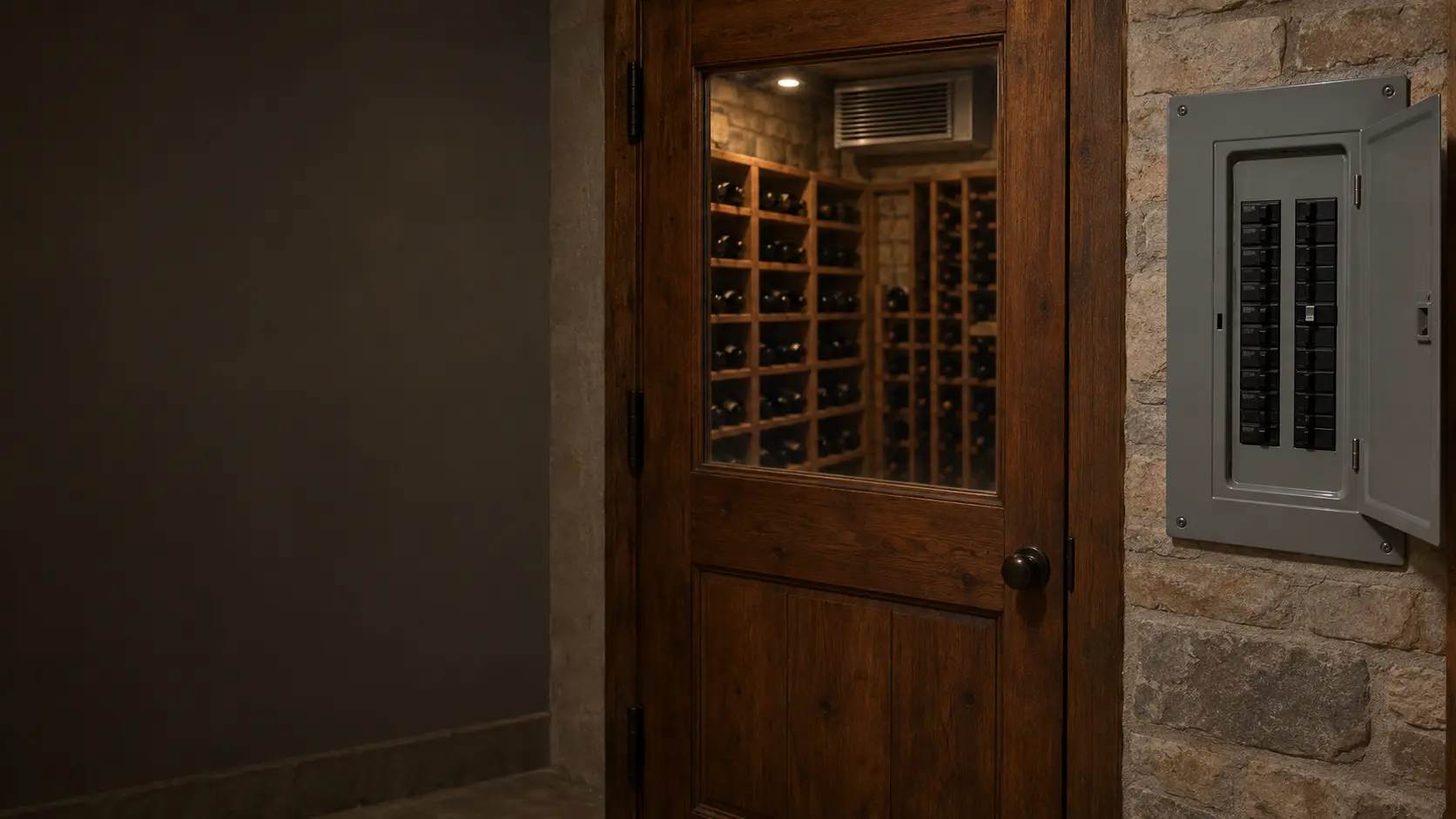
Read the thermometer through a door window or with a remote probe if you have one. Opening the door to check lets in exactly the warm, damp air the room is trying to keep out.
- Up to 60°F: nothing to do but keep the door closed.
- 60°F to 75°F: up to four weeks is acceptable in Purdue's table; plan, do not panic.
- Past 75°F and still climbing: carry your most prized bottles somewhere cooler.
- 86°F: Purdue's line wine should never reach, even briefly.
Source: Purdue Extension — Wine Storage Guidelines (FS-58-W) — Long-term storage at 50°F to 60°F; 75°F or below for one to four weeks; never 86°F or above; temperature swings test the cork

What to do while the lights are off
Ready.gov recommends unplugging or switching off appliances and electronics while the grid is down, since the supply often returns with brief spikes. For a through-the-wall or ducted unit on its own circuit, switching that breaker off is the tidy way to do it; Breezaire already asks for its units to sit on a dedicated GFCI outlet and recommends an appliance-grade surge protector. For a split system, the condensing unit outside has a breaker or disconnect of its own.
Leave the cellar lights off and the door closed. Every entry during an outage costs cold that cannot be replaced until the grid returns.
- Through-the-wall or ducted plug-in unit: its breaker, or its plug if the outlet is dry and easy to reach.
- Split system: the condensing unit's breaker at the panel and the disconnect beside it outdoors.
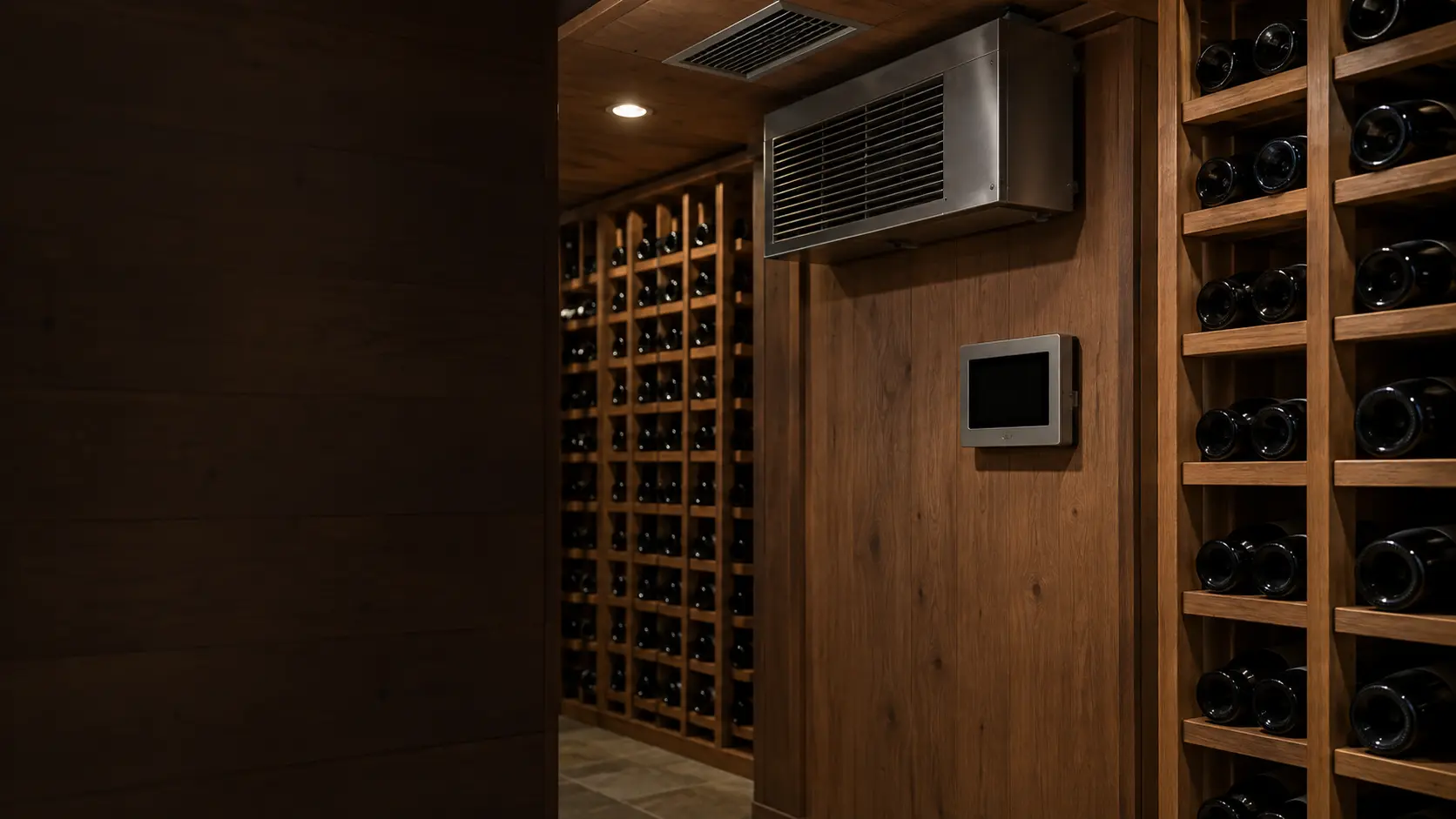
- Controller on a wall outside the cellar: it goes off with its unit and needs nothing of its own.
- Humidifier or pump on a separate outlet: switch it off too, so nothing runs dry or overflows on restart.
Running the unit from a portable generator
Ready.gov keeps generators outside the house entirely, a minimum of 20 feet away from any window, door or attached garage, sheltered from rain, and wired to appliances through heavy-duty cords. A plug-in through-the-wall unit can be fed that way if the generator is large enough for its starting current. Split systems are usually hard-wired, as WhisperKool's electrical notes describe, so they can only be put on a generator through a transfer switch an electrician installs; never feed a house circuit by plugging a generator into an outlet.
Source: Breezaire — WKL Series Installation Instructions — Units on a GFCI outlet on their own circuit with an appliance-grade surge protector; about a 3-minute restart delay after an outage; lowering the set point does not help a room that is not reaching it; Ready.gov — Power Outages — Disconnect appliances to avoid surge damage; generators only outdoors, at least 20 feet from windows, doors and attached garages, kept dry, with heavy-duty cords
When the power comes back
Give the grid a few minutes to settle, since the first minutes after reconnection are when spikes come, and only then restore the cellar circuit. Many cellar controllers deliberately hold the compressor off for a short while: Breezaire's Sentry III waits about three minutes after an interruption, so a quiet unit in the first minutes is doing what it was designed to do.
Resist turning the set point down to catch up. Breezaire's instructions say a lower setting does not help a room that is not reaching the current one, and WhisperKool notes that temperature recovers first and humidity follows gradually. A cellar that climbed ten degrees can take a day or more to settle.
No display and no airflow once the house is lit
Look at the cellar circuit's breaker and at the GFCI receptacle feeding the unit, because a spike on reconnection may have tripped one of them. Give each a single reset. A second trip, or a lit display with no cool air from the upper grille a quarter of an hour later, means the unit stays off until someone has looked at it.
Source: Breezaire — WKL Series Installation Instructions — Units on a GFCI outlet on their own circuit with an appliance-grade surge protector; about a 3-minute restart delay after an outage; lowering the set point does not help a room that is not reaching it; WhisperKool — Frequently Asked Questions — Split-system evaporators and condensing units are hard-wired; after a disturbance temperature stabilizes first and humidity follows
Cheese, platters and other food in the cellar
Cellars end up holding a wheel of cheese or a party platter the night before guests arrive. FDA draws its line for perishable food at 40°F, and a cellar held at 55°F sits well on the warm side of it, so it never was safe storage for them, outage or not. FDA's two pages give different windows, 2 hours on one and 4 on the other; this site uses the stricter: once perishables have sat warmer than 40°F for 2 hours or longer, they go in the trash.
Carry such food up to the kitchen as soon as the power drops; FDA says a refrigerator kept shut stays cold for roughly 4 hours.
Source: FDA — Power Outages: Key Tips for Consumers About Food Safety — Discard perishables held above 40°F for 2 hours or more; a closed refrigerator keeps food cold for about 4 hours; FDA — Food and Water Safety During Power Outages and Floods — Perishables above 40°F for 4 hours or more should be discarded (the site applies the stricter 2-hour figure)